Step-by-Step Guide to the Regulatory Compliance Case Process
Published: 06/18/2026 9:00 PM Updated: 06/19/2026 11:50 AM
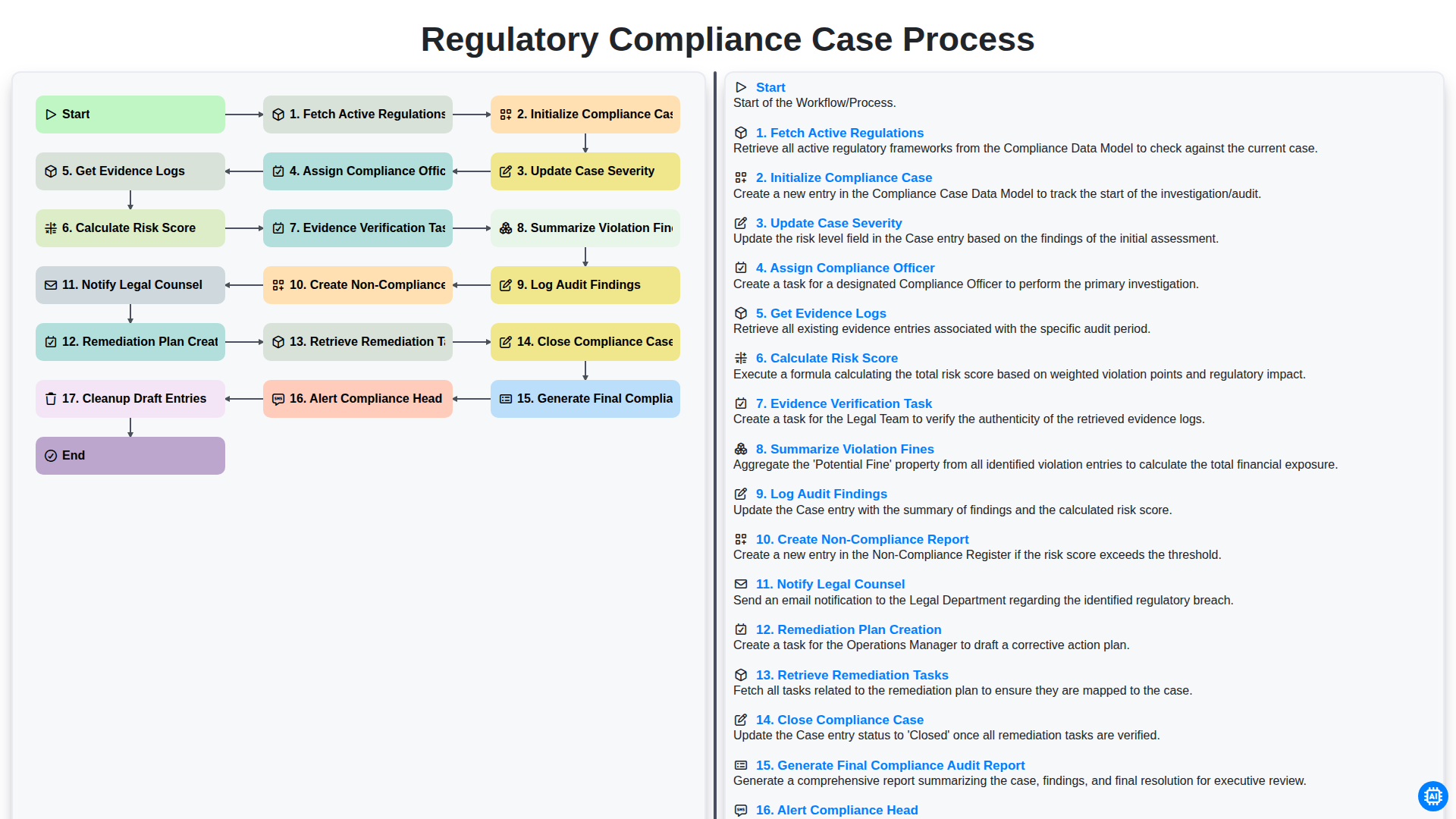
Table of Contents
- Introduction to Regulatory Compliance Management
- Phase 1: Case Initiation and Regulatory Assessment
- Fetching Active Regulations and Initializing the Case
- Determining Impact: Case Severity and Officer Assignment
- Phase 2: Evidence Collection and Risk Evaluation
- Gathering Evidence Logs and Calculating Risk Scores
- Phase 3: Investigation and Violation Analysis
- Evidence Verification and Assessing Financial Implications
- Phase 4: Reporting and Legal Escalation
- Documenting Audit Findings and Creating Non-Compliance Reports
- Notifying Legal Counsel and Initiating Remediation
- Phase 5: Remediation and Case Resolution
- Executing Remediation Tasks and Closing the Case
- Phase 6: Final Auditing and Post-Process Cleanup
- Resources & Links
TLDR: Learn how to streamline your regulatory oversight with our comprehensive guide to the Regulatory Compliance Case Process workflow. This post breaks down the end-to-end automation-from fetching active regulations and assessing risk scores to managing evidence verification and generating final audit reports-ensuring your organization maintains continuous compliance and efficient incident remediation.
Introduction to Regulatory Compliance Management
In today's rapidly evolving legal landscape, regulatory compliance has transitioned from a back-office administrative task to a critical pillar of strategic risk management. For organizations operating in highly regulated sectors-such as finance, healthcare, or manufacturing-the ability to navigate complex legal frameworks is no longer just about following rules; it is about maintaining operational integrity and stakeholder trust.
Managing compliance is a monumental challenge characterized by a constant influx of new mandates, shifting jurisdictional requirements, and the need for absolute precision. A single oversight can lead to devastating consequences, ranging from exorbitant legal fines and litigation to irreversible reputational damage. To mitigate these risks, organizations must move away from reactive, manual processes and toward a structured, automated workflow. Effective compliance management requires a systematic approach to identifying regulations, evaluating risks, gathering evidence, and executing remediation strategies in a seamless, repeatable loop.
Phase 1: Case Initiation and Regulatory Assessment
The lifecycle of a regulatory compliance case begins with a proactive approach to monitoring the ever-changing legal landscape. The process is triggered by the first critical step: Fetching Active Regulations. By continuously scanning for updates in local and international mandates, the system ensures that the organization remains aligned with current legal requirements.
Once a potential discrepancy or new regulatory requirement is identified, the workflow moves into the Initialization of the Compliance Case. This stage transforms a regulatory update into a structured, trackable entity within the compliance ecosystem. To ensure the appropriate level of resources is allocated, the system immediately performs an Update of Case Severity, assessing the potential impact on the organization. Following this, the Assignment of a Compliance Officer occurs, ensuring that a dedicated subject matter expert is accountable for the investigation from the outset. This phase sets the foundation for a structured investigation, ensuring that every case is documented, prioritized, and assigned with precision.
Fetching Active Regulations and Initializing the Case
The lifecycle of a regulatory compliance audit begins with a proactive scan of the current legal landscape. The process starts by fetching active regulations, an automated step designed to ensure that the compliance engine is always aligned with the most recent legislative updates, industry standards, and jurisdictional mandates. By pulling real-time regulatory data, the system eliminates the risk of operating under outdated frameworks.
Once the relevant regulatory parameters are identified, the workflow moves into the initialization of the compliance case. During this phase, a dedicated case file is generated within the system, establishing the foundational scope for the audit. This step creates a centralized source of truth, linking specific regulatory requirements to a unique case ID, which ensures that every subsequent action-from evidence collection to final reporting-is anchored to a specific, traceable legal obligation.
Determining Impact: Case Severity and Officer Assignment
Once a compliance case is initialized, the next critical phase involves assessing the magnitude of the potential breach. The workflow immediately moves into Updating Case Severity, a step where the system analyzes the nature of the identified discrepancy against established regulatory benchmarks. By evaluating the scale of the potential violation, the system can automatically categorize the case-ranging from a minor administrative oversight to a high-priority critical breach.
This severity level serves as the primary driver for the Assign Compliance Officer step. To ensure high-stakes issues receive the necessary scrutiny, the workflow dynamically routes the case to the most appropriate specialist. High-severity cases are instantly escalated to senior investigators with deep domain expertise, while lower-risk items are assigned to general compliance officers. This intelligent assignment ensures that organizational resources are focused where they are needed most, maintaining a streamlined and highly responsive regulatory response.
Phase 2: Evidence Collection and Risk Evaluation
Once the compliance case is initialized and severity levels are determined, the focus shifts from administrative setup to the critical investigative stage. This phase, known as Evidence Collection and Risk Evaluation, serves as the core of the audit process, where the detective work begins.
The workflow moves into high gear as the system automatically triggers the Get Evidence Logs step, pulling all relevant telemetry, transaction records, and system logs required for scrutiny. Simultaneously, the Evidence Verification Task is initiated to ensure that the gathered data is authentic, complete, and untampered.
As the evidence accumulates, the system performs a quantitative analysis through the Calculate Risk Score step. By weighing the gathered data against predefined regulatory thresholds, the workflow assigns a numerical value to the potential breach. This score is crucial, as it determines the intensity of the subsequent investigation. To ensure total transparency, the process then moves to Summarize Violation Fines, providing an immediate financial impact assessment of the identified non-compliance. This data-driven approach ensures that the transition from raw data to actionable intelligence is seamless and objective.
Gathering Evidence Logs and Calculating Risk Scores
Once the compliance case has been initialized and the severity level is determined, the workflow moves into a critical phase of data aggregation: Getting Evidence Logs. At this stage, the system automatically pulls all relevant historical data, system logs, and transaction records associated with the suspected non-compliance period. This automated retrieval ensures that no manual oversight occurs during the data-gathering phase, creating a transparent and unalterable trail of information.
With the raw evidence in hand, the next vital step is to Calculate the Risk Score. This is not merely a summary of the logs, but a sophisticated analytical process where the system evaluates the magnitude of the findings against current regulatory frameworks. By weighing the frequency of anomalies and the sensitivity of the compromised data, the system assigns a quantitative risk value. This score serves as the primary driver for the subsequent Evidence Verification Task, determining how much scrutiny the findings require and whether the breach necessitates immediate escalation to high-level stakeholders.
Phase 3: Investigation and Violation Analysis
Once the compliance case is initialized and the assigned officer begins their investigation, the workflow shifts from administrative setup to deep-dive analysis. This phase is the engine of the regulatory process, where raw data is transformed into actionable intelligence.
The process begins by systematically getting evidence logs to reconstruct the events in question. To determine the gravity of the situation, the system must calculate a risk score based on the nature of the discrepancies found. This is followed by a rigorous evidence verification task, ensuring that every piece of data used to substantiate a claim is authentic and untampered.
As the investigation concludes, the focus turns to the consequences of any identified breaches. The workflow automatically summarizes violation fines to provide an immediate financial impact assessment and logs audit findings into the permanent record to ensure transparency. This stage culminates in the creation of a non-compliance report, which serves as the formal documentation of the breach, ensuring that all stakeholders are presented with a clear, data-driven account of the regulatory failure.
Evidence Verification and Assessing Financial Implications
Once the initial evidence logs are retrieved, the workflow moves into a critical phase of validation and quantitative analysis. The Evidence Verification Task serves as the rigorous checkpoint where collected data is cross-referenced against regulatory requirements to confirm the legitimacy of the findings. This step ensures that no false positives trigger unnecessary escalations, maintaining the integrity of the compliance pipeline.
Parallel to this verification, the system performs a Summarize Violation Fines operation. This process moves beyond simple identification to quantify the potential impact of the breach. By calculating the projected financial penalties and legal liabilities associated with the identified gaps, the workflow provides stakeholders with a clear, data-driven view of the economic risks involved. This transition from data collection to financial impact assessment is vital for prioritizing remediation efforts based on their potential effect on the organization's bottom line.
Phase 4: Reporting and Legal Escalation
Once the evidence has been verified and the risk scores finalized, the workflow transitions from investigation to formal documentation and legal notification. This phase is critical for ensuring accountability and ensuring that all stakeholders are aware of the regulatory breaches and potential liabilities.
The process begins with the Summarization of Violation Fines, where the system aggregates all potential financial penalties associated with the identified breaches. Simultaneously, the system proceeds to Log Audit Findings into a permanent, immutable record, ensuring that every discovery is preserved for future regulatory inspections. This leads directly into the creation of the Non-Compliance Report, a comprehensive document that details the scope, nature, and impact of the regulatory failure.
Recognizing that significant violations carry legal implications, the workflow automatically triggers the Notify Legal Counsel step, ensuring that your legal team is briefed immediately to manage potential litigation or regulatory inquiries. Following this, the focus shifts toward resolution through Remediation Plan Creation. The system then works to Retrieve Remediation Tasks, breaking down the plan into actionable items for the responsible departments.
The final stages of this phase involve the formal Closing of the Compliance Case and the Generation of the Final Compliance Audit Report, which serves as the definitive record of the entire investigation. To ensure top-level oversight, the workflow will Alert the Compliance Head of the case conclusion and any lingering risks. Finally, to maintain system integrity and data hygiene, the process concludes with the Cleanup of Draft Entries, ensuring that only finalized, verified data remains in your active compliance records.
Documenting Audit Findings and Creating Non-Compliance Reports
Once the evidence verification process is complete and the risk score has been calculated, the workflow shifts from investigation to formal documentation. This stage is critical for maintaining a transparent audit trail and ensuring that every identified breach is actionable.
The process begins with the systematic Logging of Audit Findings. Every discrepancy,- missing log, or regulatory deviation discovered during the investigation must be recorded with precision. This step ensures that the data used for decision-making is grounded in verifiable facts, providing a clear paper trail for both internal stakeholders and external regulators.
Following the logging of findings, the workflow triggers the Creation of a Non-Compliance Report. This is not merely a summary of errors; it is a formal document that outlines the specific regulatory requirements that were unmet, the severity of the breach, and the potential impact on the organization. This report serves as the primary instrument for communicating the gravity of the situation to the organization's leadership.
By standardizing how findings are documented and how reports are generated, the organization can transition from a reactive state of discovering problems to a proactive state of managing risks, ensuring that no violation goes unnoticed or unaddressed.
Notifying Legal Counsel and Initiating Remediation
Once the non-compliance report has been finalized and the violation fines are summarized, the workflow moves into its most critical phase: Notifying Legal Counsel and Initiating Remediation. This stage marks the transition from investigation to active resolution.
The process begins with an automated notification sent to the legal department, ensuring that counsel is immediately briefed on the identified breaches and the potential legal liabilities involved. Simultaneously, the workflow triggers the Remediation Plan Creation step, where a structured strategy is developed to address the root causes of the non-compliance.
To ensure accountability, the system automatically executes the Retrieve Remediation Tasks step, pulling all necessary actionable items from the new plan and assigning them to the relevant stakeholders. This seamless transition ensures that the organization does not merely identify problems, but moves immediately toward fixing them, minimizing regulatory exposure and maintaining the integrity of the compliance framework.
Phase 5: Remediation and Case Resolution
Once the violations have been identified and the legal implications understood, the focus shifts from investigation to action. This phase is critical for ensuring that the organization not only addresses current discrepancies but also strengthens its internal controls to prevent recurrence.
The process begins with Remediation Plan Creation, where a structured roadmap is developed to rectify the identified non-compliance issues. This isn't merely about fixing a single error; it is about systemic correction. To ensure accountability, the system moves into the Retrieve Remediation Tasks stage, where specific, actionable steps are extracted and assigned to the relevant stakeholders. This ensures that every identified gap has a clear owner and a deadline for resolution.
As the remediation tasks are completed, the workflow moves toward formal closure. The Close Compliance Case step is only triggered once all corrective actions have been verified and the risk has been mitigated to an acceptable level. To maintain a complete paper trail, the system will Generate Final Compliance Audit Report, providing a comprehensive summary of the entire lifecycle-from the initial detection to the final resolution.
As a final safeguard, the workflow will Alert Compliance Head, ensuring that leadership has full visibility into the resolution of high-stakes issues. Finally, to maintain data integrity and system efficiency, the process concludes with the Cleanup Draft Entries step, removing any transient data or uncommitted logs to ensure the audit trail remains clean, professional, and ready for external inspection.
Executing Remediation Tasks and Closing the Case
Once the evidence has been verified and the violations identified, the focus shifts from investigation to action. This stage begins with the Retrieval of Remediation Tasks, where the specific corrective actions identified during the assessment are pulled into the workflow. These tasks serve as a roadmap for the compliance team, outlining the necessary steps to bridge the gap between current operations and regulatory requirements.
As these tasks are addressed, the workflow moves toward the Closing of the Compliance Case. This is not merely a formal end to the file, but a critical validation step to ensure that all identified non-compliance issues have been successfully mitigated. Once all remedial actions are confirmed as complete, the process culminates in the Generation of the Final Compliance Audit Report. This comprehensive document serves as the definitive record of the entire investigation, detailing the findings, the actions taken, and the final resolution.
To ensure oversight and accountability, the system automatically triggers an Alert to the Compliance Head, providing leadership with immediate visibility into the case resolution. Finally, to maintain system integrity and data hygiene, the process concludes with a Cleanup of Draft Entries, ensuring that only finalized, validated data remains in the permanent compliance record.
Phase 6: Final Auditing and Post-Process Cleanup
As the compliance lifecycle reaches its conclusion, the focus shifts from active investigation to formal documentation and system maintenance. The final phase is critical for ensuring that the entire investigation is encapsulated in a permanent, unalterable record and that the regulatory environment remains organized.
The process begins with the Generation of the Final Compliance Audit Report. This document serves as the definitive single source of truth, aggregating all findings, risk scores, and remediation steps taken throughout the lifecycle. This report is essential for both internal audits and external regulatory inquiries, providing a transparent trail of the organization's adherence to legal standards.
Simultaneously, a high-level Alert to the Compliance Head is triggered. This ensures that leadership is immediately informed of the case outcome, the severity of any identified violations, and the status of the remediation efforts, allowing for high-level strategic oversight.
To maintain system integrity and prevent data clutter, the final step involves the Cleanup of Draft Entries. This housekeeping task ensures that all temporary logs, incomplete notes, or transient data used during the investigation are purged, leaving only the finalized, verified evidence and formal reports within the system. This ensures that future audits are not obscured by obsolete or unverified information, maintaining a clean and efficient regulatory ecosystem.
Resources & Links
- Compliance Week: A leading source for news, analysis, and resources regarding regulatory compliance, risk management, and legal updates.
- ISACA: Global information systems audit and control association providing frameworks for IT governance, risk, and compliance.
- IIA (Institute of Internal Auditors): Professional resources for internal auditors focused on risk management, control, and governance processes.
- PwC Compliance Insights: Expert insights and whitepapers on navigating complex regulatory landscapes and managing enterprise-wide risk.
- Governance Institute: Resources dedicated to improving corporate governance and implementing effective compliance frameworks.
- U.S. Securities and Exchange Commission: Official regulatory guidelines and enforcement actions that serve as the foundation for compliance case assessment.
Found this Article helpful?
Comments
There are no comments yet. Be the first to add one!
Case Management Solution Demo
Streamline your casework & improve outcomes! ChecklistGuro centralizes case details, tasks, & communication. Enhance efficiency, ensure compliance, & deliver exceptional service. Manage it all with our Work OS.
Related Articles
Streamline Your Deals: The Ultimate Real Estate Case Management Checklist Template
Streamline Your Debt Collection: A Case Management Checklist Template
Cybersecurity Incident Response: Your Checklist Template for Success
Streamline Your Case Management: The Ultimate Checklist Template
Mastering IP: Your Intellectual Property Case Management Checklist Template
HR Case Management Checklist Template: Your Guide to Fair & Compliant Investigations
Streamlining Veteran Care: Your Comprehensive Case Management Checklist Template
Mastering Investigations: Your Case Management Checklist Template Guide
We can do it Together
Need help with
Checklists?
Have a question? We're here to help. Please submit your inquiry, and we'll respond promptly.