Mastering Uncertainty: The Ultimate Supply Chain Disruption Case Management Checklist Template for 2026
Published: 10/28/2026 Updated: 10/29/2026
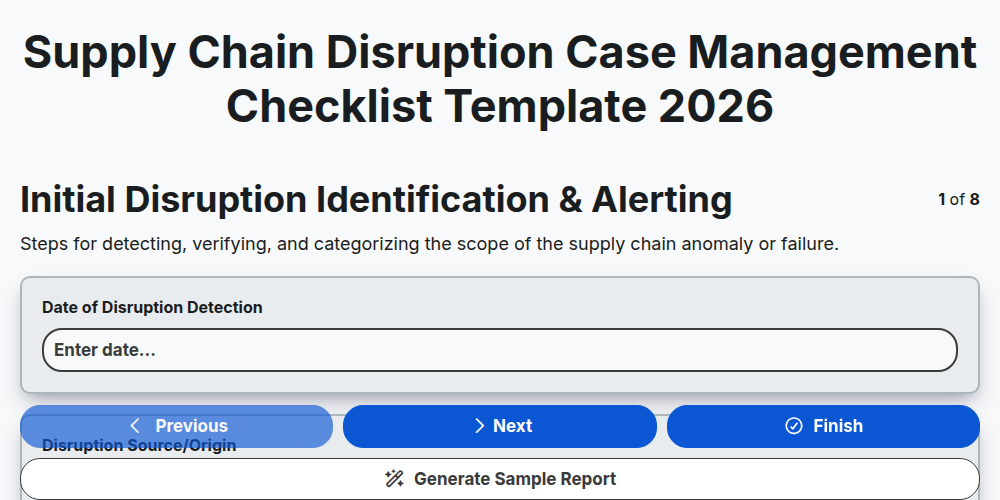
Table of Contents
- Introduction: Navigating the Complexity of 2026 Supply Chains
- Phase 1: Rapid Response - Initial Disruption Identification & Alerting
- Phase 2: Assessing the Damage - Impact Assessment & Criticality Analysis
- Phase 3: Maintaining Transparency - Stakeholder Communication Protocol
- Phase 4: Implementing Contingencies - Alternative Sourcing & Logistics Redirection
- Phase 5: Safeguarding Continuity - Inventory & Buffer Stock Management
- Phase 6: Risk Containment - Financial & Contractual Review
- Phase 7: Active Recovery - Mitigation & Recovery Execution
- Phase 8: Building Resilience - Post-Disruption Post-Mortem & Process Improvement
- Conclusion: Future-Proofing Your Supply Chain Strategy
- Resources & Links
TLDR: Learn how to safeguard your operations against the evolving global uncertainties of 2026 with our comprehensive Supply Chain Disruption Case Management Checklist. This guide provides a structured, step-by-step framework-from initial identification and impact assessment to alternative sourcing and post-disruption recovery-designed to help logistics leaders minimize downtime, manage stakeholders, and build a more resilient, agile supply chain.
Introduction: Navigating the Complexity of 2026 Supply Chains
The global supply chain landscape in 2026 is no longer defined by predictable cycles, but by permacrisis-a state of continuous, overlapping disruptions. From geopolitical shifts and climate-driven logistics bottlenecks to the rapid integration of autonomous freight and AI-driven demand volatility, the margin for error has vanished. In this new era, the question for supply chain leaders is no longer if a disruption will occur, but how effectively your organization can manage the fallout.
The Shift from Reactive to Proactive Management
Years ago, supply chain management focused heavily on cost optimization and lean manufacturing. While efficiency remains vital, the 2026 standard is resilience. A single breakdown in a tier-two supplier or a sudden blockage in a key maritime corridor can ripple through your entire network, turning a minor delay into a catastrophic financial loss.
Traditional firefighting is no longer a viable strategy. When a disruption hits, the time lost to indecision or disorganized communication is often more expensive than the disruption itself. This is why Case Management has emerged as the critical discipline for the modern era.
Why a Standardized Checklist is Your Greatest Asset
In the heat of a crisis, cognitive load is at its highest. Decision-makers are forced to process massive amounts of data under extreme pressure. Without a structured framework, teams often fall into common traps:
- Focusing on symptoms rather than root causes.
- Neglecting critical stakeholder communication.
- Failing to review contractual protections until it is too late.
The Supply Chain Disruption Case Management Checklist Template 2026 is designed to move your team from chaos to control. By implementing a standardized, step-by-step protocol, you ensure that every disruption-regardless of scale-is met with a synchronized, data-driven, and repeatable response. This template provides the blueprint to stabilize operations, protect your margins, and ultimately, turn supply chain volatility into a competitive advantage.
Phase 1: Rapid Response - Initial Disruption Identification & Alerting
Immediate Detection and Real-Time Intelligence
In the hyper-connected landscape of 2026, the window between a disruption occurring and its impact hitting your bottom line has shrunk to near zero. The first phase of your case management is not just about noticing a problem; it is about precision detection.
To manage a disruption effectively, your response must transition from reactive to automated. This phase focuses on the critical first minutes of a crisis to ensure that no signal goes unnoticed.
Establishing the Early Warning System (EWS)
The goal of this stage is to eliminate blind spots in your global footprint. Your checklist must include:
- Multi-Tier Monitoring: Implementing AI-driven tools to scan not just your Tier 1 suppliers, but Tier 2 and Tier 3 nodes for geopolitical shifts, climate events, or labor unrest.
- Automated Alert Triggers: Defining specific thresholds (e.g., a port delay exceeding 48 hours or a sudden spike in raw material pricing) that automatically escalate an incident from a monitor status to an active case.
Verification and Incident Logging
Once an alert is triggered, the Identification phase requires rigorous validation to prevent alert fatigue caused by false positives.
- Data Triangulation: Cross-referencing IoT sensor data, news feeds, and direct supplier notifications to confirm the disruption's legitimacy.
- The Digital Incident Log: Every alert must be timestamped and logged into a centralized Case Management System (CMS). This creates a single source of truth, ensuring that the incident response team is working from the same real-time dataset.
Categorization and Severity Level Assignment
Not all disruptions are created equal. As soon as an alert is verified, the incident must be categorized:
- Level 1 (Localized): Minor delays with no immediate impact on downstream production.
- Level 2 (Significant): Potential impact on specific SKUs or customer orders; requires active management.
- Level 3 (Critical): Total stoppage of a critical component or logistics route; requires immediate executive intervention and cross-functional task force activation.
Phase 2: Assessing the Damage - Impact Assessment & Criticality Analysis
Once the initial alert has been triggered, the clock begins to tick against your operational stability. You cannot fix what you haven't accurately measured. In the 2026 landscape-characterized by hyper-connected digital twins and real-time data-your assessment must move beyond what happened to what is at risk.
This phase is about separating immediate noise from structural threats. The goal is to determine the depth, breadth, and duration of the disruption to prioritize resources effectively.
Determining the Scope of the Disruption
The first step is to map the disruption against your entire value chain. It isn't enough to know that a specific port is closed; you must trace that blockage through your tiers of supply.
- Tiered Impact Mapping: Identify if the disruption is isolated to a Tier 1 supplier or if it has compromised Tier 2 or Tier 3 components that are critical to your finished goods.
- Product-Level Exposure: Categorize which SKUs are directly affected. Are these high-margin flagship products or seasonal items?
- Temporal Projection: Estimate the Time-to-Recover (TTR). How long will this specific bottleneck persist based on current intelligence?
Criticality Analysis: The Heat Map Approach
Not all disruptions are created to be treated equally. Use a criticality matrix to categorize the impact based on two key dimensions: Severity and Urgency.
1. High-Criticality (Immediate Action Required)
These are Code Red scenarios where a disruption directly threatens your ability to fulfill primary customer obligations or poses a risk to safety and compliance.
- Indicators: Single-source dependency failure, perishable goods at risk, or total stoppage of a primary assembly line.
2. Medium-Criticality (Active Monitoring)
The disruption is present but manageable through existing buffer stocks or minor logistical adjustments.
- Indicators: Delayed shipments that can be absorbed by safety stock, or secondary supplier shortages that haven't yet impacted the main production line.
3. Low-Criticality (Routine Management)
Minor delays that do not deviate from the standard operational baseline.
- Indicators: Slight fluctuations in transit times or non-essential component delays that do not halt production.
Data-Driven Decision Making
In 2026, this analysis should be powered by Predictive Analytics. Use your digital twin models to run what-if simulations. By inputting the disruption parameters into your supply chain control tower, you can visualize the ripple effect across your global network before the physical impact even hits your warehouse.
Pro-Tip: Avoid the Panic Multiplier. Never escalate a disruption to executive leadership without a preliminary assessment of the Estimated Cost of Inaction (ECI). This allows for faster, more rationalized decision-making during the next phase.
Phase 3: Maintaining Transparency - Stakeholder Communication Protocol
Navigating the Information Flow: Establishing a Unified Communication Protocol
In the high-stakes environment of 2026, where supply chain volatility is the new baseline, silence is your greatest enemy. When a disruption hits, the vacuum created by a lack of information is quickly filled by speculation, panic, and loss of trust. An effective Stakeholder Communication Protocol ensures that instead of chaos, you provide clarity.
Effective case management during a crisis depends on a structured, multi-tiered communication strategy that reaches everyone from the warehouse floor to the boardroom.
The Three Pillars of Crisis Communication
To manage a disruption effectively, your protocol must address three distinct layers of stakeholders:
1. Internal Operations & Leadership The first priority is the internal Command Center. Your protocol must define:
- Immediate Escalation Paths: Who needs to know within the first 15 minutes? (e.g., Logistics Managers, Procurement Heads, and Risk Officers).
- Real-Time Reporting Cadence: Establishing a heartbeat for updates-whether it is a twice-daily briefing or a real-time dashboard update-to prevent leadership from constantly interrupting the execution team for status reports.
- Single Source of Truth: Designating one central repository (such as an integrated ERP or a dedicated crisis management module) where all vetted, verified data resides.
2. Upstream and Downstream Partners (Suppliers & Logistics Providers) Disruptions are rarely isolated. Your communication must extend to your ecosystem:
- Supplier Feedback Loops: Establishing rapid-response channels to confirm if a disruption is localized to you or if your tier-2 and tier/tier-3 suppliers are also impacted.
- Logistics Coordination: Proactive outreach to freight forwarders and carriers to assess transit delays and re-routing feasibility before the backlog becomes unmanageable.
3. Downstream Customers & Key Clients The goal here is reputation preservation.
- Transparency vs. Panic: Developing pre-approved templates that communicate the fact of the disruption and the action being taken, without over-promising on recovery timelines that may shift.
- Tiered Notification Logic: Prioritizing communication based on customer criticality and the severity of the impact on their specific orders.
Implementation Checklist for this Phase:
- Identify Communication Owners: Assign a single Spokesperson per department to prevent conflicting messages.
- Pre-Drafted Templates: Prepare Alert, Update, and Resolution templates for various disruption scenarios (e.g., port strikes, natural disasters, geopolitical shifts).
- Channel Redundancy: Ensure you have secondary communication methods (e.g., SMS alerts, satellite messaging, or backup cloud platforms) in case primary digital infrastructures are compromised.
- The No-Surprise Rule: Ensure that your Sales and Customer Success teams are briefed before the broader customer base to allow them to manage direct inquiries.
Phase 4: Implementing Contingencies - Alternative Sourcing & Logistics Redirection
Navigating the Pivot: Executing Real-Time Redirection
When the initial impact assessment confirms that your primary supply route or supplier is compromised, the Golden Hour of disruption management begins. In 2026, the ability to pivot rapidly is no longer a luxury-it is a competitive necessity. This phase focuses on the transition from damage control to active mitigation through two critical levers: supply diversification and logistical agility.
Strategic Alternative Sourcing
Once a disruption is identified, the focus shifts from what happened to where else can we go? In a modern, resilient supply chain, this involves activating pre-vetted secondary and tertiary suppliers.
- Rapid Supplier Activation: Immediately trigger Plan B protocols with pre-qualified backup vendors. This includes verifying their current capacity, lead times, and any potential ripple effect risks they may be facing due to the same disruption.
- Nearshoring and Regionalization: If global lanes are blocked, evaluate the feasibility of shifting to regional or nearshore suppliers. While unit costs may be higher, the reduction in transit time and geopolitical risk often justifies the premium during a crisis.
- Product Substitution Assessment: Work closely with R&D and Procurement to identify if alternative components or raw materials can be used without compromising product integrity or regulatory compliance.
Agile Logistics Redirection
If your goods are already in transit or stuck at a bottlenecked port, your logistics strategy must shift from cost-optimized to speed-optimized.
- Dynamic Route Optimization: Utilize real-time visibility tools to reroute shipments around disrupted zones (e.g., avoiding weather-impacted corridors or geopolitical conflict zones).
- Multimodal Switching: Be prepared to execute mode shifts-for example, transitioning high-priority ocean freight to air cargo or utilizing rail alternatives to bypass congested maritime hubs.
- Last-Mile Redirection: Coordinate with 3PL (Third-Party Logistics) partners to redirect incoming shipments to secondary distribution centers or temporary pop-up warehouses to prevent warehouse congestion at primary nodes.
The Goal: Maintaining Continuity
The objective of this phase is not necessarily to find the cheapest option, but to find the most reliable one. Success in Phase 4 is measured by your ability to maintain flow and prevent the bullwhip effect from paralyzing your downstream operations.
Phase 5: Safeguarding Continuity - Inventory & Buffer Stock Management
Strategic Inventory Buffering: Protecting the Bottom Line
When a disruption hits, your inventory levels are your primary line of defense. In the volatile landscape of 2026, reactive replenishment is no longer enough; you must transition from Just-in-Time to Just-in-Case strategically. This phase of the checklist focuses on maximizing your existing reserves while preventing the bullwhip effect from crippling your operations.
Critical Inventory Audits
As soon as a disruption is identified, your first priority is a real-time audit of available stock. You cannot manage what you cannot see.
- Immediate Stock Verification: Reconcile physical warehouse counts with your ERP/Digital Twin data to identify discrepancies.
- Work-in-Progress (WIP) Assessment: Evaluate the status of semi-finished goods that may be trapped in the affected supply node.
- Transit Visibility Check: Identify all inventory in motion. Where are your shipments currently located, and which are likely to be intercepted by the disruption?
Buffer Stock Optimization & Reallocation
The goal here is to prevent stockouts of high-margin products by strategically deploying your remaining safety stock.
- SKU Rationalization: Identify A-Class items (high value/high volume) that require immediate protection and determine which C-Class items can be temporarily deprioritized to save resources.
- Dynamic Reallocation: If one region is unaffected but another is at risk, initiate the movement of buffer stock to the most vulnerable distribution centers before logistics lanes become congested.
- Safety Stock Recalibration: Use predictive analytics to adjust your safety stock levels based on the duration of the projected disruption, not just the fact that one has occurred.
Preventing the Bullwhip Effect
During a crisis, the natural impulse is to over-order to compensate for scarcity. This can lead to massive excess costs once the disruption settles.
- Demand Signal Monitoring: Closely monitor real-time consumer demand to ensure you aren't over-stocking items that are no longer moving due to the disruption.
- Order Throttling: Implement temporary controls on replenishment orders to prevent a surge in downstream pressure on your remaining functional suppliers.
Phase 6: Risk Containment - Financial & Contractual Review
Safeguarding the Bottom Line: Financial & Contractual Review
When a disruption hits, the physical movement of goods is only half the battle. To ensure long-term business continuity, you must immediately pivot to protecting your organization's capital and legal standing. In the volatile landscape of 2026, a failure to audit your financial exposure can turn a manageable logistics delay into a terminal liquidity crisis.
Evaluating Financial Exposure and Cash Flow Impact
The immediate priority is quantifying the hidden costs of the disruption. Beyond the obvious increased freight rates or spot-buy premiums, you must analyze:
- Working Capital Volatility: Calculate how delayed shipments affect your cash conversion cycle.
- Cost-to-Serve Fluctuations: Identify the real-time spike in operational expenses (e.g., expedited shipping, overtime labor, or emergency warehousing).
- Budget Re-forecasting: Update your quarterly projections to account for the increased Cost of Goods Sold (COGS).
Legal Safeguards and Contractual Enforcement
Disruptions often trigger complex legal dilemmas regarding liability and delivery obligations. This stage of the checklist requires a rigorous review of your existing agreements to determine where the burden of loss lies.
1. Force Majeure Assessment
Determine if the current event meets the specific criteria defined in your Force Majeure clauses. In 2026, unforeseeable is a high bar to meet; ensure your legal team verifies if the disruption qualifies for relief or if your company remains liable for non-performance.
2. Service Level Agreement (SLA) Audits
Review your contracts with both upstream suppliers and downstream customers.
- Upstream: Identify if suppliers are in breach of delivery timelines and if there are predefined penalties for delays.
- Downstream: Assess the risk of penalties or liquidated damages owed to your clients due to fulfillment failures.
3. Insurance Trigger Identification
Evaluate whether the disruption activates any components of your Business Interruption Insurance or Cargo Insurance. Prompt documentation is critical here-ensure that every cost spike and delay is logged as evidence for potential claims processing.
Phase 7: Active Recovery - Mitigation & Recovery Execution
Navigating the Transition from Crisis to Stability
Once the immediate chaos of a disruption has been stabilized, the focus must shift from emergency response to structured recovery. The Mitigation & Recovery Execution phase is where the long-term integrity of your supply chain is rebuilt. It is not merely about returning to the status quo, but about implementing the temporary workarounds and permanent fixes required to resume normal operations without inheriting the same vulnerabilities.
Executing the Recovery Roadmap
At this stage, your primary objective is the systematic deployment of the contingency plans activated during the impact assessment. This involves a dual-track approach:
- Operational Resumption: This involves the phased reactivation of primary shipping lanes, the re-engagement of original suppliers, and the transition of production schedules back to baseline levels.
- Workaround Formalization: If a temporary supplier or logistics route was used during the peak of the disruption, this sub-phase involves evaluating whether these emergency measures should be transitioned into permanent structural changes to enhance future resilience.
Implementation of Control Measures
To ensure that the recovery does not trigger a secondary wave of failures, rigorous monitoring is required.
- Validation of New Workflows: As new logistics routes or alternative materials enter the stream, quality assurance (QA) protocols must be intensified to prevent secondary disruptions caused by unvetted sources.
- Resource Reallocation: Re-deploying personnel and capital from emergency mode back to standard operations must be done incrementally to prevent talent burnout and budget overruns.
Monitoring Recovery KPIs
You cannot manage what you do not measure. During execution, keep a close eye on specific recovery metrics to ensure the disruption is truly receding:
- Lead Time Stabilization: Is the time between order and delivery returning to historical norms?
- Order Fulfillment Rate: Are we meeting customer demand levels as we scale back up?
- Cost-to-Serve Variance: Is the premium paid for emergency logistics decreasing as we return to standard lanes?
Failure to execute this phase with precision can lead to a rebound crisis, where the momentum of the recovery is lost to unmanaged secondary impacts. Success here sets the stage for the final, most critical step: the Post-Mortem analysis.
Phase 8: Building Resilience - Post-Disruption Post-Mortem & Process Improvement
Turning Crisis into Capability: The Power of the Post-Mortem
The final step in your disruption management lifecycle is arguably the most critical for long-term survival. Once the immediate crisis has passed and supply chains have returned to a steady state, the temptation is to simply move on to the next task. However, true supply chain resilience is not built during the storm, but in the reflection that follows it.
The Post-Disruption Post-Mortem is your opportunity to transform a period of high volatility into a strategic advantage. By systematically analyzing the why and how of the event, you transition from reactive firefighting to proactive risk management.
The Post-Mortem Framework
To extract maximum value from a disruption event, your review process should focus on three core dimensions:
1. Root Cause Analysis (RCA) Don't just identify what happened; uncover the underlying vulnerabilities.
- The Trigger: Was it a geopolitical shift, a natural disaster, or a failure in a Tier 2 supplier?
- The Cascade: Why did the disruption spread? Identify the specific points where the domino effect gained momentum.
- The Detection Gap: How long did it take between the initial event and the first alert? Where were the blind spots in your visibility software or communication loops?
2. Performance Auditing Evaluate the effectiveness of your execution during the crisis.
- Protocol Adherence: Did the team follow the established Stakeholder Communication Protocol, or was information siloed?
- Decision Speed: Review the timeline of the Impact Assessment. Were critical decisions made with sufficient data, or were they delayed by manual processes?
- Resource Utilization: Did your alternative sourcing and logistics redirection strategies work as intended, or did they introduce unexpected costs?
3. Strategic Process Improvement This is where the Checklist evolves into a Strategy. Based on your findings, update your 2026 operational playbook with actionable changes:
- Update Risk Maps: Refine your criticality analysis to include new geographic or vendor-specific risks identified during the event.
- Buffer Optimization: Adjust your inventory and buffer stock levels. If a stockout occurred, increase safety stock; if you over-indexed on expensive air freight, recalibrate your logistics contingency plans.
- Contractual Strengthening: If the disruption was caused by a supplier failure, use the data from your Financial & Contractual Review to renegotiate SLAs or implement stricter penalty clauses.
From Reactive to Predictive
In 2026, a supply chain that learns is a supply chain that wins. By treating every disruption as a stress test for your existing processes, you ensure that the next unexpected event finds your organization not just prepared, but fundamentally stronger. The goal is to ensure that the same mistake is never made twice.
Conclusion: Future-Proofing Your Supply Chain Strategy
Navigating the New Era of Global Volatility
As we move into 2026, the definition of unexpected has changed. The era of predictable, linear supply chains is officially behind us, replaced by a landscape of rapid-fire geopolitical shifts, climate-driven logistical bottlenecks, and unprecedented digital vulnerabilities. In this environment, the difference between a minor hiccup and a catastrophic failure lies not in the absence of disruption, but in the maturity of your response framework.
Moving from Reactive to Proactive
The checklist provided above is more than just a tactical troubleshooting guide; it is a strategic blueprint for organizational resilience. By integrating these eight critical stages into your standard operating procedures, you transition your supply chain team from a state of constant firefighting to a state of controlled, methodical execution.
Building a Culture of Continuous Improvement
The most vital step in this entire process is the final one: the Post-Disruption Post-Mortem. In 2026, a supply chain that fails to learn from its scars is destined to repeat them. Use every disruption as a laboratory for optimization. Every time you identify a weakness in your Impact Assessment or a gap in your Alternative Sourcing, you are essentially upgrading your company's immune system.
The Bottom Line
Success in the coming years will be measured by visibility and velocity. Having the right data to identify a threat early (Initial Identification) and the pre-established protocols to act on it (Mitigation Execution) will be your greatest competitive advantages.
Don't wait for the next global event to test your capabilities. Download this template, integrate it into your digital twin or ERP systems, and start building a supply chain that doesn't just survive disruption-but thrives because of its ability to adapt.
Resources & Links
- Gartner Supply Chain Practice: Industry-leading research and insights on supply chain technology, risk management, and strategic planning for 2026.
- McKinsey & Company - Operations Practice: Deep dives into operational excellence, global supply chain resilience, and navigating macroeconomic volatility.
- Association for Supply Chain Management (ASCM): The global leader in supply chain certification and best practices for inventory management and logistics.
- Supply Chain Brain: Comprehensive news and analysis regarding logistics, warehousing, and disruption management strategies.
- Supply Chain Management Review: Academic and practical perspectives on managing complex global supply networks and risk mitigation.
- ISSA - International Supply Chain Standards: Resources regarding standardization and protocols for global logistics and incident response.
- DHL Logistics Insights: Real-world case studies on logistics redirection and managing global transport disruptions.
- MIT Center for Transportation & Logistics: Cutting-edge research on supply chain visibility, resilience, and predictive analytics for future disruptions.
- IBM Supply Chain Intelligence: Tools and frameworks for AI-driven risk identification and real-time visibility in complex networks.
- Oracle Supply Chain Management: Enterprise solutions for inventory management, buffer stock optimization, and contingency planning.
- SAP Integrated Business Planning: Resources on synchronizing supply, demand, and risk assessment through digital transformation.
- Inbound Logistics: Focuses on the tactical side of logistics, including alternative sourcing and transport redirection.
- CRISIL - Supply Chain Risk Analysis: Financial and contractual risk assessment tools for evaluating supplier stability and economic impact.
- Supply Chain Digital: Insights into digital transformation and building resilient, future-proofed supply chain infrastructures.
- WCAworld: Global network insights for managing international freight forwarding and customs-related disruptions.
- Project Management Institute (PMI): Frameworks for managing the 'Post-Mortem' and continuous process improvement phases of disruption recovery.
Comments
There are no comments yet. Be the first to add one!
Case Management Solution Demo
Streamline your casework & improve outcomes! ChecklistGuro centralizes case details, tasks, & communication. Enhance efficiency, ensure compliance, & deliver exceptional service. Manage it all with our Work OS.
Related Articles
Streamline Your Deals: The Ultimate Real Estate Case Management Checklist Template
Streamline Your Debt Collection: A Case Management Checklist Template
Cybersecurity Incident Response: Your Checklist Template for Success
Streamline Your Case Management: The Ultimate Checklist Template
Mastering IP: Your Intellectual Property Case Management Checklist Template
HR Case Management Checklist Template: Your Guide to Fair & Compliant Investigations
Streamlining Veteran Care: Your Comprehensive Case Management Checklist Template
Mastering Investigations: Your Case Management Checklist Template Guide
Need help with
Case Management?
Have a question? We're here to help. Please submit your inquiry, and we'll respond promptly.