Mastering Cycle Counts: Your Warehouse WMS Checklist Template
Published: 12/20/2025 Updated: 07/02/2026
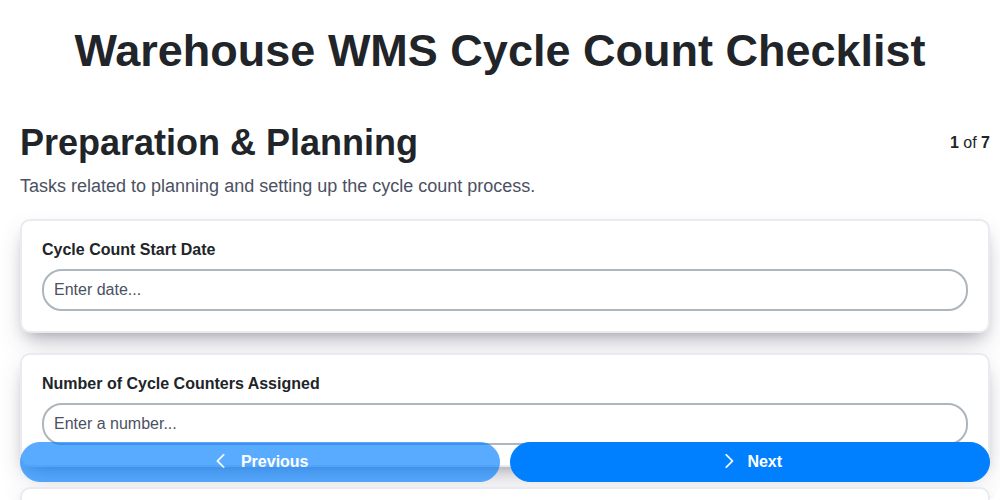
Table of Contents
- Introduction: Why Cycle Counts Matter
- 1. Preparation & Planning: Setting the Stage for Accuracy
- 2. Location Verification: Ensuring Count Accuracy Begins
- 3. Item Selection & Prioritization: Focusing on High-Risk Areas
- 4. Physical Count: The Hands-On Process
- 5. Recording Your Counts: Meticulous Data Capture
- 6. Discrepancy Investigation: Root Cause Analysis
- 7. System Adjustment & Reconciliation: Bringing the Numbers in Line
- 8. Documentation: Keeping a Clear Audit Trail
- 9. Review and Analysis: Identifying Trends & Improving Processes
- 10. WMS Integration: Automating and Streamlining
- 11. Training Your Team: Consistency is Key
- 12. Common Cycle Count Challenges and Solutions
- Conclusion: Maintaining Inventory Health
- Resources & Links
TLDR: Keep your warehouse inventory accurate with this cycle count checklist template! It breaks down the process into clear steps - planning, verifying locations, counting items, investigating differences, and updating your WMS - to minimize errors, improve efficiency, and boost your bottom line. Download the template and start mastering your cycle counts today!
Introduction: Why Cycle Counts Matter
Cycle counts are more than just a tedious task; they's the backbone of a healthy warehouse operation. Think of your inventory records as a map - a cycle count is the process of verifying that the map accurately reflects the actual terrain. Without regular cycle counts, discrepancies between your system records and the physical inventory accumulate, leading to order fulfillment errors, lost sales, increased operational costs, and a general erosion of trust in your data. They're a proactive approach to identifying and correcting inventory inaccuracies before they escalate into major problems during a full physical inventory. By regularly verifying a small portion of your inventory, you can maintain a more accurate and reliable picture of your stock, leading to increased efficiency and customer satisfaction.
1. Preparation & Planning: Setting the Stage for Accuracy
A successful warehouse cycle count hinges on thorough preparation. Don't just grab a scanner and start counting! This stage is about laying the groundwork for accuracy and efficiency.
First, define your cycle count frequency and scope. How often will you cycle count specific areas or items? This depends on factors like inventory value, historical accuracy, and business needs. More valuable or frequently moved items warrant more frequent counts.
Next, select your counting team. Ensure they're well-trained on the cycle counting process, understand the importance of accuracy, and have access to the necessary equipment (scanners, labels, pens).
Clearly communicate the schedule and objectives to everyone involved. Transparency reduces confusion and ensures buy-in.
Finally, review previous cycle count data. Identify locations or items that consistently show discrepancies. These should be prioritized in the upcoming count for closer scrutiny. A quick look at historical data can highlight potential problem areas and inform your selection strategy for the next step.
2. Location Verification: Ensuring Count Accuracy Begins
Before diving into the actual counting, meticulous location verification is paramount. It's surprising how often errors creep in simply because the physical location doesn't match what the WMS indicates. This step isn't just a formality; it's a critical foundation for accurate cycle counts.
Here's how to ensure robust location verification:
- Confirm Aisle, Rack, and Bin: Don't assume the WMS is always correct. Physically check the aisle, rack, and bin number against the system record. This is especially vital in older warehouses or those experiencing frequent reorganization.
- Visual Inspection: Look for any obvious discrepancies. Are items stored in the correct location? Are there any obstructions or mislabeled bins? A quick visual scan can prevent miscounts later.
- Utilize Location Scanners (if available): If your warehouse uses location scanners, leverage them! Scan the location barcode to verify against the WMS record. This eliminates manual data entry errors.
- Note Any Anomalies: Document any discrepancies found during location verification - a misplaced item, a missing label, a blocked bin. These notes are valuable for future improvements to warehouse organization.
- Address Issues Immediately: If you find a location isn't correct, don't proceed with the count. Alert the relevant personnel (supervisor, inventory manager) to correct the issue before counting begins. A corrected location is a foundation for a correct count.
3. Item Selection & Prioritization: Focusing on High-Risk Areas
Not all items in your warehouse demand the same level of scrutiny during cycle counts. Prioritizing which items to count first drastically improves efficiency and focuses your efforts where they matter most. Here's how to approach item selection and prioritization:
- ABC Analysis: This is the most common method. Categorize your inventory based on value and usage. 'A' items represent a small percentage of your inventory (e.g., 20%) but a large percentage of your total value (e.g., 80%). These must be included in your cycle count program. 'B' items represent a moderate percentage of both value and quantity, and 'C' items represent a small percentage of value but a large percentage of quantity. Focus your frequent counts on 'A' items and consider less frequent counts or sampling for 'C' items.
- High-Value Items: Regardless of ABC classification, items with high individual values warrant higher priority. A single discrepancy can represent a significant financial impact.
- Fast-Moving Items: These items are more prone to errors due to frequent movement and handling. Increased activity raises the likelihood of miscounts.
- Historically Problematic Items: Keep a log of items that consistently show discrepancies during cycle counts. These require closer attention and potential investigation into root causes (e.g., receiving errors, picking mistakes).
- Seasonal Items: Prioritize these before and during peak seasons to ensure accurate stock levels to meet demand.
- Random Selection: While prioritization is key, incorporating random selection ensures a broad overview of inventory accuracy, uncovering potential issues outside your identified high-risk areas.
By strategically selecting items for cycle counting, you maximize the impact of your efforts and improve overall inventory accuracy.
4. Physical Count: The Hands-On Process
This is where the rubber meets the road. The physical count phase is arguably the most time-consuming but crucial part of a cycle count. It's not just about moving items; it's about accuracy and thoroughness. Here's a breakdown of what's involved:
- Gather Your Tools: Ensure you have your scanning equipment (if applicable), clipboards, pens, and any other necessary tools readily available.
- Systematic Approach: Don't just randomly grab items. Follow the pre-determined counting route established during planning. This ensures consistency and prevents missed locations.
- Careful Counting: Count each item meticulously. Double-check your count, especially for items with small quantities or those that are easily confused with others.
- Scanning (If Applicable): Utilize scanners to record the count directly into the WMS. This minimizes transcription errors. If manual recording is required, print clear and legible numbers.
- Unit of Measure: Be acutely aware of the unit of measure (e.g., each, case, pallet). Discrepancies in unit of measure are a common source of errors.
- Damaged or Obsolete Goods: Note any damaged or obsolete items during the count. These should be flagged for separate review and potentially removed from inventory.
- Secure the Area: While counting, try to minimize disruption and secure the area to prevent unauthorized movement of goods.
5. Recording Your Counts: Meticulous Data Capture
Accuracy in cycle counting hinges on precise record-keeping. Don't just count - document everything immediately and legibly. Here's how to ensure your recording process is robust:
- Use a Standardized Form: Whether digital or paper, a consistent form ensures all necessary information is captured. Include fields for location code, item number, current system quantity, physical count, counter's initials, and any notes regarding the count.
- Real-Time Input (Ideal): If your WMS allows, record counts directly into the system as you complete them. This minimizes transcription errors and allows for quicker discrepancy resolution.
- Clear Handwriting/Digital Entry: If using paper forms, ensure handwriting is legible. Digital entries should be double-checked for accuracy. Avoid abbreviations that could be misinterpreted.
- Timestamp Every Count: Including a timestamp provides a clear timeline and aids in identifying potential issues later.
- Photographic Evidence (Recommended): For complex or problematic counts, take a photograph of the location and the physical inventory. This serves as visual confirmation and can be invaluable during investigations.
- Note Any Anomalies: Don't just record the quantity. Note any unusual conditions you observe - damaged goods, incorrect labeling, misplacement - as these may be related to the discrepancy.
- Review Recorded Data: A quick review by a supervisor or another counter can help catch errors before they impact the system.
6. Discrepancy Investigation: Root Cause Analysis
Once discrepancies are identified during the cycle count, the real work begins: investigating the root cause. Don't just adjust the system and move on! A thorough investigation prevents future errors and strengthens your warehouse processes.
Start by categorizing the discrepancies: are they minor (within a small tolerance) or significant? Minor discrepancies may warrant observation and process review, while significant ones demand deeper probing.
Gather the facts. Who performed the original putaway? Was the item properly labeled? Was the receiving process accurate? Review transaction history for the item and location. Talk to the team members involved in the relevant processes - receiving, putaway, picking, and shipping. They often have valuable insights.
Common root causes include:
- Data Entry Errors: Mistakes during receiving, putaway, or inventory adjustments.
- Misidentification: Items being mislabeled or confused with similar items.
- Damage or Loss: Items being damaged and not accounted for, or being lost in transit or within the warehouse.
- Process Breakdown: Issues with labeling procedures, picking routes, or storage locations.
- System Integration Issues: Errors arising from communication failures between the WMS and other systems.
- Human Error: Simple mistakes due to fatigue, distraction, or lack of training.
Document your findings meticulously. The goal is not to assign blame, but to identify the systemic issues that led to the discrepancy and to develop corrective actions. This documentation becomes a vital tool for continuous improvement.
7. System Adjustment & Reconciliation: Bringing the Numbers in Line
Once discrepancies are identified and thoroughly investigated, it's time to reconcile the physical count with the Warehouse Management System (WMS). This isn't just about making numbers match; it's about understanding why they didn't and preventing future errors.
Here's what this stage involves:
- System Update: Based on the findings of your investigation (misplaced items, data entry errors, shrinkage, etc.), adjust the WMS inventory records to reflect the accurate physical count. This may involve increasing or decreasing quantities for specific items. Crucially, document the reason for each adjustment! This is vital for future audit trails and analysis.
- Variance Review: The WMS should automatically highlight any remaining variances (even small ones) after the adjustments. Review these carefully. Recurring, even minor, discrepancies often signal underlying process issues.
- Transaction Trace: For significant variances, trace the transaction history within the WMS. This helps pinpoint where the error might have originated - was it a receiving error, a picking mistake, or a shipping discrepancy?
- Workflow Validation: Confirm that any automated workflows triggered by the cycle count (reordering, alerts) function correctly after the reconciliation.
- User Training Reinforcement: If the investigation revealed user errors, reinforce the relevant training. A quick refresher can prevent repeat mistakes.
Ultimately, this stage is about correcting the record and learning from the experience. It ensures the WMS accurately reflects warehouse reality and improves data integrity.
8. Documentation: Keeping a Clear Audit Trail
Cycle counting isn't just about finding and correcting errors; it's about understanding why those errors occurred and preventing them in the future. Thorough documentation is absolutely critical for this. Every step of the cycle count process should be recorded, creating a clear audit trail.
Here's what you should document:
- Cycle Count Plan: Include the scope (which locations/items were counted), the date, and the team involved.
- Count Details: Record the initial count, the person performing the count, and any observations made during the physical count (e.g., damaged goods, incorrect labeling).
- Discrepancy Notes: Meticulously document the discrepancies found, the investigation steps taken, the reasons determined for the difference, and the corrective actions implemented.
- System Adjustments: Clearly document every adjustment made to the WMS, including the date, the adjustment amount, and the user who made the change.
- Review Findings: Summarize the overall findings of the cycle count, highlighting trends, recurring issues, and potential process improvements.
This documentation isn't just for internal review. It's essential for audits, troubleshooting, and demonstrating the accuracy and reliability of your inventory. A well-maintained documentation trail proves your commitment to inventory control and provides invaluable data for continuous improvement. Don't underestimate its power!
9. Review and Analysis: Identifying Trends & Improving Processes
The cycle count isn't just about correcting discrepancies; it's a powerful tool for continuous improvement. Once all counts are reconciled and adjustments made, the real learning begins. This review and analysis phase is critical for identifying recurring issues and refining your warehouse processes.
Here's what you should be looking for:
- Trend Identification: Analyze the data. Are certain locations consistently showing discrepancies? Are particular items frequently inaccurate? Identifying these patterns can pinpoint underlying problems. For example, a consistently inaccurate location might indicate issues with labeling or layout. Frequent errors with a specific item could point to misidentification or handling issues.
- Root Cause Analysis: Don't just note the trends; dig deeper. Use techniques like the 5 Whys to uncover the root causes. If location A consistently has errors, why is that? Is it visibility, obstructions, incorrect picking routes, or something else?
- Process Evaluation: Based on your findings, evaluate your current warehouse processes. Do your receiving procedures need improvement? Is your bin location strategy effective? Are pickers adequately trained?
- Adjust Cycle Count Frequency: If a particular location or item consistently shows accuracy, consider reducing its cycle count frequency. Conversely, increase the frequency for areas with high discrepancy rates.
- Feedback to the Team: Share your findings and proposed solutions with the warehouse team. Encourage open communication and collaboration to implement improvements.
- Document Changes: Record all changes made to processes or cycle count frequency. This documentation serves as a baseline for future analysis and allows you to track the effectiveness of your improvements.
- Regular Reporting: Create a regular reporting cycle (monthly or quarterly) to track key metrics like discrepancy rates and cycle count accuracy. This keeps the focus on continuous improvement.
10. WMS Integration: Automating and Streamlining
Cycle counting shouldn't be a purely manual process. Integrating your cycle count checklist with your Warehouse Management System (WMS) is paramount for efficiency and accuracy. This isn't just about transferring data; it's about building a workflow that eliminates redundant tasks and minimizes errors.
Here's how WMS integration elevates your cycle count process:
- Automated Task Assignment: The WMS can automatically generate cycle count tasks based on prioritization rules (e.g., high-value items, frequently moved items, locations with past discrepancies). This removes manual assignment and ensures a proactive approach.
- Real-Time Data Visibility: Counters can access real-time inventory data directly within the WMS on mobile devices, eliminating the need for printed reports and reducing the risk of outdated information.
- Guided Counting: The WMS can guide counters through the correct locations and items, minimizing picking errors and ensuring the entire warehouse is covered in a systematic manner.
- Instant Discrepancy Flagging: As counts are entered, the WMS immediately compares them to the system's records, flagging discrepancies in real-time. This allows for immediate investigation and prevents minor issues from escalating.
- Automatic Reconciliation: Many WMS solutions allow for direct reconciliation of discrepancies within the system, updating inventory records instantly once adjustments are approved.
- Detailed Audit Trails: WMS integration provides a complete audit trail of all cycle count activities, including who performed the count, when it was completed, and what adjustments were made.
Investing in WMS integration for your cycle count process is a significant step towards a more accurate and efficient warehouse operation.
11. Training Your Team: Consistency is Key
A meticulously crafted cycle count checklist is only as effective as the team executing it. Inconsistent execution leads to unreliable data, negating all the effort put into planning. Thorough training isn't just a one-time event; it's an ongoing process.
Here's what effective training should cover:
- Understanding the Why: Explain the importance of cycle counts and how they contribute to inventory accuracy and overall warehouse efficiency. Explain how inaccuracies impact other departments like sales and order fulfillment.
- Checklist Familiarization: Walk your team through each step of the cycle count checklist, ensuring they understand the purpose of each action and how to correctly perform it. Include practical demonstrations.
- Location Verification Best Practices: Show them how to accurately identify and verify locations using your WMS, emphasizing the importance of confirming the location code and physical placement.
- Item Identification & Prioritization: Train them on how to correctly identify items, including variations in packaging, labeling, and barcodes. Clearly outline the prioritization methodology.
- Recording Procedures: Emphasize the importance of accurate and legible recording of counts. Explain how to handle damaged or mislabeled items during the count.
- Discrepancy Resolution: Equip them with the knowledge of when to escalate discrepancies and to whom. Discuss common causes of discrepancies and how to avoid them in the future.
- WMS Interaction: Ensure proficiency in using the WMS for recording counts, investigating discrepancies, and performing adjustments.
- Regular Refreshers: Schedule periodic refresher training sessions to reinforce best practices and address any emerging issues.
Ultimately, consistently well-executed cycle counts build trust in your inventory data and contribute significantly to a smooth-running warehouse operation.
12. Common Cycle Count Challenges and Solutions
Cycle counts aren't always smooth sailing. Several hurdles can trip up even the most experienced warehouse teams. Here's a breakdown of frequent challenges and practical solutions to keep your cycle count program running efficiently:
1. Inconsistent Data Entry: Typos, incorrect units of measure, or simply misreading labels during the physical count significantly impact accuracy. Solution: Implement rigorous training on data entry procedures. Utilize barcode scanners and handheld devices to minimize manual input errors. Consider implementing a data validation process to catch errors in real-time.
2. Incorrect Location Assignments: Items stored in the wrong locations are a nightmare for cycle counting. A misplaced pallet can throw off an entire count. Solution: Regularly review and update your warehouse layout and location assignments. Implement a putaway verification system where staff confirm the correct location during putaway processes.
3. Lack of Clear Prioritization: Counting everything equally wastes valuable time. Focusing on high-value or fast-moving items is crucial. Solution: Utilize ABC analysis to categorize inventory based on value and volume. Prioritize cycle counts accordingly - A items (high value/volume) should be counted more frequently than C items (low value/volume).
4. Insufficient Training: Untrained staff can make mistakes, interpret instructions incorrectly, and struggle with using cycle counting tools. Solution: Invest in comprehensive training for all cycle counters, covering procedures, tools, and common discrepancies. Refresher training should be conducted periodically.
5. Time Constraints: Rushing through cycle counts leads to inaccuracies. Solution: Allocate sufficient time for cycle counts. Consider staggered counts or breaking down the warehouse into smaller zones to manage workload.
6. Discrepancy Investigation Bottlenecks: Slow or ineffective discrepancy investigations prolong the cycle count process and impact overall inventory accuracy. Solution: Establish clear escalation paths and assign responsibility for discrepancy investigation. Empower cycle counters to resolve minor discrepancies immediately.
7. Poor Communication: Lack of communication between the cycle count team and other warehouse departments (e.g., receiving, shipping) can lead to unexpected inventory changes. Solution: Establish a clear communication protocol to notify the cycle count team of any inventory adjustments or movements.
8. Unclear Responsibilities: Ambiguity regarding who is responsible for which aspect of the cycle count process can lead to confusion and dropped balls. Solution: Document roles and responsibilities clearly, and ensure everyone understands their part in the cycle count workflow.
9. System Limitations: Older or less sophisticated WMS systems can hinder cycle count efficiency and accuracy. Solution: Evaluate your WMS and consider upgrades or improvements to support more efficient cycle counting processes.
10. Inadequate Resources: Insufficient staff or equipment (e.g., barcode scanners, mobile computers) can slow down the process and increase errors. Solution: Assess your resource needs and ensure adequate staffing and equipment are available.
11. Lack of Continuous Improvement: Treating cycle counts as a one-off event prevents identification of systemic issues. Solution: Regularly review cycle count performance, identify areas for improvement, and implement changes to enhance accuracy and efficiency.
12. Limited Visibility into Results: Without analyzing cycle count data, you can'm easily identify trends and problem areas. Solution: Implement robust reporting and analytics to track cycle count performance, identify root causes of discrepancies, and measure the effectiveness of corrective actions.
Conclusion: Maintaining Inventory Health
Cycle counting isn't a one-and-done activity; it's a continuous process vital for maintaining inventory health and overall warehouse efficiency. By consistently following a robust cycle count checklist - from meticulous preparation to thorough reconciliation - you're not just correcting errors, you're proactively preventing them. This commitment to accuracy builds trust in your data, streamlines operations, and ultimately impacts your bottom line. Remember, a well-executed cycle count program is an investment in the long-term accuracy and reliability of your warehouse management system and the integrity of your inventory. Don't just count; continuously improve your process to keep your warehouse running smoothly.
Resources & Links
- WMS Vision: A provider of Warehouse Management Systems (WMS) and related solutions. Their website offers insights into inventory management best practices, including cycle counting, and showcases how WMS can automate and improve the process.
- Infor: Offers a range of WMS solutions with cycle counting functionality. Their site provides articles and case studies illustrating the benefits of accurate inventory management.
- Oracle: Provides comprehensive WMS solutions, including tools for cycle counting and reconciliation. Explore their resources for understanding how to leverage technology for inventory accuracy.
- Blue Harbor: Consulting firm specializing in supply chain and warehouse optimization. They provide expertise on cycle counting methodologies and implementing best practices. Their website often features informative articles and whitepapers.
- A Pick Systems: Provider of warehouse optimization solutions, including resources on inventory accuracy. Their website offers advice and guidance on cycle counting techniques.
- Supply Chain Digital: A digital publication covering all aspects of supply chain management, including articles on inventory control and cycle counting strategies. Search their site for relevant content.
- DC Analytics: Offers solutions and resources focused on warehouse performance metrics and optimization. Useful for analyzing cycle count data and identifying areas for improvement.
- Zebra Technologies: Provides barcode scanners and other data capture devices crucial for accurate physical counting and record-keeping. Their website provides information about technology enabling efficient cycle counts.
- Zebra - Warehouse Management Solutions: A specific section of Zebra's website detailing how their technology supports warehouse management, including cycle counting.
- Shopify Enterprise - Warehouse Management: While Shopify is known for e-commerce, their enterprise solutions often incorporate WMS features. This section offers insights into modern warehouse management practices and could be helpful for understanding broader context.
Frequently Asked Questions
How can I improve the accuracy of my cycle counts?
Implement clear procedures, provide adequate training, use scanning technology to minimize errors, regularly review and update cycle count frequency, and investigate the root cause of discrepancies.
Comments
There are no comments yet. Be the first to add one!
WMS - Warehouse Management System Solution Demo
Optimize your warehouse operations & boost efficiency! ChecklistGuro's WMS streamlines inventory management, order fulfillment, and shipping. Reduce errors, improve accuracy, & maximize space utilization. Manage it all with our Work OS.
Related Articles
Seamless RFID Integration: Your WMS Checklist Template for Success
Mastering Warehouse Labeling: Your WMS Process Checklist Template
The Ultimate Supply Chain Inventory Accuracy Audit Checklist: A Step-by-Step Guide
Mastering Putaway: Your WMS Optimization Checklist

Mastering Your Yard: A Warehouse WMS Yard Management Checklist Template
Warehouse Data Integrity: Your WMS Checklist Template
WMS System Performance Monitoring Checklist: A Comprehensive Guide
Warehouse WMS Error Handling Checklist: A Proactive Guide to Minimizing Disruptions
We can do it Together
Need help with
Warehouse Management System (WMS)?
Have a question? We're here to help. Please submit your inquiry, and we'll respond promptly.