Mastering Warehouse WMS Reporting: Your Essential Checklist Template
Published: 12/19/2025 Updated: 12/20/2025

Table of Contents
- Introduction: Why Robust WMS Reporting is Crucial
- 1. Report Configuration: Setting the Foundation
- 2. Data Accuracy & Completeness: Ensuring Reliable Insights
- 3. Report Scheduling & Delivery: Automation for Efficiency
- 4. User Access & Permissions: Security and Control
- 5. Report Performance & Optimization: Speed & Scalability
- 6. Report Customization & Validation: Tailoring to Your Needs
- 7. Audit Trail & Logging: Tracking Changes and Ensuring Accountability
- 8. Defining Key Performance Indicators (KPIs) for Warehouse Reporting
- 9. Data Source Verification and Integration Checks
- 10. Report Design and Visualization Best Practices
- 11. Disaster Recovery and Report Backup Procedures
- 12. Training and Documentation for Report Users
- Conclusion: Continuous Improvement in WMS Reporting
- Resources & Links
TLDR: Feeling overwhelmed by your Warehouse WMS reports? This checklist template ensures your reports are accurate, reliable, and performing optimally. Covering everything from setup and data integrity to security and optimization, it's your shortcut to mastering warehouse reporting and eliminating costly errors.
Introduction: Why Robust WMS Reporting is Crucial
In today's fast-paced and competitive logistics landscape, a Warehouse Management System (WMS) is more than just a software solution - it's a vital operational hub. However, the true power of your WMS isn't realized simply by implementing it. It's unlocked through insightful and accurate reporting. Without comprehensive and reliable reports, you're essentially flying blind.
Robust WMS reporting provides a clear, data-driven view of warehouse performance, enabling proactive decision-making, identifying bottlenecks, and ultimately optimizing efficiency. It allows you to track key performance indicators (KPIs) like order fulfillment rates, inventory turnover, labor productivity, and storage utilization. This granular visibility translates directly into cost savings, improved customer satisfaction, and a stronger competitive advantage. This checklist will provide a framework to ensure your WMS reporting is not only functional, but truly contributing to your warehouse's success.
1. Report Configuration: Setting the Foundation
Before you can glean any meaningful insights from your Warehouse Management System (WMS) reports, you need to ensure the foundation - the report configuration itself - is rock solid. This isn't just about selecting a few boxes on a screen; it's a crucial step impacting the accuracy and relevance of everything that follows.
Here's what you need to consider:
- Define Report Purpose: What business questions are you trying to answer with each report? Clearly defining the purpose upfront dictates the data fields needed, the filtering criteria, and the desired output format.
- Data Source Mapping: Verify that each report is pulling data from the correct tables and fields within your WMS database. Incorrect mappings are a common source of errors.
- Parameter Settings: Confirm all report parameters (e.g., location, date ranges, product types) are appropriately configured and accessible to users who need them.
- Filtering and Sorting: Set up appropriate filters to narrow down the data and ensure the report presents the information most relevant to the intended audience. Sorting options are equally important for readability and analysis.
- Output Format: Choose the output format (e.g., CSV, Excel, PDF) that best suits the report's purpose and how it will be consumed.
- Naming Conventions: Implement consistent naming conventions for your reports to enhance organization and ease identification.
- Documentation: Thoroughly document the configuration details for each report, including the purpose, data sources, and parameters. This is invaluable for troubleshooting and future modifications.
2. Data Accuracy & Completeness: Ensuring Reliable Insights
Warehouse WMS reporting is only as good as the data it's built upon. Inaccurate or incomplete data leads to flawed decisions and potentially significant operational issues. This section of your checklist should focus on verifying the integrity of the data feeding your reports.
Key Checks:
- Source Data Validation: Regularly audit the raw data sources used by your WMS reports. This includes transaction data (receiving, putaway, picking, shipping), inventory records, and location information.
- Data Mapping Verification: Confirm that data fields are correctly mapped between the WMS and the reporting system. Mismatched fields are a common source of errors.
- Cycle Counts & Physical Inventory Reconciliation: Compare reported inventory levels with physical counts. Significant discrepancies require investigation and correction.
- Unit of Measure Consistency: Ensure consistent application of units of measure (e.g., each, case, pallet) across all transactions and reports.
- Data Entry Error Identification: Implement checks to identify and prevent common data entry errors (e.g., incorrect part numbers, miskeyed quantities). Consider automated validation rules.
- Exception Reporting: Monitor for unusual or unexpected data patterns that may indicate underlying data quality problems.
- Data Retention Policies: Review and maintain data retention policies to ensure data availability for historical reporting and analysis, while also complying with regulatory requirements.
- Regular Data Quality Audits: Conduct periodic, scheduled audits specifically focused on data accuracy and completeness. Document findings and corrective actions.
3. Report Scheduling & Delivery: Automation for Efficiency
Consistent, timely reporting is crucial for proactive warehouse management. Manually generating and distributing reports is a recipe for delays, errors, and frustrated users. Implementing automated scheduling and delivery is a game-changer.
Here's what to consider for a robust scheduling and delivery process:
- Define Frequency: Determine the optimal frequency for each report - daily, weekly, monthly, or even real-time depending on the report's purpose and the urgency of the insights it provides.
- Automated Distribution Channels: Leverage the WMS's capabilities to automatically distribute reports via email, shared folders, dashboards, or other preferred channels. Ensure distribution lists are accurate and easily updatable.
- Exception Handling: Set up notifications for failed report generation or distribution. Proactively address issues before they impact decision-making.
- Delivery Formats: Offer a variety of report formats (PDF, CSV, Excel) to cater to different user preferences and downstream systems.
- Review & Adjustment: Regularly review the scheduling and delivery schedule. Business needs evolve, and your reporting should adapt accordingly. Consider incorporating feedback from report recipients to optimize the process.
4. User Access & Permissions: Security and Control
Warehouse WMS reporting isn't just about generating pretty charts and graphs; it's about ensuring the right people have access to the right data, and only that data. Implementing robust user access and permissions is critical for data security, compliance, and operational efficiency.
Here's a breakdown of essential considerations:
- Role-Based Access: Assign users roles (e.g., Warehouse Manager, Inventory Clerk, Shipping Supervisor) and grant permissions based on those roles. Avoid individual permissions whenever possible - it's much easier to manage and audit.
- Principle of Least Privilege: Users should only have access to the reports and data they absolutely need to perform their duties. Don't grant broad "administrator" access unless truly necessary.
- Report-Specific Permissions: Some reports might contain sensitive information. Configure permissions so that only authorized personnel can view or export these specific reports. Consider data masking or redaction for highly sensitive data.
- Regular Review & Updates: Employee roles and responsibilities change. Regularly review user access permissions (at least quarterly) to ensure they remain accurate and appropriate. Remove access immediately when an employee leaves or changes positions.
- Multi-Factor Authentication (MFA): Implement MFA for an added layer of security, especially for users with elevated access privileges.
- Password Management Policies: Enforce strong password requirements and encourage (or mandate) regular password changes.
- Documentation: Maintain clear documentation outlining user roles, permissions, and access procedures. This aids in onboarding new users and troubleshooting access issues.
Failing to properly manage user access and permissions can lead to data breaches, unauthorized modifications, and a lack of accountability - all of which can significantly impact your warehouse operations.
5. Report Performance & Optimization: Speed & Scalability
Warehouse WMS reporting shouldn't be a bottleneck. Slow reports frustrate users, delay decision-making, and ultimately impact efficiency. Optimizing report performance is crucial for a responsive and valuable WMS.
Key Considerations:
- Query Optimization: Regularly review report queries. Are they using appropriate indexes? Are joins efficient? Consult with your WMS vendor or a database administrator for assistance. Poorly written queries are a common culprit for slow report generation.
- Data Volume & Aggregation: Are you pulling too much data? Consider aggregating data where possible to reduce the dataset size. Explore pre-calculated aggregates or summary tables for frequently accessed metrics.
- Hardware Resources: Ensure sufficient server resources (CPU, memory, disk I/O) are allocated to the WMS server, particularly during peak reporting times. Monitor server utilization and consider upgrades if necessary.
- Report Caching: Implement caching strategies for frequently run reports to reduce the load on the database and deliver faster response times.
- Scalability Testing: As your warehouse grows, your reporting needs will increase. Conduct periodic scalability testing to identify potential bottlenecks and ensure your reporting infrastructure can handle the growing demands. This includes simulating increased data volumes and concurrent user access.
- Report Complexity: Complex reports with numerous calculations and intricate visualizations naturally take longer to generate. Evaluate if the complexity is truly necessary or if simpler alternatives can deliver the essential information.
6. Report Customization & Validation: Tailoring to Your Needs
Standard reports are a good starting point, but rarely perfectly align with your warehouse's unique operational requirements. This section focuses on ensuring your WMS reports are truly valuable by allowing for customization and rigorous validation.
Customization Considerations:
- Field Selection: Can you choose which data fields appear in each report? Often, you're paying for data you aren't using. Stripping away unnecessary fields improves readability and reduces processing time.
- Calculated Fields: Can you create new fields based on existing data? Examples include calculating cycle time, order fill rate, or inventory aging. This provides deeper insights that standard reports simply can't offer.
- Grouping & Sorting: Flexibility in grouping data by location, product category, employee, or other relevant criteria is crucial. Ensure reports can be sorted in a way that highlights key trends and potential issues.
- Filtering Options: Robust filtering is essential for drilling down into specific data sets. Can you filter by date range, order status, product type, and other relevant parameters?
- Conditional Formatting: Utilize conditional formatting to visually highlight critical data points - for example, low stock levels or overdue orders.
Validation is Key:
Customization without validation is a recipe for disaster. Here's how to ensure your customized reports are accurate:
- Sample Data Verification: After customizing a report, pull data for a small sample of transactions and manually verify the accuracy of the figures.
- Comparison with Existing Systems: Compare the data in your WMS reports with data from other systems, like your accounting software or ERP, to ensure consistency.
- User Acceptance Testing (UAT): Involve key users in the report validation process. They can identify inaccuracies or usability issues that you might have missed.
- Document Customizations: Maintain a detailed log of all customizations made to reports, including who made the changes and when. This simplifies troubleshooting and future modifications.
7. Audit Trail & Logging: Tracking Changes and Ensuring Accountability
In a warehouse environment, understanding who made what changes to your WMS reports is paramount for compliance, troubleshooting, and maintaining data integrity. A robust audit trail and logging system isn't just a nice-to-have; it's a critical component of a well-managed Warehouse Management System (WMS).
Your WMS reporting checklist must include a thorough assessment of your audit trail functionality. This means verifying that the system is capturing:
- User Activity: Who accessed, modified, or generated reports?
- Report Modifications: When and how were report configurations, filters, or parameters changed? Documenting these adjustments ensures you can revert to previous versions if needed.
- Data Changes: While not always directly linked to report changes, a clear connection between report data and underlying transactional data changes is invaluable.
- Timestamping: Every action related to reporting needs to be time-stamped accurately for chronological tracking.
Regularly review your audit logs. Don't let them become a digital graveyard! Analyze them for anomalies, unauthorized access attempts, and discrepancies. Ensure the logs are easily searchable and accessible to authorized personnel. Finally, confirm your organization's retention policy for audit trails is being adhered to, ensuring you retain the necessary data for legal and operational purposes. A neglected audit trail can quickly become a source of headaches - proactive management is key.
8. Defining Key Performance Indicators (KPIs) for Warehouse Reporting
Your warehouse reporting isn't just about generating data; it's about understanding performance and driving improvement. That's where Key Performance Indicators (KPIs) become essential. These metrics provide a clear picture of your warehouse's health and highlight areas needing attention. But what KPIs should you be tracking?
The right KPIs will depend on your specific warehouse operations and business goals. However, here are some common and valuable examples to consider, categorized for clarity:
- Inventory Management: Inventory Turnover Rate, Stock Accuracy, Obsolescence Rate, Carrying Costs. These indicate how efficiently you're managing your inventory and minimizing waste.
- Order Fulfillment: Order Fill Rate, Order Cycle Time, Perfect Order Rate, On-Time Delivery Rate. These reflect your ability to fulfill orders accurately and quickly, directly impacting customer satisfaction.
- Operational Efficiency: Labor Productivity (units per hour), Space Utilization, Dock-to-Stock Time, Picking Accuracy. These focus on how effectively your resources are being used and processes are running.
- Cost Management: Warehouse Operating Costs, Cost Per Order, Cost Per Unit Shipped. Tracking these reveals potential areas for cost reduction.
Don't overwhelm yourself by tracking too many KPIs. Start with a few critical ones aligned with your biggest challenges or opportunities. Regularly review your chosen KPIs, ensuring they remain relevant and provide actionable insights. Remember to baseline your performance, set targets, and monitor progress consistently.
9. Data Source Verification and Integration Checks
Your WMS reports are only as good as the data feeding them. This section focuses on rigorous checks of your data sources and integration points to ensure accuracy and consistency. Begin by documenting all data sources contributing to your reports - this includes ERP systems, transportation management systems (TMS), and any other external data feeds.
Then, perform these key verification steps:
- Source Mapping Validation: Confirm that the data fields in your WMS are accurately mapped to the corresponding fields in the source systems. A simple misaligned mapping can introduce significant errors.
- Data Type Consistency: Verify that data types (e.g., dates, numbers, text) are consistent across the WMS and source systems. Incompatibilities can lead to errors or data truncation.
- Integration Health Checks: Regularly monitor the health of your data integrations. Look for error logs, latency issues, or failed data transfers. Implement automated alerts for critical failures.
- Data Transformation Verification: If your WMS performs any data transformation (e.g., unit conversions, calculations), thoroughly validate these transformations. Document all transformations and have a process for reviewing and updating them.
- Data Reconciliation: Periodically reconcile data between your WMS and source systems to identify and resolve discrepancies. Use test reports or data extracts for comparison.
Consistent monitoring and validation of these integrations are vital for building trust in your WMS reporting.
10. Report Design and Visualization Best Practices
Beyond just having reports, ensuring they are easily understood and actionable is crucial. Poorly designed reports can lead to misinterpretations and wasted time. Here's a breakdown of key design and visualization best practices for your warehouse WMS reports:
- Choose the Right Chart Type: Don't just default to a bar chart! Consider the data you're presenting. Pie charts are good for proportions, line graphs for trends over time, scatter plots for correlations, and heatmaps for density.
- Keep it Clean and Uncluttered: Remove unnecessary elements like excessive gridlines, 3D effects (they distort perception), and too many colors. Focus on the essential data.
- Use Color Strategically: Employ a consistent color palette. Use color to highlight key trends or outliers, not just for aesthetics. Consider accessibility - ensure sufficient color contrast for users with visual impairments.
- Clear Labeling & Titles: Every chart and table needs a descriptive title that clearly communicates its purpose. Label axes and data points explicitly. Use clear, concise units of measurement.
- Prioritize Key Metrics: Draw attention to the most critical KPIs. Use size, color, or placement to make them stand out.
- Interactive Dashboards: Where possible, create interactive dashboards allowing users to drill down into data, filter by specific parameters, and explore different perspectives.
- Consistent Formatting: Maintain a consistent look and feel across all reports, using standardized fonts, sizes, and layouts. This reduces cognitive load and improves readability.
- Consider Your Audience: Tailor the design to the needs and technical expertise of the intended recipients. A report for warehouse staff will differ from one for executive management.
- Use Legends Effectively: Ensure legends are clear, concise, and positioned logically.
- Test for Readability: Print reports in grayscale and view them from a distance to assess readability. Get feedback from users to ensure understanding.
11. Disaster Recovery and Report Backup Procedures
Warehouse WMS reports aren't just valuable during normal operations; they're critical for recovery efforts after a disaster. A robust disaster recovery plan for your reports is paramount. This goes beyond just backing up your WMS data; it involves protecting the reports themselves and ensuring their accessibility when needed.
Here's what should be included in your disaster recovery checklist for WMS reports:
- Regular Report Backups: Implement a scheduled backup process that captures not just the report definitions (layouts, filters, calculations) but also any associated historical data extracts. Consider offsite storage or cloud-based solutions for redundancy.
- Report Definition Recovery Plan: Document the steps needed to recreate report configurations in a disaster scenario. This includes identifying key personnel and providing them with the necessary documentation and access.
- Testing the Recovery Process: Regularly test your report recovery plan. Simulate disruptions to your WMS system and verify that reports can be reconstructed and accessed within an acceptable timeframe. Document any issues and update your procedures accordingly.
- Data Backup Alignment: Ensure your report backups are aligned with your overall WMS data backup strategy to maintain data consistency.
- Reporting System Redundancy: Explore options for reporting system redundancy. This could involve a secondary reporting server or a cloud-based reporting platform capable of assuming operations if the primary system fails.
12. Training and Documentation for Report Users
Effective WMS reporting isn't just about generating reports; it's about ensuring your team understands and utilizes them effectively. A beautifully crafted report is useless if no one knows how to interpret it or act upon its findings.
This section focuses on establishing robust training and documentation practices. Here's what you need to cover:
- Role-Based Training: Tailor training to specific user roles. Warehouse managers need different insights than receiving clerks or inventory specialists.
- Report Functionality & Interpretation: Explain what each report represents, how the data is calculated, and what key performance indicators (KPIs) it highlights. Provide clear explanations of any complex metrics.
- Data Source Transparency: Help users understand where the data originates and the potential limitations of the data. This fosters trust and accurate interpretation.
- Actionable Insights: Guide users on how to translate report findings into concrete actions to improve warehouse operations. Examples: If the 'Picking Accuracy' report consistently shows low scores, investigate training needs for pickers.
- Documentation is Key: Create readily accessible documentation outlining report definitions, data sources, refresh cycles, and common troubleshooting steps. A central knowledge base is ideal.
- Regular Refresher Sessions: WMS systems and reporting evolve. Schedule periodic refresher training sessions to reinforce knowledge and address new features or changes.
- Feedback Loop: Encourage users to provide feedback on reports and training materials. This helps identify areas for improvement and ensures ongoing relevance.
Investing in user training and comprehensive documentation is critical for maximizing the return on your Warehouse WMS reporting implementation.
Conclusion: Continuous Improvement in WMS Reporting
Ultimately, a robust WMS reporting system isn't a "set it and forget it" endeavor. This checklist provides a strong foundation, but continuous improvement is key. Regularly revisiting each point - Report Configuration, Data Accuracy, Scheduling, User Access, Performance, Customization, Audit Trails - ensures your reports remain accurate, relevant, and efficient. Encourage feedback from report users and proactively seek opportunities to refine processes and leverage new WMS features. By embracing a culture of ongoing evaluation and adaptation, you'll maximize the value of your WMS data and drive ongoing operational excellence in your warehouse.
Resources & Links
- Warehouse Management System (WMS) Providers: General resource for understanding WMS functionality and potential reporting capabilities. Different vendors offer varied features; browsing their sites provides context for the checklist items.
- Oracle Warehouse Management: A leading WMS provider; their documentation and case studies can illustrate best practices in reporting and KPI tracking.
- SAP Warehouse Management: Another major WMS provider. Exploring SAP's documentation provides insight into data integration and reporting architectures.
- Blue Yonder (formerly JDA): Offers WMS solutions with advanced analytics and reporting capabilities; useful for understanding report customization and validation possibilities.
- Infor Warehouse Management: Provides different warehouse management solutions. Great for comparing reporting options and features.
- Microsoft Dynamics 365 Supply Chain Management: Explore the reporting and analytics capabilities within Microsoft's SCM suite.
- Tableau: A popular data visualization tool. Often integrated with WMS to enhance report design and accessibility - helpful for understanding report design and visualization best practices.
- Microsoft Power BI: Another data visualization tool that can enhance reporting. Useful for gaining an understanding of report design and visualization best practices.
- Gartner: Research and analysis of Warehouse Management Systems. Helps understanding the industry landscape and identifying best practices.
- APICS (Now ASCM): Professional organization focused on supply chain and operations management; resources and certifications can provide a deeper understanding of KPIs and data accuracy.
- Smartsheet: Useful tool for creating and managing checklists like the one described in the article. Good resource to know for any checklist users.
- atoss: Provides warehouse management solutions with an emphasis on real-time visibility and control, illustrating possibilities for audit trail and logging.
Frequently Asked Questions
What is a WMS and why do I need reporting?
A Warehouse Management System (WMS) is a software system designed to manage and control warehouse operations, from receiving and putaway to picking, packing, and shipping. Reporting is crucial to understand warehouse performance, identify bottlenecks, make data-driven decisions, and optimize processes. Without it, you're essentially operating blind.
Who is this checklist template for?
This checklist is for warehouse managers, operations supervisors, inventory specialists, and anyone responsible for analyzing and improving warehouse performance using a WMS. It's helpful whether you're new to WMS reporting or looking to refine existing processes.
What types of reports does the checklist cover?
The checklist covers a broad range of reports, including inventory accuracy, order fulfillment rates, labor productivity, shipping costs, receiving efficiency, and putaway performance. It also includes sections on report distribution, review, and action planning.
Can I customize the checklist template?
Absolutely! The checklist is designed to be a starting point. Feel free to add, remove, or modify reports based on your specific warehouse's needs, WMS capabilities, and business objectives. The 'Notes' section in each item is there for that purpose.
What does 'KPI' mean in the context of the checklist?
KPI stands for Key Performance Indicator. These are measurable values that demonstrate how effectively a company is achieving key business objectives. The checklist identifies several KPIs commonly used in warehouse management.
How often should I review these reports?
The frequency of review depends on the report and the criticality of the data. Some reports, like daily order fulfillment rates, may require daily review. Others, like annual inventory accuracy, can be reviewed less frequently. The checklist includes a suggested review frequency for each item.
What should I do if a report consistently shows a negative trend?
A consistent negative trend indicates a problem. Investigate the root cause of the issue. This might involve analyzing data, observing processes, and speaking with warehouse staff. Then, develop and implement corrective actions. Track the results to ensure the problem is resolved.
Does this checklist cover specific WMS software?
The checklist is designed to be generally applicable across different WMS platforms. While the specific terminology and report names might vary depending on your WMS, the core concepts and KPIs remain relevant. Consult your WMS documentation for specifics.
Where can I find more information about warehouse performance metrics?
There are numerous resources available online, including industry publications, blogs, and webinars. Search for terms like 'warehouse KPIs,' 'WMS metrics,' and 'supply chain performance measurement.' Your WMS vendor may also offer training and support materials.
How do I use the 'Action Planning' section of the checklist?
The 'Action Planning' section is for outlining specific steps you'll take to address issues identified in the reports. Clearly define the action, assign responsibility, set a deadline, and track progress. Regular follow-up is crucial to ensure actions are completed effectively.
Comments
There are no comments yet. Be the first to add one!
WMS - Warehouse Management System Solution Demo
Optimize your warehouse operations & boost efficiency! ChecklistGuro's WMS streamlines inventory management, order fulfillment, and shipping. Reduce errors, improve accuracy, & maximize space utilization. Manage it all with our Work OS.
Related Articles
Seamless RFID Integration: Your WMS Checklist Template for Success
Mastering Warehouse Labeling: Your WMS Process Checklist Template
The Ultimate Supply Chain Inventory Accuracy Audit Checklist: A Step-by-Step Guide
Mastering Putaway: Your WMS Optimization Checklist

Mastering Your Yard: A Warehouse WMS Yard Management Checklist Template
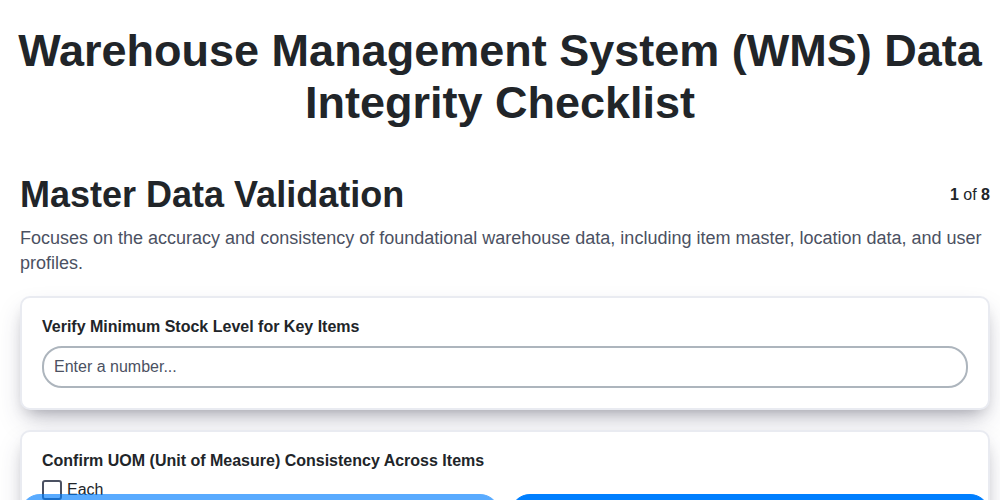
Warehouse Data Integrity: Your WMS Checklist Template
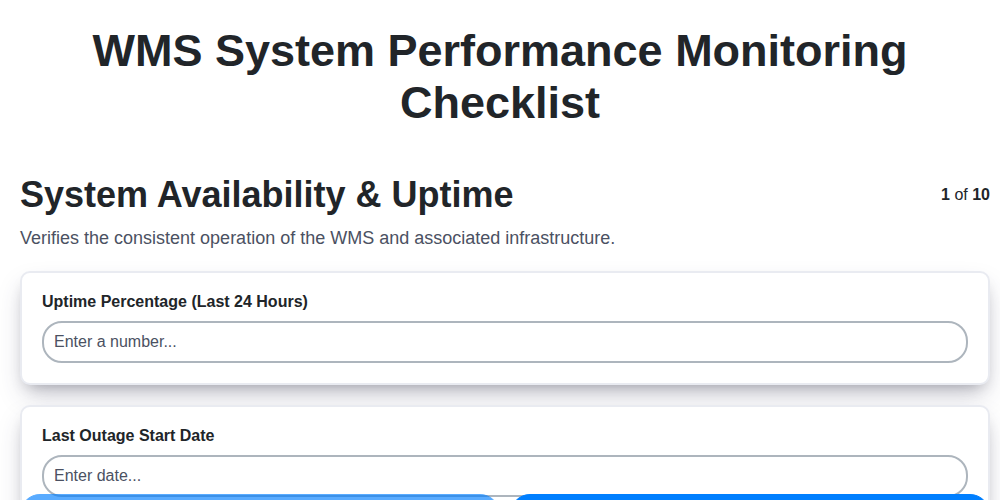
WMS System Performance Monitoring Checklist: A Comprehensive Guide
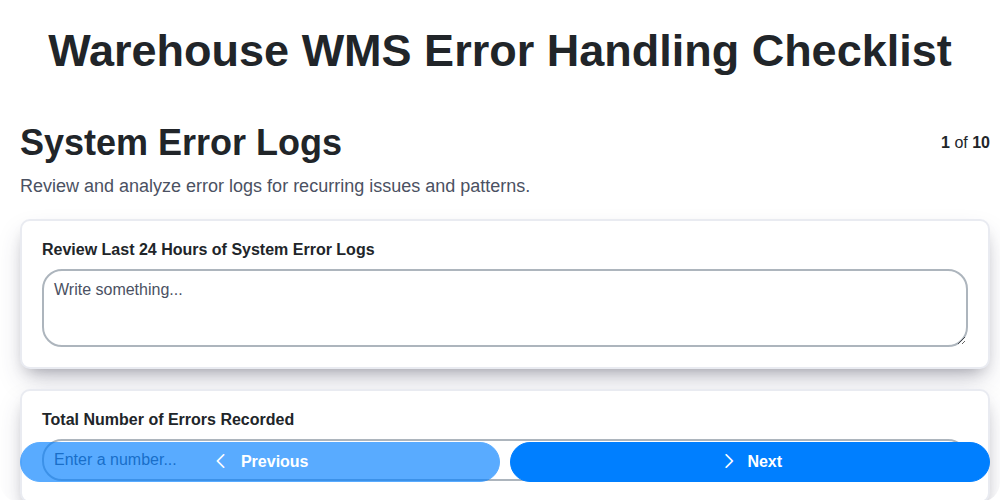
Warehouse WMS Error Handling Checklist: A Proactive Guide to Minimizing Disruptions
We can do it Together
Need help with
Warehouse Management System (WMS)?
Have a question? We're here to help. Please submit your inquiry, and we'll respond promptly.