Mastering Your BOM: A Comprehensive Checklist Template for Success
Published: 12/10/2025 10:00 PM Updated: 12/14/2025 7:52 AM
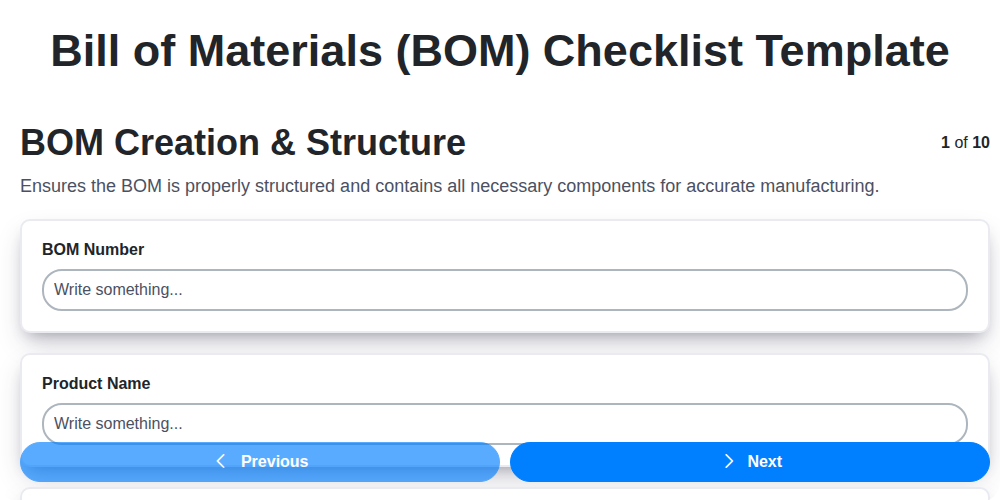
Table of Contents
- Introduction: Why a BOM Checklist is Essential
- 1. BOM Creation & Structure: Laying the Foundation
- 2. Part Number Validation: Ensuring Accuracy and Uniqueness
- 3. Quantity & Usage Definition: Precise Material Requirements
- 4. Supplier Information: Building a Reliable Supply Chain
- 5. Cost & Pricing Accuracy: Controlling Your Project Budget
- 6. Engineering Change Order (ECO) Integration: Managing Design Changes
- 7. Version Control & History: Tracking BOM Evolution
- 8. Classification & Categorization: Streamlining Information
- 9. Regulatory Compliance & Documentation: Meeting Industry Standards
- 10. BOM Approval Workflow: Establishing Accountability
- 11. Checklist Template: Your Guide to BOM Success
- Best Practices for BOM Management
- Common BOM Checklist Pitfalls to Avoid
- Conclusion: Achieving BOM Mastery
- Resources & Links
TLDR: Overwhelmed by Bills of Materials (BOMs)? This checklist template is your roadmap! It covers everything from initial creation and part validation to pricing accuracy, ECO integration, and version control. Use it to ensure your BOMs are accurate, complete, compliant, and ultimately, contribute to smoother production and reduced errors.
Introduction: Why a BOM Checklist is Essential
A Bill of Materials (BOM) is the backbone of any manufacturing operation. It's more than just a list of parts; it's a critical document detailing every component needed to build a product, along with its quantity, cost, and other vital information. However, a poorly managed BOM can lead to costly errors, production delays, and frustrated stakeholders. That's where a BOM checklist comes in.
Think of it as your quality control for your BOM. A well-defined checklist ensures consistency, accuracy, and completeness across all your BOMs, regardless of who's creating or updating them. It minimizes the risk of overlooking crucial details, reduces errors that can ripple through the supply chain, and ultimately, contributes to improved efficiency and profitability. Without a standardized process, you're relying on individual memory and potentially conflicting interpretations, which is a recipe for disaster. This checklist provides that necessary structure and accountability, allowing you to confidently manage your BOM and optimize your manufacturing processes.
1. BOM Creation & Structure: Laying the Foundation
A well-defined BOM structure is the bedrock of accurate manufacturing and efficient operations. This initial phase dictates how easily your BOM can be understood, updated, and leveraged throughout your organization. Start by establishing a clear hierarchical structure - consider a modular or kBAOM (knowledge-based assembly operations management) approach if appropriate for your product complexity. Define the levels of your BOM (e.g., top-level assembly, sub-assemblies, components, raw materials) and ensure consistent nomenclature across all entries. Clearly delineate the type of BOM you're using - whether it's an engineering BOM (EBOM), manufacturing BOM (MBOM), or a service BOM - and document the rationale for your choice. Avoid ambiguity by implementing standardized units of measure and clearly outlining the relationships between components and assemblies. A solid foundation here minimizes errors and streamlines downstream processes.
2. Part Number Validation: Ensuring Accuracy and Uniqueness
A seemingly small oversight in a part number can snowball into significant downstream problems - from incorrect orders and manufacturing errors to frustrated teams and delayed projects. Part number validation is, therefore, a critical step in BOM creation and deserves meticulous attention.
This isn't just about ensuring the part number is technically correct (e.g., adheres to your company's numbering system). It's about verifying its uniqueness across the entire organization and, ideally, comparing it to external databases where applicable.
Here's what should be included in your validation process:
- Format Compliance: Does the part number adhere to your defined format (e.g., alphanumeric, length restrictions, prefix requirements)? Automate checks for this whenever possible.
- Duplication Check: A robust search across your existing BOM database (and ERP system) is essential to avoid accidental duplicates.
- Meaningful Indication: Does the part number convey relevant information about the part? While not always possible, a well-structured part number can aid in identification and understanding.
- Lifecycle Stage: Does the part number reflect the part's lifecycle stage (e.g., prototype, active, obsolete)? Consider using prefixes or suffixes to denote this.
- Cross-Reference (where applicable): If your part is a substitute for a legacy part or a supplier part, record the cross-reference information within the BOM.
- Review and Approval: A second person should always review and approve part numbers before they are finalized.
Investing in a thorough part number validation process is an investment in the accuracy and efficiency of your entire supply chain. It reduces errors, streamlines operations, and ultimately, contributes to a more robust and reliable product.
3. Quantity & Usage Definition: Precise Material Requirements
Defining quantity and usage accurately within your BOM is crucial - it's the foundation for procurement, manufacturing, and cost control. Vague or inaccurate numbers here can ripple through your entire operation, leading to shortages, overstocking, and unnecessary expenses. This section isn't just about listing numbers; it's about understanding why each part is needed and how much is necessary for a functional end product.
Here's what to consider for a robust Quantity & Usage Definition:
- Functional Usage: Clearly state how the part is used in the assembly. Is it a critical component, a secondary fastener, or a cosmetic element? This context helps with future design changes and material substitutions.
- Unit of Measure (UOM): Be consistent. Specify the UOM for each part (e.g., each, piece, meter, kilogram). Inconsistent UOMs will cause headaches during ordering and production.
- Quantity Per Assembly (QPA): The most basic number - how many of this part are required for one finished product.
- Scrap Factor/Overage: Account for material loss during manufacturing. This might include trimming, machining loss, or defective parts. Defining a scrap factor prevents shortages.
- Sub-Assembly Quantities: For components used in sub-assemblies, ensure the quantities in the parent BOM align with the sub-assembly BOM.
- Phantom Parts: Clearly identify phantom parts - components that are consumed during assembly but don't become part of the final product. They need to be tracked correctly.
- Future Scalability: Consider potential variations in your product and whether the defined quantities are adaptable to future models or features.
By diligently defining quantity and usage, you move beyond simple numbers and build a BOM that supports accurate planning, efficient manufacturing, and reduced costs.
4. Supplier Information: Building a Reliable Supply Chain
A robust Bill of Materials (BOM) isn't just about listing components; it's a cornerstone of your supply chain efficiency and resilience. Accurate supplier information within your BOM is critical for procurement, inventory management, and ultimately, product delivery. This section focuses on what details should be included and why.
Essential Data Points:
- Supplier Name & Contact Details: Include the full legal name of the supplier, along with key contact information - name, title, phone number, and email address. Having multiple contacts is beneficial for redundancy.
- Part-Specific Supplier: Clearly identify which supplier is the designated source for each specific part listed in the BOM. This avoids ambiguity and ensures the correct component is ordered.
- Supplier Part Number: This is vital. The supplier's part number is what they use for ordering and tracking. Mismatches here are a significant source of errors.
- Lead Times: Accurate lead times from each supplier are crucial for production planning and avoiding delays. Regularly review and update these as supplier conditions change.
- Minimum Order Quantities (MOQs): Knowing the supplier's MOQs helps you optimize order sizes, minimize inventory costs, and avoid potential shortages.
- Supplier Rating/Performance Metrics: (Optional, but highly recommended) A system for rating supplier performance - on time delivery, quality, responsiveness - allows you to identify top performers and address areas for improvement.
- Contract Information: Reference to any contracts or agreements with the supplier should be included, providing visibility into pricing terms, service level agreements, and other key details.
Best Practices:
- Regularly Review & Update: Supplier information changes. Implement a schedule to review and update this data (at least annually, or more frequently if circumstances warrant).
- Centralized Data Management: Keep supplier information centralized, ideally within the BOM system itself, to ensure data consistency and accessibility.
- Supplier Collaboration: Consider sharing relevant BOM data with key suppliers to foster collaboration and improve communication.
5. Cost & Pricing Accuracy: Controlling Your Project Budget
A BOM is more than just a list of parts; it's a financial blueprint. Inaccurate cost and pricing data within your BOM directly impacts project budgeting, profitability, and ultimately, success. This section dives into ensuring the numbers are right.
Beyond Listed Prices: Don't just rely on the supplier's listed price. Factor in:
- Volume Discounts: Negotiate and document applicable discounts based on order quantity.
- Shipping Costs: Account for freight charges, import duties, and any related fees.
- Taxes: Factor in applicable sales tax or VAT.
- Currency Fluctuations: For international sourcing, consider currency exchange rate volatility and potentially hedge against unfavorable changes.
- Lead Times & Stock Availability: Unexpected lead time extensions or stock shortages can trigger expedited shipping and associated costs.
- Packaging & Handling: Include any costs associated with specialized packaging or handling requirements.
Regularly Review & Update: Supplier pricing isn't static. Implement a process for regularly reviewing and updating BOM costs (ideally quarterly or more frequently for volatile commodities). This could involve automated price feeds or manual checks against supplier quotes.
Cost Breakdown & Analysis: Maintain a detailed cost breakdown for each component, allowing for easy identification of areas where cost reductions can be achieved. This also facilitates value engineering exercises.
Impact of Errors: A single misplaced decimal point or outdated price can lead to significant cost overruns. Implement checks and balances within your BOM creation and approval process to minimize errors.
6. Engineering Change Order (ECO) Integration: Managing Design Changes
A robust Bill of Materials (BOM) isn't static; it evolves alongside your product's lifecycle. Engineering Change Orders (ECOs) are the formal process for managing these changes, and seamless integration between your BOM and ECO system is crucial for accuracy and minimizing disruption. Without it, you risk using outdated information, creating manufacturing errors, and potentially facing compliance issues.
Here's why ECO integration is vital and what to consider:
- Automated Updates: Ideally, ECO approval should trigger automatic updates to the BOM. This eliminates manual intervention, reduces the risk of human error, and ensures everyone is working with the latest version.
- Traceability: Link ECOs directly to the affected BOM items. This provides a complete audit trail, allowing you to understand why a change was made, who authorized it, and the impact it had.
- Impact Analysis: Before approving an ECO, assess its ripple effects on the BOM. This includes identifying all affected parts, assemblies, and downstream processes. Your system should highlight these dependencies.
- Workflow Automation: Connect the ECO approval workflow directly with BOM modification. Once an ECO is approved, the BOM should automatically update and notify relevant stakeholders (engineering, procurement, manufacturing).
- Version Control Synergy: ECOs should be tightly integrated with your BOM version control system. Each ECO should create a new BOM version, preserving historical data and allowing you to revert to previous states if necessary.
- Communication is Key: Automated notifications to all affected parties upon ECO approval and BOM updates are paramount. This ensures everyone is aware of the changes and their impact.
By integrating your BOM and ECO systems, you're not just managing changes; you're streamlining your product development and manufacturing processes.
7. Version Control & History: Tracking BOM Evolution
A Bill of Materials isn't a static document; it's a living record that changes throughout a product's lifecycle. Effective version control and a detailed history are crucial for understanding why changes were made, who made them, and what the impact of those changes were.
Without proper version control, you risk confusion, errors in manufacturing, and potential legal issues. Imagine a scenario where engineers are referencing an outdated BOM, leading to incorrect component sourcing or a finished product that doesn't meet specifications. It's a recipe for disaster!
Here's what you need for robust version control & history:
- Unique Version Numbers: Implement a clear, sequential numbering system (e.g., Rev A, Rev B, 1.0, 1.1) for each BOM revision.
- Timestamped Records: Every change should be timestamped, automatically if possible, providing a clear chronology of modifications.
- Change Author Identification: Record who made the change. This ensures accountability and allows for follow-up questions if needed.
- Change Description/Reason: Require a brief explanation for each change. Was it a cost reduction initiative? A design correction? A supplier change? The 'why' is just as important as the 'what.'
- Rollback Capability: Ideally, your system should allow reverting to previous BOM versions in case of errors or unforeseen consequences.
- Audit Trail: Maintain a comprehensive audit trail of all changes, allowing you to trace any issue back to its origin.
- Archiving: Properly archive older BOM versions, retaining them for reference and potential future recall situations.
By prioritizing version control and maintaining a detailed history, you're not just managing a list of parts; you're safeguarding your product's integrity, improving collaboration, and ensuring a smoother, more efficient production process.
8. Classification & Categorization: Streamlining Information
A well-defined classification and categorization system within your BOM is crucial for efficient information retrieval and analysis. It moves beyond simply listing parts; it establishes a logical structure that allows everyone - from procurement to manufacturing - to quickly understand the purpose and placement of each component.
Think of it as organizing a library. Without a Dewey Decimal System, finding a specific book would be a frustrating search. Similarly, a chaotic BOM is a bottleneck.
Consider these aspects:
- Hierarchical Structure: Implement a clear hierarchy. Start with top-level assemblies and break them down into sub-assemblies, components, and raw materials. This visual representation aids in understanding the product's construction.
- Standardized Categories: Develop standardized categories and sub-categories. Examples might include Electrical Components, Mechanical Fasteners, Raw Materials - Plastics, or Cables & Connectors. Consistency is key - use the same terminology across the entire BOM.
- Material Type Codes: Assign codes to identify the material type of each part (e.g., Metal, Plastic, Electronic). This simplifies material planning and procurement.
- Functional Categories: Group parts based on their function within the product (e.g., Power Supply, Display, User Interface). This is particularly useful for identifying potential cost-reduction opportunities or sourcing alternatives.
- Lifecycle Status: Categorize parts based on their lifecycle status (e.g., Active, Obsolete, Phase-Out). This provides valuable insights for planning replacements and managing obsolescence risks.
By implementing a robust classification and categorization system, you transform your BOM from a simple list into a powerful tool for data analysis, improved decision-making, and streamlined operations.
9. Regulatory Compliance & Documentation: Meeting Industry Standards
A robust Bill of Materials (BOM) isn't just about listing parts; it's a critical tool for demonstrating regulatory compliance and maintaining accurate documentation. Depending on your industry - whether it's aerospace, automotive, medical devices, or electronics - specific regulations and standards dictate how your products and their components are sourced, manufactured, and documented.
Your BOM should be designed to support this compliance. This means more than just listing parts; it means associating relevant compliance data directly with each entry. Consider the following:
- RoHS/REACH: Clearly indicate if materials comply with Restriction of Hazardous Substances (RoHS) and Registration, Evaluation, Authorisation and Restriction of Chemicals (REACH) directives. Include compliance certificates or declarations as supporting documentation linked to the BOM entry.
- Conflict Minerals Reporting: For certain industries, tracking the origin of minerals used in your components is mandatory. Your BOM should facilitate this traceability.
- FDA Compliance (Medical Devices): For medical devices, meticulous documentation and material traceability are paramount. The BOM plays a crucial role in demonstrating adherence to FDA regulations.
- ISO Standards: Align your BOM's structure and data fields to support ISO standards related to quality management (e.g., ISO 9001).
- Country of Origin: Accurately capture the country of origin for each part, especially important for import/export regulations and trade agreements.
- Material Safety Data Sheets (MSDS): Link MSDS documents to relevant BOM entries, ensuring accessibility for safety and handling information.
Beyond direct regulatory mandates, maintaining detailed and accessible documentation around your BOM is vital for audits, recalls, and continuous improvement efforts. Your BOM system should be capable of generating reports that demonstrate compliance and provide a clear audit trail. Regularly review and update your BOM's compliance information to reflect changes in regulations and supplier information.
10. BOM Approval Workflow: Establishing Accountability
A robust Bill of Materials (BOM) isn't just a document; it's a critical piece of your manufacturing process. To ensure its accuracy and usefulness, a well-defined BOM Approval Workflow is essential. This isn't just about getting someone to sign off on the BOM; it's about establishing clear roles, responsibilities, and approval thresholds at each stage of its lifecycle.
Here's why a structured approval workflow is vital and what it should encompass:
- Define Roles: Clearly assign responsibility for BOM creation, review, and approval. This often involves engineers, procurement specialists, manufacturing personnel, and potentially quality assurance representatives.
- Establish Approval Levels: Implement tiered approval levels based on BOM complexity, cost, or impact. Minor changes might require approval from an engineer, while significant changes affecting design or cost would necessitate senior management approval.
- Document Approval Criteria: Outline specific criteria that must be met before a BOM can be approved. This could include confirming accuracy, validating supplier information, and ensuring compliance with design specifications.
- Automate Notifications & Routing: Leverage your BOM management system (or a simple email system if you're starting out) to automate notifications and route the BOM for review and approval. This reduces delays and ensures no steps are missed.
- Maintain an Audit Trail: Your system should automatically track who approved the BOM, when they approved it, and any comments or concerns raised during the review process. This is crucial for traceability and accountability.
- Regular Review & Optimization: The approval workflow isn't set in stone. Periodically review the process to identify bottlenecks, inefficiencies, and areas for improvement.
A clearly defined and consistently followed BOM Approval Workflow protects your business from costly errors, improves collaboration, and reinforces the importance of data accuracy throughout the product lifecycle.
11. Checklist Template: Your Guide to BOM Success
Creating and maintaining an accurate Bill of Materials (BOM) is critical for efficient manufacturing, cost control, and overall project success. But where do you start? A comprehensive checklist ensures no crucial element is overlooked. Here's a breakdown of the key areas and what you should be verifying within your BOM. Download our free BOM Checklist Template at the end of this article to streamline your process!
Here's a detailed look at the components of a robust BOM checklist:
1. BOM Creation & Structure: Is your BOM logically structured? Consider using hierarchical levels to represent assemblies and sub-assemblies clearly. Is the BOM format (e.g., tabular, modular) appropriate for your needs and systems? Does it include necessary fields like part description, unit of measure, and reference designators?
2. Part Number Validation: Are all part numbers accurate and cross-referenced? Are they linked to your internal systems (ERP, PLM) and vendor catalogs? Regularly check for obsolete or superseded parts.
3. Quantity & Usage Definition: Does the BOM accurately reflect the required quantity of each part per assembly? Is the usage clearly defined - e.g., "used in sub-assembly A, quantity 2"?
4. Supplier Information: Is the preferred supplier for each component clearly identified? Include contact details and any relevant agreement numbers.
5. Cost & Pricing Accuracy: Are the current costs of all parts accurately reflected in the BOM? Regularly review and update pricing to avoid budget surprises. Include lead times, if applicable.
6. Engineering Change Order (ECO) Integration: Is the BOM process integrated with your ECO system? Does the BOM automatically update when changes are implemented?
7. Version Control & History: Is there a robust version control system in place? Are all changes meticulously documented with timestamps and author information? Ensure easy access to historical BOM versions.
8. Classification & Categorization: Are parts classified and categorized appropriately for reporting, analysis, and procurement efficiency? Use standardized categories when possible.
9. Regulatory Compliance & Documentation: Does the BOM include all information required for regulatory compliance (e.g., RoHS, REACH)? Are necessary certifications documented?
10. BOM Approval Workflow: Is there a defined approval process that ensures accuracy and prevents unauthorized changes? Who is responsible for approving each BOM version?
11. Regular Audits: Schedule periodic audits to verify BOM accuracy and identify areas for improvement.
Best Practices for BOM Management
A robust Bill of Materials (BOM) is the backbone of efficient product development and manufacturing. Simply having a BOM isn't enough; it needs to be actively managed and consistently updated. Here's a breakdown of best practices to elevate your BOM management processes:
Embrace a Centralized System: Ditch the spreadsheets (or at least, significantly reduce their use!). A centralized, cloud-based Product Lifecycle Management (PLM) or Enterprise Resource Planning (ERP) system provides a single source of truth for your BOM data, improving collaboration and reducing errors.
Establish Clear Roles & Responsibilities: Define who is responsible for creating, updating, approving, and maintaining the BOM. This prevents confusion and ensures accountability. Consider designating a BOM owner for each product or product line.
Automate Where Possible: Leverage automation to streamline repetitive tasks like part number validation, cost updates, and ECO integration. This frees up your engineers and buyers to focus on more strategic activities.
Regularly Audit Your BOM: Periodically review your BOM to identify inaccuracies, obsolete parts, and opportunities for improvement. This is especially crucial after design changes or component price fluctuations.
Foster Cross-Functional Collaboration: The BOM isn't just an engineering document. It impacts procurement, manufacturing, and costing. Encourage open communication and collaboration between these departments to ensure the BOM accurately reflects the product and its lifecycle.
Implement a Robust Approval Workflow: Don't allow changes to the BOM without proper authorization. A clearly defined approval workflow ensures that changes are reviewed and validated before they're implemented.
Train Your Team: Provide comprehensive training on BOM management best practices and the tools used to manage them. This minimizes errors and maximizes efficiency.
Think Long-Term: Consider the entire product lifecycle when managing your BOM. Plan for obsolescence, component changes, and future design iterations.
Common BOM Checklist Pitfalls to Avoid
Creating a robust Bill of Materials (BOM) is critical for efficient manufacturing and product lifecycle management. However, even with a detailed checklist, common pitfalls can derail your efforts. Here's what to watch out for:
- Treating the BOM as a Static Document: A BOM isn't a one-and-done deal. It's a living document that needs regular updates as designs evolve, suppliers change, or costs fluctuate. Failing to recognize this leads to inaccuracies and inefficiencies.
- Lack of Cross-Department Collaboration: BOM creation rarely happens in a vacuum. Engineering, Procurement, Manufacturing, and even Sales often have input. Insufficient communication between these departments often results in missed details or conflicting information.
- Insufficient Part Number Validation: Simply accepting part numbers at face value is a recipe for disaster. Verify that part numbers are current, accurate, and sourced directly from the supplier or manufacturer. Misleading part numbers can halt production.
- Ignoring Usage Context: Defining quantity and usage isn't just about a number - it's about how the part is used. Failing to capture usage context can lead to incorrect ordering or assembly errors. For example, is a fastener used for a primary or secondary function?
- Neglecting Supplier Lead Times: Cost is crucial, but so is availability. Omitting supplier lead times in the BOM prevents proactive planning and can lead to production delays.
- Poor ECO Integration: Engineering Change Orders (ECOs) directly impact the BOM. A disconnected ECO process means the BOM quickly becomes outdated, leading to confusion and potentially defective products.
- Insufficient Version Control: Without clear version control, it's impossible to track changes and identify the correct BOM revision for specific production runs or engineering projects. This leads to confusion and potential errors.
- Overlooking Regulatory Requirements: For regulated industries, neglecting to document compliance information within the BOM is a significant risk. This can lead to recalls, fines, and damage to your brand reputation.
Conclusion: Achieving BOM Mastery
Ultimately, a robust Bill of Materials isn't just a list - it's the backbone of your product lifecycle. By diligently following a comprehensive BOM checklist, like the one we've outlined, you move beyond basic data tracking and begin to achieve BOM mastery. This means improved accuracy, reduced errors, streamlined processes, and, crucially, greater control over your product costs and timelines. Don't view this checklist as a burden, but as an investment - an investment in efficiency, quality, and a competitive edge. Continuously review and refine your BOM processes, integrating feedback and adapting to evolving product complexities. The journey to BOM mastery is ongoing, but the rewards - from increased profitability to enhanced customer satisfaction - are well worth the effort.
Resources & Links
- PTC Windchill: A comprehensive Product Lifecycle Management (PLM) system, Windchill offers robust BOM management capabilities, including version control, workflows, and data integration. It's a good example of a platform integrating many BOM functionalities. Explore features like electronic BOMs, change management, and supplier collaboration.
- Oracle PLM: Similar to PTC, Oracle PLM provides extensive BOM management tools, supporting complex product structures and collaborative processes. Their BOM tools cover design, manufacturing, and service, providing a unified view.
- Propel PLM: Focuses on flexibility and adaptability for BOM management, often suitable for companies with unique or evolving product requirements. Offers BOM authoring, revision control, and integration with ERP systems.
- Dassault Systèmes 3DEXPERIENCE: Provides a wide range of PLM tools, including advanced BOM management for complex products and assemblies. Focuses on a collaborative, data-driven product development environment. Check their product lifecycle management suite.
- Autodesk Vault: Designed for manufacturers, Autodesk Vault provides version control and data management, with BOM capabilities integrated for engineering workflows. Often chosen for its ease of use within Autodesk's design ecosystem.
- SAP PLM: SAP's PLM solution offers comprehensive BOM management, tightly integrated with their ERP system. This integration is crucial for synchronizing product data across design, manufacturing, and business processes. Explore their BOM authoring and change management features.
- Smartsheet: A versatile online platform with spreadsheet-like functionality. While not a dedicated PLM, it can be used effectively to create and manage BOM checklists and track progress, especially for smaller projects or teams. Good for initial checklist creation and simple tracking.
- Microsoft Excel: A ubiquitous spreadsheet program. While it lacks the full capabilities of a PLM system, Excel can be used to create basic BOM checklists and track data. Ideal for very small businesses or initial concept checklists.
- ISO (International Organization for Standardization): Explore ISO standards related to quality management (e.g., ISO 9001) and product realization. Understanding these standards is important for ensuring BOM accuracy and compliance.
- NIST (National Institute of Standards and Technology): Offers resources and standards related to manufacturing and product data management. Important for understanding US-based regulatory requirements that can affect BOM compliance.
- MES (Manufacturing Execution Systems): MES systems often integrate with BOMs to track material consumption and production processes. Understanding how BOM data feeds into manufacturing execution is important for accuracy and efficiency.
- The IA (The Information Architecture): The Information Architecture focuses on structured information management, a critical aspect of effective BOM organization and classification. Offers guidance on data modeling and taxonomies.
- ASQ (American Society for Quality): Provides resources and training on quality management principles. Understanding quality control processes is crucial for ensuring BOM accuracy and preventing errors.
- GoLeanSixSigma: Lean Six Sigma principles can be applied to BOM management to streamline processes, reduce waste, and improve accuracy. Focuses on process improvement within your BOM workflow.
Frequently Asked Questions
What is a BOM and why is it important?
BOM stands for Bill of Materials. It's a comprehensive list of all the raw materials, components, assemblies, subassemblies, intermediate assemblies, and the quantities of each required to manufacture a product. It's crucial for accurate cost estimation, procurement, manufacturing planning, and inventory management - essentially, it's the recipe for your product.
Who should use this BOM checklist template?
This checklist is designed for anyone involved in product creation, including engineers, manufacturing managers, procurement specialists, production planners, and anyone responsible for managing product components and materials.
What kind of products can this BOM checklist be used for?
This checklist is versatile and can be used for a wide range of products, from simple consumer goods to complex machinery and electronics. It's adaptable to various industries and manufacturing processes.
What's included in the BOM checklist template?
The template covers key areas such as component identification, material specifications, supplier information, cost details, revision control, and more. It provides a structured approach to ensure all essential BOM elements are accounted for.
Is the checklist customizable? Can I add or remove sections?
Yes, absolutely! The template is designed to be flexible. You can easily add or remove sections, add custom fields, and adjust the level of detail to match your specific product and business requirements. We encourage you to tailor it to your needs.
How does this checklist help with cost control?
By providing a detailed breakdown of all materials and components, the checklist allows for accurate cost estimation and tracking. You can readily identify cost drivers and explore opportunities for optimization or alternative sourcing.
What is revision control and why is it important in a BOM?
Revision control tracks changes made to the BOM over time. It's vital for maintaining accuracy, managing product changes, and ensuring everyone is working with the correct version. The checklist includes fields for tracking revisions and change history.
How can this checklist improve collaboration between different departments?
A centralized and well-structured BOM, facilitated by this checklist, promotes clear communication and coordination between engineering, procurement, manufacturing, and other departments. It provides a single source of truth for product information.
Found this Article helpful?
Comments
There are no comments yet. Be the first to add one!
BOM - Bill of Materials Management Solution Demo
Struggling with inaccurate BOMs & costly errors? ChecklistGuro provides a centralized BOM Management solution, connecting your design, engineering, & manufacturing teams for improved collaboration and control. Simplify operations & boost efficiency.
Related Articles
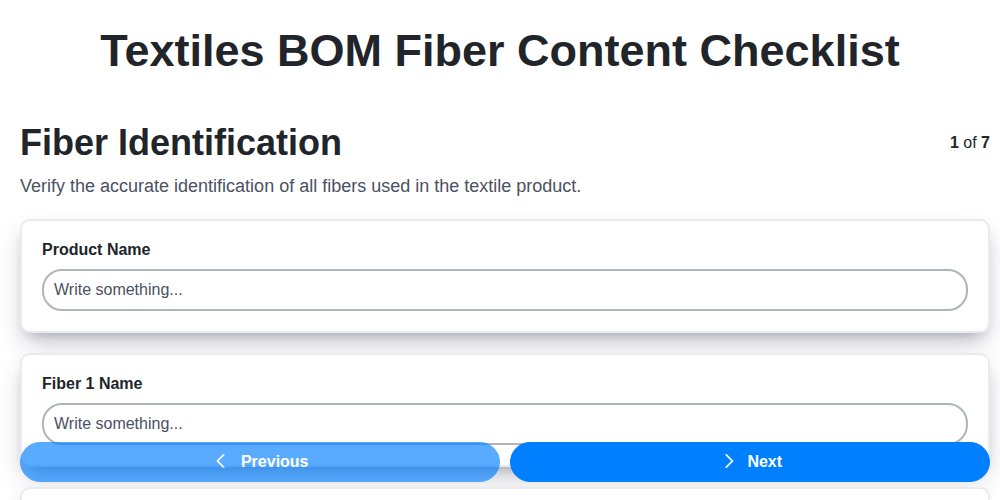
Mastering Textiles: Your Fiber Content Checklist for BOM Accuracy
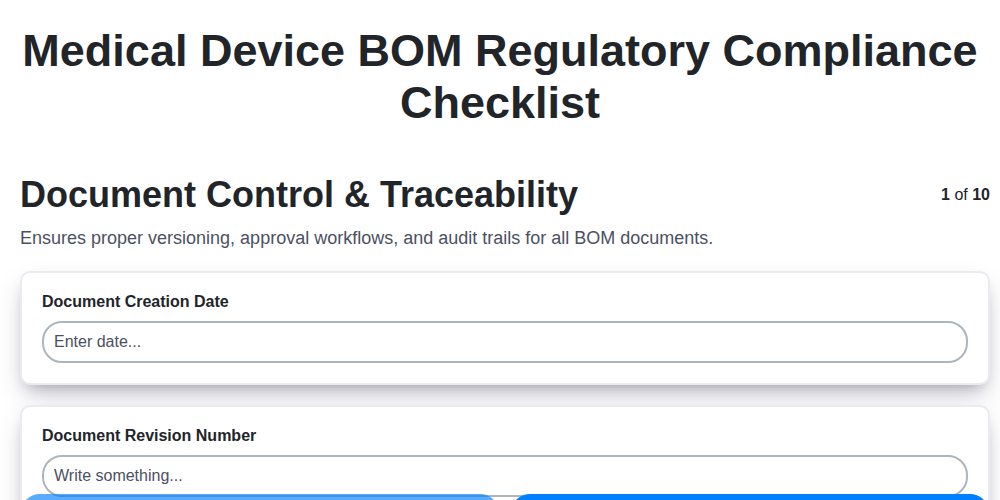
Navigating Medical Device BOM Regulatory Compliance: Your Essential Checklist
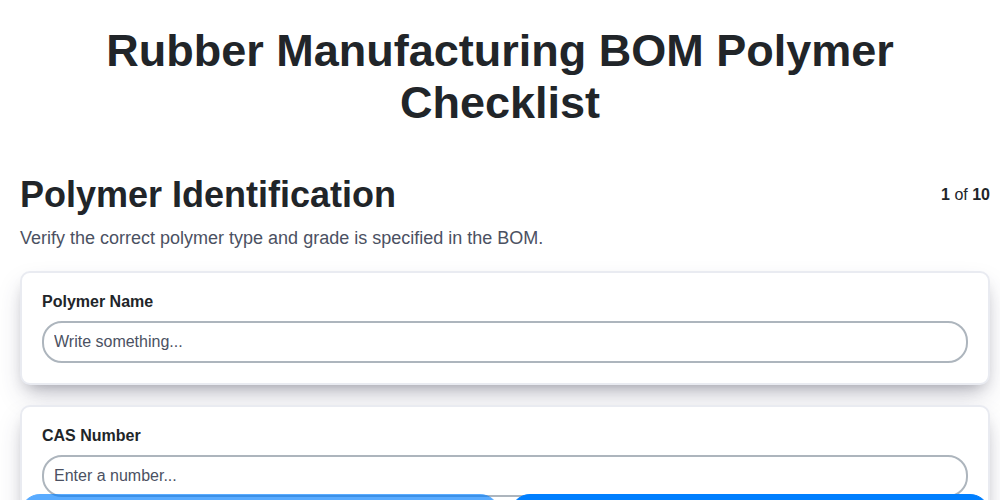
Ensuring Quality: Your Rubber Manufacturing Polymer BOM Checklist Guide
Mastering Leather Manufacturing: Your Tannery BOM & Compliance Checklist
Decoding Origins: Your Construction Materials BOM Origin Checklist Guide
The Ultimate Retail BOM Product Definition Checklist: A Step-by-Step Guide
Ensuring Success: Your Oil & Gas BOM Component Approval Checklist Guide
The Ultimate Logistics BOM Packaging Checklist: Ensuring Safe & Efficient Shipments
We can do it Together
Need help with
Bill of Materials (BOM) Management?
Have a question? We're here to help. Please submit your inquiry, and we'll respond promptly.