Mastering Clay: Your Ceramics BOM Clay Composition Checklist Guide
Published: 12/10/2025 10:00 PM Updated: 12/14/2025 7:56 AM
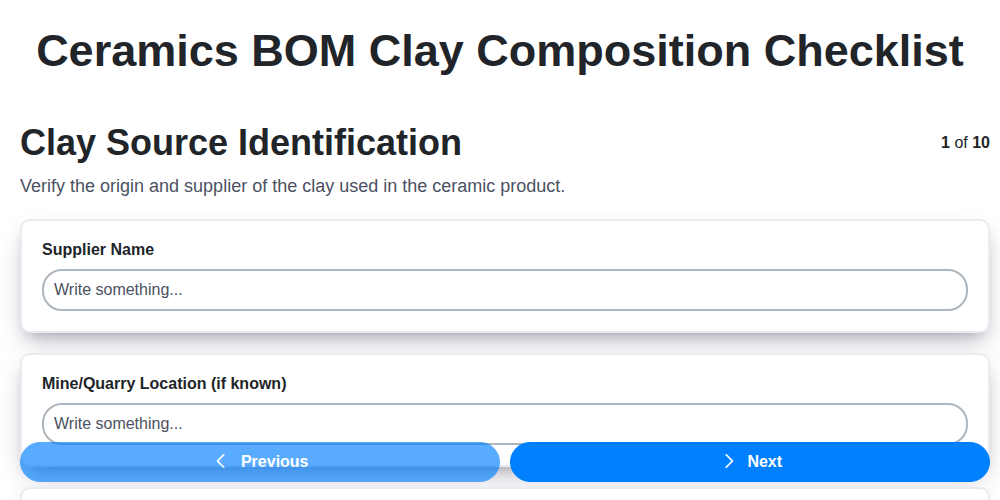
Table of Contents
- Introduction: Why a Clay BOM is Essential
- What is a Ceramics Bill of Materials (BOM)?
- Clay Source Identification: Knowing Your Origin
- Mineralogical Analysis: Unveiling the Clay's Building Blocks
- Particle Size Distribution: The Key to Texture and Firing
- Organic Content: Assessing Potential Issues
- Impurity Analysis: Identifying Problematic Elements
- Water Content: A Critical Factor in Workability
- pH Level: Impact on Glaze Compatibility
- Plasticity and Workability: Assessing Feel and Formability
- Consistency with Specification: Ensuring Batch-to-Batch Uniformity
- Documentation & Traceability: Maintaining a Record
- Interpreting Your Clay Analysis Results
- Beyond the Checklist: Continuous Improvement
- Resources & Links
TLDR: Ever worried about inconsistent clay affecting your ceramics? This checklist is your solution! It guides you through analyzing your clay - from source to final properties (mineral content, particle size, water, plasticity, etc.) - ensuring quality control and repeatability in your ceramic creations. Think of it as a clay recipe guarantee!
Introduction: Why a Clay BOM is Essential
Understanding your clay is the cornerstone of successful ceramics. It's far more than just digging up some dirt - it's about knowing its very nature. A Clay Bill of Materials (BOM) isn't just a nice-to-have; it's a need for predictable and repeatable results. Without a thorough understanding of your clay's properties, you're essentially throwing darts in the dark, hoping for a good firing. Inconsistent clay composition leads to unpredictable shrinkage, cracking, warping, and ultimately, wasted materials and frustrated potters. A comprehensive Clay BOM, built around a rigorous checklist of characteristics, provides the transparency and control necessary to ensure quality, consistency, and ultimately, stunning ceramic creations. This isn't just about avoiding failure; it's about optimizing your clay's potential and achieving your artistic vision with confidence.
What is a Ceramics Bill of Materials (BOM)?
A Ceramics Bill of Materials (BOM) is a comprehensive list detailing all the raw materials and components required to produce a ceramic product. Think of it as the recipe for your ceramics - it goes far beyond simply stating clay. It's a critical document for consistent quality control, repeatability, and traceability in ceramic manufacturing. This BOM isn't just a shopping list; it meticulously outlines the specific properties of each ingredient, ensuring that every batch of clay or glaze yields predictable and desirable results. It's especially important for larger studios, production facilities, or anyone aiming for consistent outcomes across multiple firings and over time. A well-crafted BOM moves beyond generic terms and specifies details like clay source, mineralogical composition, particle size, and even levels of organic matter - all of which can significantly impact the final product.
Clay Source Identification: Knowing Your Origin
The foundation of any successful ceramic project begins with understanding where your clay comes from. Simply put, knowing your clay source is paramount. It's far more than just knowing the geographic location; it's about understanding the geological history and how that impacts the clay's properties.
Different regions boast unique clay deposits, formed by distinct weathering processes and mineral compositions. A clay from the Mississippi Delta will behave very differently from one sourced from the Scottish Highlands, for example. These differences manifest in everything from firing color and shrinkage rates to workability and overall strength.
Before even considering other analyses, meticulously document the clay's origin. This includes:
- Detailed Location: Note the specific quarry, mine, or supplier. Precise GPS coordinates are ideal.
- Geological Formation: Research the geological formation the clay was extracted from. This provides crucial context about its mineralogical makeup.
- Supplier Information: Keep detailed records of the supplier, including contact information and any available geological reports.
- Lot Number/Batch ID: Every batch should have a unique identifier to ensure traceability.
Knowing the source allows you to anticipate potential issues, replicate successful results, and ultimately, produce ceramics with predictable and desirable qualities. Don't underestimate the power of a well-documented clay origin - it's your first step towards ceramic mastery.
Mineralogical Analysis: Unveiling the Clay's Building Blocks
Understanding the mineralogical makeup of your clay is crucial for predictable and repeatable ceramic results. It's not enough to simply know what clay you're using; you need to know what's in it. This analysis goes beyond identifying the dominant clay minerals (like kaolinite, illite, and smectite) and delves into the presence of other contributing minerals.
We use techniques like X-ray Diffraction (XRD) and potentially Scanning Electron Microscopy (SEM) with Energy-Dispersive X-ray Spectroscopy (EDS) to identify these components. The presence of quartz, feldspar, mica, or iron oxides, for example, will significantly influence firing behavior, color development, and the final properties of the ceramic piece.
For instance, a high quartz content might lead to warping during drying or firing, while iron oxides contribute to color and can impact thermal shock resistance. Knowing these details allows you to tailor your firing schedule, blending strategies, and overall formulation to achieve the desired outcomes. A detailed mineralogical report provides a solid foundation for understanding your clay's potential and how to best utilize it.
Particle Size Distribution: The Key to Texture and Firing
Particle size distribution (PSD) is arguably one of the most critical factors influencing the behavior and final outcome of your ceramic pieces. It's not just about having "small" or "large" particles; it's about how many of each size are present. This distribution dictates everything from the clay's plasticity and workability to the fired texture and potential for cracking.
Why does PSD matter so much? Different sized particles contribute differently to the clay body. Fine particles (think silt and clay) provide plasticity and hold water, allowing the clay to be molded and shaped. Medium-sized particles (sand) add strength and can contribute to visual texture. Larger particles (grit) add significant visual interest and potentially influence firing behavior.
An unbalanced PSD - too many large particles, for example - can lead to poor plasticity, excessive shrinkage, and stress cracking during drying and firing. Conversely, a PSD dominated by extremely fine particles can result in a sticky, difficult-to-work-with clay.
When analyzing PSD, we're looking for a range, not a single number. The ideal distribution depends heavily on the intended application - a porcelain body will require a different PSD than a stoneware or earthenware. Understanding the PSD allows you to predict how the clay will behave at each stage of the process, enabling you to adjust the recipe accordingly and achieve consistent, predictable results. Modern techniques like laser diffraction provide detailed PSD data, providing invaluable insight into the clay body's composition and its potential for success.
Organic Content: Assessing Potential Issues
Organic content in clay bodies, while seemingly insignificant, can significantly impact firing behavior and the final ceramic product. These organics are primarily derived from decaying plant matter incorporated into the clay during its geological formation. While a small amount is generally unavoidable and can even contribute to desirable properties like increased plasticity, excessive organic content presents a range of potential problems.
During firing, organics decompose, releasing gases. This can lead to bloating, cracking, or even explosions, particularly in thicker pieces or complex forms. The type and amount of organic matter dictate the nature and severity of these issues. Lighter-colored clays often have a higher organic content, as dark coloration often indicates iron oxides rather than decaying plant material.
Routine analysis for organic content, typically measured as Loss on Ignition (LOI), is crucial. LOI involves heating a weighed sample of clay to a high temperature (usually around 600-900°C) and weighing it again after the volatile components, including organics, have been driven off. A typical range might be 1-5%, but values above 5% warrant further investigation.
If elevated organic content is identified, strategies include:
- Blending: Mixing the problematic clay with a lower-organic clay.
- De-organizing: Employing techniques like prolonged wedging or adding calcined materials (e.g., calcined clay, grog) to break down organic structures.
- Controlled Firing: Adjusting firing schedules to allow for gradual gas release.
Careful monitoring and adjustments based on LOI results are essential for consistent and reliable ceramic production.
Impurity Analysis: Identifying Problematic Elements
Beyond the major components that define your clay body, the presence of impurities can significantly impact firing behavior, glaze compatibility, and the overall aesthetic and structural integrity of your ceramics. These impurities, often present in trace amounts, can originate from the clay source itself - carried in from the surrounding geological environment - or introduced during processing.
Identifying and understanding these impurities is crucial for consistent and predictable results. Common problematic impurities include iron (which can cause speckling or color changes), calcium (which can affect glaze surfaces and body interactions), alkalis (sodium, potassium - influencing glaze melting points and body shrinkage), and manganese (which contributes to dark coloration).
Analysis methods typically involve techniques like X-ray Fluorescence (XRF) spectroscopy, which provides a quantitative elemental composition. Visual inspection, particularly after firing, can also reveal clues - for example, dark speckles often indicate iron oxides. The results of impurity analysis should be carefully compared against known thresholds for acceptable levels within your specific clay body recipe. If impurities exceed these limits, consider sourcing a different clay body or implementing purification processes, though the latter can be complex and costly. Thorough documentation of impurity levels alongside other clay body data is essential for reproducibility and troubleshooting.
Water Content: A Critical Factor in Workability
Water content is arguably one of the most frequently adjusted element in a ceramic body recipe, and for good reason. It's the keystone to achieving optimal plasticity and workability - the very qualities that allow us to throw, handbuild, and sculpt with clay. Too little water and your clay will be stiff and unyielding, prone to cracking and failure. Too much, and you'll be dealing with a slumping, weak mass that's difficult to control.
Determining the water content accurately isn't just about a quick feel test. While experience plays a role, it's crucial to employ reliable measurement techniques, ideally using a moisture analyzer. This provides a precise percentage, typically expressed as a percentage of the dry clay weight.
The ideal water content varies significantly based on clay source, mineralogy, and desired firing temperature. A clay body rich in fine particles will generally require less water than one with coarser grains. Remember that organic matter can also drastically affect water absorption, leading to a higher apparent water content than what's truly necessary for plasticity.
Consistency is key. Document your water content measurements alongside other clay characterization data. This allows for replication of successful batches and troubleshooting any issues that might arise. Minor fluctuations can impact your entire production run, so meticulous record-keeping here is invaluable.
pH Level: Impact on Glaze Compatibility
The pH level of your clay body significantly impacts glaze compatibility. Clay pH is measured on a scale of 1-14, with 7 being neutral. Most clay bodies fall within a slightly acidic to slightly alkaline range (pH 5-9). However, even small variations can influence how your glaze matures and adheres to the clay.
A clay body with a low pH (acidic) tends to require glazes with a higher pH to ensure proper bonding and prevent issues like crazing (fine cracks in the glaze) or shivering (glaze peeling). Conversely, an alkaline clay body may work best with glazes having a lower pH.
Understanding your clay's pH allows you to make informed glaze choices. Glaze recipes often specify a compatible pH range. While testing is always recommended (more on that below!), knowing the general pH of your clay body narrows down your glaze selection and increases your chances of a successful firing.
Testing and Adjustment: A simple pH meter or pH test strips can easily measure your clay's pH. If necessary, you can adjust the pH slightly using additives, but proceed with caution and always test small batches first. It's generally better to choose a clay body that aligns with your desired glaze chemistry rather than attempting significant pH alterations.
Plasticity and Workability: Assessing Feel and Formability
Beyond the quantifiable data from mineralogy and particle size, the feel of your clay is critical. Plasticity and workability describe how the clay responds to pressure and manipulation - essentially, how easily it can be shaped and held without cracking or slumping. This is a subjective assessment, but incredibly important and should be documented alongside the objective data.
What to Look For:
- Plasticity: Refers to the clay's ability to be deformed without cracking or breaking. A highly plastic clay will stretch and mold easily.
- Workability: Encompasses how smoothly the clay responds to pressure and the ease with which it can be shaped into complex forms. It's about the 'feel' - does it feel sticky, buttery, or crumbly?
Testing Methods & Observations:
- The Roll Test: Roll a small ball of clay into a coil. A good clay will roll smoothly and evenly without cracking. Observe the thickness of the coil and how easily it maintains its shape.
- The Cone Test: Form a cone shape and gently press it to see how much it slumps. Less slump generally indicates better workability.
- Hand Feel: Experienced ceramicists rely heavily on feel. Note the clay's stickiness, texture (smooth, gritty, etc.), and how it behaves under pressure. Does it feel resistant, yielding, or overly soft?
- Drying Behavior: Observe how the clay dries over a few days. Does it warp, crack, or shrink excessively?
Documentation:
Record your observations in detail. Rather than simply writing good or bad, use descriptive language. Examples: Very plastic - stretches easily, minimal cracking during rolling. Or, "Somewhat crumbly; requires more water to achieve workability." These notes will be invaluable for batch consistency and troubleshooting. Remember that environmental factors (humidity, temperature) can influence feel, so note these conditions during testing.
Consistency with Specification: Ensuring Batch-to-Batch Uniformity
The beauty of ceramics lies in its predictability and reliability. A stunning glaze effect achieved on one piece shouldn't be a fluke; it should be repeatable. Achieving that repeatability starts with a rigorous understanding and adherence to specifications throughout the clay body formulation process. This "Consistency with Specification" step isn't just a formality; it's the gatekeeper for quality control.
Once all the individual analyses (clay source, mineralogy, particle size, etc.) are completed, it's time to compare those results against your predetermined specification sheet. This sheet should clearly outline acceptable ranges for each measured parameter - for example, a minimum percentage of kaolinite, a targeted plasticity value, or a maximum allowable iron oxide content.
Deviations from these specifications, even seemingly minor ones, can impact firing behavior, glaze compatibility, and the final aesthetic and functional properties of your ceramic pieces. A slight difference in water content can affect drying rates and lead to cracking. An unexpected impurity might introduce unwanted color changes during firing.
The comparison process often involves creating a detailed report that highlights any out-of-spec results. This report isn't meant to assign blame; it's a critical tool for identifying potential issues and implementing corrective actions. Perhaps a new supplier is needed, a different blending technique is required, or adjustments to the formulation itself are necessary.
Regularly revisiting and updating your specifications - especially when introducing new materials or suppliers - is crucial. This ensures that your clay body consistently delivers the desired results, batch after batch, leading to predictable, beautiful, and durable ceramics.
Documentation & Traceability: Maintaining a Record
Maintaining meticulous documentation and ensuring traceability is paramount in ceramics, especially when working with clay. It's not enough to simply create a beautiful piece; you need to understand why it behaves the way it does and be able to replicate that success (or troubleshoot failures).
This begins with a dedicated logbook or digital system to record every step of the clay testing process. Each analysis - from the initial mineralogical assessment to the final plasticity test - should be documented with date, analyst, methodology used, and results. Don't just record the numbers; add qualitative observations! Did the clay feel unusually sticky during the plasticity test? Was the mineralogical analysis challenging due to a particular grain structure? These details can be invaluable later on.
Batch numbers are critical. Assign a unique identifier to each clay source and subsequent batches. This allows you to link specific firing issues, cracking, or color variations back to the original clay source and its specific characteristics. Imagine being able to say, Batch 2023-07-15 of this clay showed exceptional green strength, while later batches exhibited more shrinkage? That's the power of traceability.
Furthermore, retain all raw material certificates from your clay supplier. These documents serve as a baseline for comparison and can help identify any deviations in quality over time. Regularly review your documentation, update your processes based on learnings, and consider implementing a system for sample retention - a small, labeled sample from each batch should be stored for future reference. Ultimately, robust documentation and traceability are not just good practice; they're essential for consistent quality, problem-solving, and advancing your ceramics knowledge.
Interpreting Your Clay Analysis Results
Understanding the numbers and descriptions from your clay analysis can feel overwhelming at first, but it's the key to consistent and predictable results in your ceramics. Let's break down what each element of your checklist reveals.
Mineralogical Analysis: This isn't just about identifying what's present (kaolinite, illite, quartz, feldspar, etc.). The proportion of each mineral dictates firing behavior, color development, and overall body strength. High quartz content, for example, might lead to bloating during firing if not properly managed.
Particle Size Distribution: This is critical for plasticity. A balanced range of particle sizes-from large to very fine-allows for good binding and workability. Too much coarse material results in a gritty feel and poor green strength; too much fine material can lead to excessive shrinkage and cracking. Look for a distribution that supports your intended forming method (wheel throwing, handbuilding, slip casting).
Organic Content: While a small amount of organic material is unavoidable, higher levels can cause black coring or blistering during firing. It's often a sign of poor sourcing or contamination.
Impurities Analysis: Identifying impurities like iron oxides (which affect color) or calcium carbonate (which can cause efflorescence) is crucial for predicting glaze compatibility and potential firing issues. Knowing what's present allows you to compensate with glaze adjustments or firing schedules.
Water Content: This impacts plasticity and shrinkage. Track it carefully, as variations can significantly alter your throwing or handbuilding experience.
pH Level: Clay pH can influence glaze reactions. Slightly acidic clays are generally more stable with a wider range of glazes.
Plasticity and Workability: This isn't just a number; it's your subjective experience confirmed by the other data. Do the quantitative results correlate with how the clay feels? This provides invaluable feedback.
Consistency with Specification: Did your analysis meet the requirements outlined in your clay specification? If not, investigate the source and adjust accordingly.
Ultimately, a complete clay BOM (Bill of Materials) and thorough checklist like this is about understanding your raw material and ensuring predictability in your ceramic process. It's a foundation for consistent results and allows you to experiment with confidence.
Beyond the Checklist: Continuous Improvement
While this detailed checklist provides a robust foundation for ensuring consistent clay body performance, it's crucial to view it as a starting point, not a finish line. Ceramics is an art and a science, and subtle variations in clay behavior can significantly impact firing outcomes and final product quality. Simply completing the checklist once isn't enough.
Think of it as establishing a baseline. Regularly revisiting these tests - perhaps quarterly, or whenever you introduce a new batch of clay - will allow you to identify trends and proactively address potential issues. Unexpected results, even within acceptable ranges, can be valuable learning opportunities. Perhaps a slight shift in particle size distribution consistently leads to minor cracking during drying; understanding this connection allows you to adjust firing schedules or add deflocculants.
Furthermore, consider expanding your analysis. Observe the clay's behavior throughout the entire process - from wedging and throwing to bisque firing and glazing. Record these observations alongside your checklist data. This holistic approach creates a richer understanding of your clay body and allows for continuous improvement, leading to more predictable and beautiful ceramic pieces. Ultimately, the best clay body is one that's not just characterized, but understood.
Resources & Links
- Ceramic Source: A comprehensive resource for ceramic materials, including clay bodies. They offer technical data sheets, articles, and a forum for discussion - a great starting point for understanding clay composition and properties. Provides raw material information and potential suppliers.
- Skutt Pottery Equipment: While primarily an equipment supplier, Skutt often publishes articles and technical guides related to ceramics, sometimes touching on clay body formulations and properties. Look for their technical support sections.
- Big Jim's Clay: Big Jim's offers a variety of clay bodies and frequently provides detailed technical data sheets for each, including mineral composition, firing range, and shrinkage rates. Helpful for understanding the practical implications of different clay formulations.
- Dekalb Potters Supply: Another reputable supplier, Dekalb Potters Supply, provides detailed product information on their clays and offers valuable resources on clay body selection and usage, often referencing material properties.
- Clay Works: Clay-Works focuses on high-quality clay bodies and provides extensive technical information regarding their products. Their product pages often include detailed composition breakdowns.
- Morgan Clay Products: Morgan Clay Products provides a wide range of clay bodies, and their website offers technical data sheets detailing composition, firing range, and physical properties. Excellent for finding specific clay formulations.
- Western Clay Products: Western Clay Products provides raw materials and clay bodies, with a focus on consistency and quality. Their website can be a valuable source for understanding clay raw materials and specifications.
- Mineralogy for Kids: While aimed at younger audiences, this site provides a simplified explanation of mineralogy concepts, which is essential for understanding the building blocks of clay. Good for a basic understanding of the mineral components.
- Microspectrophotometry: This resource (though focused on a specific analytical technique) offers insights into particle size distribution analysis, a key aspect of clay body assessment. Provides background on measurement techniques relevant to the 'Particle Size Distribution' section.
- Lab Manager - Understanding pH: A more general article on pH measurement and its significance in various applications. Provides context for understanding the importance of pH in ceramics (specifically regarding glaze compatibility) and explaining the testing method.
- ResearchGate: A platform for scientific research. Search for papers related to 'clay mineralogy,' 'clay body analysis,' or specific clay components to find detailed scientific studies. (Requires searching, not a single resource).
- US Geological Survey - Geochemistry: Provides information about water content in soil and rock, and its significance in geological processes. Relates to understanding clay's water content and its effect on workability and shrinkage.
Frequently Asked Questions
What does BOM stand for in the context of ceramics?
BOM stands for Bill of Materials. In ceramics, it's a detailed list of all the ingredients and their precise proportions needed to create a specific clay body.
Why is a BOM important for ceramics?
A BOM ensures consistency. It allows you to recreate the exact same clay body every time, guaranteeing predictable results in terms of texture, firing behavior, and durability. It's crucial for professional potters and important for serious hobbyists.
What are the common clay ingredients listed in a BOM?
Typical ingredients include earthenware clay, stoneware clay, ball clay, kaolin, feldspar, silica (quartz), and sometimes grog (pre-fired clay). The proportions of each will vary depending on the desired properties of the clay body.
What is kaolin, and what does it contribute to a clay body?
Kaolin is a pure form of clay mineral. It contributes whiteness, plasticity, and strength to the clay body. It's considered a 'refined' clay.
What is ball clay and why is it used?
Ball clay is known for its high plasticity and binding properties. It helps create a more workable clay, allowing for finer details and a smoother feel.
What is feldspar's role in a clay body?
Feldspar acts as a flux. It lowers the firing temperature and helps the clay body become vitrified (glass-like) during firing, creating a strong and waterproof piece.
What is silica (quartz) and its function?
Silica, or quartz, provides structural integrity and helps control shrinkage during drying and firing. It's a stable and abundant mineral.
What is grog, and when should I use it?
Grog is crushed, pre-fired clay added to a clay body. It reduces shrinkage, adds texture, and increases strength, especially useful for larger or more functional pieces.
How do I adjust a BOM if I want a clay body that fires darker?
You can increase the proportion of darker-firing ingredients like iron-rich clays or grog. Experimentation is key, as even small changes can significantly alter the fired color.
Can I create my own clay body BOM, or is it best to buy pre-blended clays?
You *can* create your own BOM, but it requires a good understanding of clay chemistry and access to raw materials. Pre-blended clays offer convenience and consistency for those less experienced.
What is shrinkage and how does it relate to BOM composition?
Shrinkage is the reduction in size of clay as it dries and fires. Different ingredients affect shrinkage rates. A well-balanced BOM minimizes unpredictable shrinkage.
Where can I find reliable sources for clay ingredient percentages?
Look for published clay recipes from reputable ceramic suppliers, potters' guilds, or ceramic journals. Remember to start with small test batches to refine the recipe for your specific kiln and firing conditions.
Found this Article helpful?
Comments
There are no comments yet. Be the first to add one!
BOM - Bill of Materials Management Solution Demo
Struggling with inaccurate BOMs & costly errors? ChecklistGuro provides a centralized BOM Management solution, connecting your design, engineering, & manufacturing teams for improved collaboration and control. Simplify operations & boost efficiency.
Related Articles
The Ultimate Logistics BOM Packaging Checklist: Ensuring Safe & Efficient Shipments
Mastering Leather Manufacturing: Your Tannery BOM & Compliance Checklist
Mastering Your BOM: A Comprehensive Checklist Template for Success
Ensuring Success: Your Oil & Gas BOM Component Approval Checklist Guide
Navigating Medical Device BOM Regulatory Compliance: Your Essential Checklist
The Ultimate Retail BOM Product Definition Checklist: A Step-by-Step Guide
Ensuring Quality: Your Rubber Manufacturing Polymer BOM Checklist Guide
Decoding Origins: Your Construction Materials BOM Origin Checklist Guide
We can do it Together
Need help with
Bill of Materials (BOM) Management?
Have a question? We're here to help. Please submit your inquiry, and we'll respond promptly.