Engineering BOM Validation Checklist: Your Guide to Accuracy and Compliance
Published: 12/10/2025 10:00 PM Updated: 12/14/2025 7:54 AM
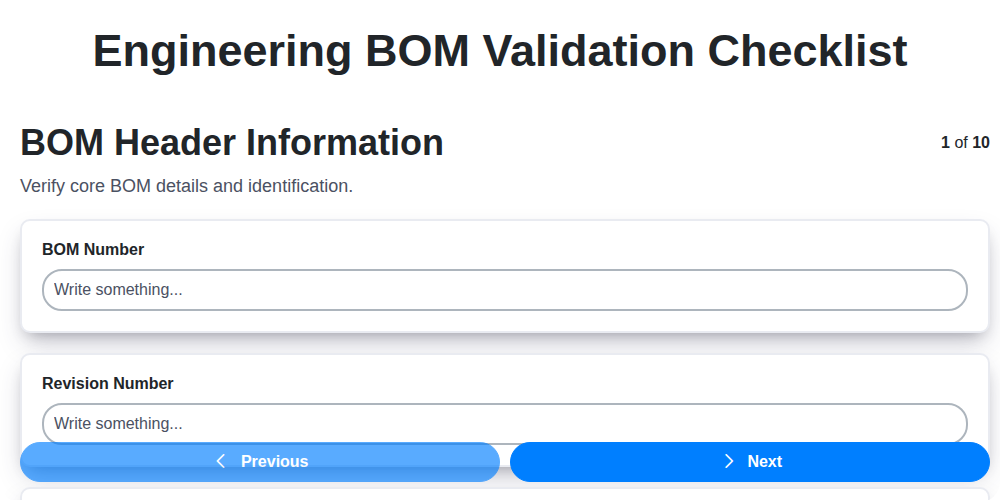
Table of Contents
- Introduction: Why BOM Validation Matters
- 1. BOM Header Information: Laying the Foundation
- 2. Part Number Accuracy: The Cornerstone of BOM Integrity
- 3. Quantity & Unit of Measure: Avoiding Costly Errors
- 4. Component Description & Specifications: Ensuring Clarity
- 5. Material & Supplier Information: Traceability and Reliability
- 6. Alternate Part Validation: Contingency Planning
- 7. BOM Structure & Hierarchy: Maintaining Logical Organization
- 8. Engineering Change Order (ECO) Tracking: Managing Updates
- 9. Revision Control: Keeping Track of Changes
- 10. Compliance & Regulatory Checks: Meeting Industry Standards
- 11. Data Integrity Checks: Catching Hidden Errors
- 12. Validation Tools & Best Practices
- Conclusion: Your BOM - A Source of Truth
- Resources & Links
TLDR: Ensure your Bills of Materials (BOMs) are accurate and compliant! This checklist guides you through verifying everything from part numbers and quantities to regulatory compliance. It's your shortcut to avoiding costly errors and delays in manufacturing and product development.
Introduction: Why BOM Validation Matters
A Bill of Materials (BOM) is the backbone of any manufacturing process, acting as a comprehensive list of raw materials, parts, assemblies, sub-assemblies, and the quantities of each needed to manufacture an end product. But a BOM isn's just a list; it's a critical communication tool connecting engineering, procurement, manufacturing, and ultimately, the customer. An inaccurate or incomplete BOM can trigger a cascade of problems - from production delays and increased costs to quality issues and even product recalls.
Effective BOM validation isn't merely a best practice; it's a necessity. It's the process of meticulously reviewing and confirming the accuracy and completeness of your BOM data before it's used in production. This proactive approach significantly reduces errors, improves efficiency, and ensures that you're building the right product, the first time. Skipping this vital step can lead to costly rework, scrap, and negatively impact your bottom line and customer satisfaction. This article outlines a comprehensive checklist to help you ensure your BOMs are reliable and accurate.
1. BOM Header Information: Laying the Foundation
The BOM header contains the essential metadata that defines the entire Bill of Materials. This section is your foundation, and errors here can cascade through the entire validation process. Key elements to scrutinize include the BOM number (ensuring uniqueness and traceability), the product name and description (verifying accuracy and clarity), the creation and last modified dates (critical for revision control), and the responsible engineer or department. Double-check that the product family or category aligns with the item being represented. A misplaced item or incorrect categorization can lead to confusion during manufacturing and procurement. Finally, verify the effective date - it dictates when the BOM becomes active and which version of the product it applies to. A seemingly small discrepancy here can trigger significant downstream issues.
2. Part Number Accuracy: The Cornerstone of BOM Integrity
A BOM is only as reliable as its part numbers. Inaccurate part numbers ripple through the entire manufacturing process, leading to delays, incorrect builds, increased costs, and potentially even product recalls. This is why rigorous validation of part number accuracy is paramount.
This isn't simply a matter of verifying that a number exists. It's about ensuring it's the correct part number for the specific component at the designated location within the assembly. We've all been there: a seemingly minor typo can lead to a completely different component being ordered, leading to costly rework and frustrated engineers.
Our validation process for part number accuracy goes beyond a simple lookup. It includes:
- Cross-referencing: Comparing the part number against supplier catalogs, internal databases, and manufacturer datasheets.
- Lifecycle Status Verification: Confirming the part is still active and not obsolete or superseded. Obsolete parts can halt production entirely.
- Alias Resolution: Identifying and resolving any aliases or equivalent part numbers to avoid confusion and ensure consistent usage.
- Geometric Dimensioning & Tolerancing (GD&T) Alignment: When applicable, ensuring the part number reflects the specific GD&T requirements of the component.
- Multiple Source Verification: Ideally, validating part numbers with multiple suppliers to confirm availability and pricing consistency.
A seemingly small investment in meticulous part number validation pays dividends in avoiding much larger problems down the line.
3. Quantity & Unit of Measure: Avoiding Costly Errors
A seemingly small discrepancy in quantity or unit of measure can snowball into significant financial and production headaches. Imagine ordering 1,000 instead of 100 of a critical component, or mistakenly specifying "each" instead of "meters" for a raw material. The impact on budget, lead times, and potential waste can be substantial.
This section of your BOM validation checklist focuses on ensuring the accuracy of these key details. Here's what to scrutinize:
- Verify Quantity: Double-check the listed quantities for every component against engineering drawings, specifications, and procurement requirements. Don't rely on memory or outdated records.
- Confirm Unit of Measure (UOM): Is it accurately reflected? Are you using "each," "lbs," "meters," "gallons," or another appropriate UOM? Mismatched UOMs lead to ordering the wrong amount and often require returns or costly rework.
- Check for Decimal Placement: Pay close attention to decimal points - a misplaced decimal can dramatically alter the quantity.
- Consider Packaging: Does the listed quantity align with the standard packaging from the supplier? Ordering based on a unit of measure that doesn't reflect packaging can lead to handling and storage issues.
- Cross-Reference with Purchase Orders: Regularly compare BOM quantities and UOMs with corresponding purchase orders to detect errors early.
Accuracy here is paramount. Thorough verification will save time, reduce waste, and ensure a smoother production process.
4. Component Description & Specifications: Ensuring Clarity
Component descriptions and specifications are often overlooked, yet they're critical for manufacturing accuracy and preventing costly errors. A vague or incomplete description can lead to incorrect parts being ordered, assembled, or even lead to design flaws going undetected.
This section of the BOM validation process demands meticulous scrutiny. Don't just verify that the description exists; ensure it's detailed enough for anyone - from procurement to assembly technicians - to confidently identify the exact component required. Consider these key points:
- Specificity is Key: Generic terms like resistor or capacitor aren't sufficient. Include values, tolerances, voltage ratings, package types, and any other relevant parameters.
- Data Sheet Verification: Always cross-reference the BOM description with the manufacturer's data sheet. Discrepancies are red flags that require immediate investigation.
- Dimensional Accuracy: If applicable, ensure dimensional details are included and accurate. This is especially crucial for mechanical parts.
- Performance Characteristics: If performance characteristics like frequency range, power dissipation, or operating temperature are important, they must be documented.
- Clear Units: Specify units of measure within the description (e.g., "10kΩ resistor, 1% tolerance" not just 10k resistor).
Thorough validation in this area minimizes ambiguity, promotes collaboration, and ultimately contributes to a higher-quality product.
5. Material & Supplier Information: Traceability and Reliability
A robust BOM isn't just about what components are used, but where they come from. This section focuses on ensuring the BOM accurately reflects material sourcing and supplier details, vital for traceability, quality control, and risk mitigation.
Key Checks:
- Supplier Part Number Alignment: Verify that the supplier part numbers listed in the BOM precisely match the supplier's documentation and internal records. Discrepancies can lead to incorrect orders and manufacturing delays.
- Supplier Contact Information: Confirm that the BOM includes current and accurate supplier contact details - company name, address, phone number, and designated contact person.
- Material Certifications: If applicable, ensure the BOM indicates required material certifications (e.g., RoHS, REACH, UL compliance) and links to the relevant certificates. Document certificate expiration dates for proactive renewal.
- Material Origin: Identify the origin of raw materials. Knowing where materials are sourced from can be critical for supply chain security and risk assessment (e.g., conflict minerals).
- Approved Supplier Status: Validate that all listed suppliers are currently approved and meet the company's quality standards. Regularly review supplier performance and approvals.
- Material Traceability: Define a system for tracing materials back to their origin, enabling root cause analysis in case of defects or recalls.
Accurate material and supplier information directly impacts product quality, supply chain resilience, and adherence to regulatory requirements. Don't underestimate the importance of rigorous validation in this area.
6. Alternate Part Validation: Contingency Planning
Relying on a single component supplier or part number can be a significant risk. Supply chain disruptions, obsolescence, or even unexpected demand spikes can quickly derail production. That's why thorough alternate part validation is a crucial step in BOM management.
This isn't just about finding a 'like-for-like' replacement. It's about proactive contingency planning. Your checklist should encompass several key areas:
- Identify Potential Alternatives: Research and identify a minimum of two, ideally three, qualified alternate parts for critical components.
- Functional Equivalence Testing: Verify that the alternate part performs identically to the primary part under the same operating conditions. This goes beyond datasheet comparisons - physical testing is often necessary.
- Form, Fit, and Function (FFF) Verification: Ensure the alternate part physically fits within the assembly and integrates seamlessly without requiring modifications to the product design or manufacturing process.
- Performance Comparison: Assess key performance metrics like voltage, current, power consumption, operating temperature range, and any other relevant specifications. Document any discrepancies.
- Supplier Qualification: Evaluate the alternate supplier's reputation, quality control processes, and delivery capabilities. Don't just consider cost; reliability is paramount.
- Cost Analysis: While cost is a factor, prioritize qualification and performance over simply choosing the cheapest option. Factor in potential costs associated with switching suppliers or adapting to different parts.
- Documentation: Clearly document the validation process, including test results, supplier information, and any observed differences between the primary and alternate parts.
By diligently validating alternate parts, you build resilience into your BOM and safeguard your production schedule against unforeseen circumstances.
7. BOM Structure & Hierarchy: Maintaining Logical Organization
A well-defined BOM structure is more than just a list of parts; it's a visual representation of how your product is assembled. Maintaining a logical hierarchy-often using levels like Top-Level Assemblies, Sub-Assemblies, and Components-is crucial for clarity, efficient manufacturing, and accurate cost calculations.
Why is Hierarchy Important?
- Ease of Understanding: A clear hierarchy allows engineers, manufacturing teams, and buyers to quickly understand the relationships between parts and assemblies.
- Improved Manufacturing: Manufacturing processes are streamlined when the BOM accurately reflects the assembly sequence. This minimizes errors and reduces production time.
- Accurate Costing: Hierarchical BOMs facilitate a more accurate breakdown of product costs at various levels, enabling better pricing and margin analysis.
- Effective Change Management: Modifications at one level of the hierarchy should only impact dependent levels, preserving the integrity of the entire BOM.
Key Considerations for Hierarchy:
- Define Clear Levels: Establish a standard for defining and naming assembly levels.
- Parent-Child Relationships: Ensure accurate representation of how assemblies are composed of sub-assemblies and components.
- Avoid Circular References: Prevent situations where an assembly depends on itself, as this will create errors.
- Regular Review: Periodically review the hierarchy to ensure it aligns with current design and manufacturing practices.
Poorly structured BOMs can lead to confusion, errors, and costly delays. Investing in a robust and well-organized BOM structure is a cornerstone of efficient product development and manufacturing.
8. Engineering Change Order (ECO) Tracking: Managing Updates
Engineering Change Orders (ECOs) are the backbone of controlled product development. A robust BOM validation process must include meticulous ECO tracking. Without it, you risk applying incorrect data, introducing errors, and creating a chaotic build process.
Here's what effective ECO tracking looks like during BOM validation:
- ECO Association: Each BOM revision must be directly linked to the originating ECO(s). This provides a clear audit trail - you can instantly see why a BOM changed and who authorized it.
- Status Tracking: Monitor the status of ECOs - Proposed, Approved, Released, Implemented, Closed. Ensure the BOM validation process only considers ECOs in the 'Released' or 'Implemented' states. A BOM shouldn't be validated based on an ECO still in proposal.
- Impact Assessment: The ECO should detail the impacted BOM items and areas. Validate that the BOM accurately reflects these changes. Don't just blindly apply the ECO; understand its effect.
- Approval Workflow Verification: Confirm that the ECO approval workflow was followed correctly. Was it reviewed by the necessary engineers, procurement, and manufacturing stakeholders?
- Documentation Linking: ECO documentation (change requests, justifications, drawings) should be readily accessible and linked to the relevant BOM records. This allows for immediate clarification of any discrepancies.
- ECO History: Maintain a complete history of all ECOs associated with the BOM, even those that were rejected or withdrawn. This provides valuable context and prevents future errors stemming from forgotten changes.
Neglecting ECO tracking during BOM validation jeopardizes product quality, increases costs, and creates significant rework. Implement a system that integrates ECO management seamlessly into your validation process for a more reliable and traceable BOM.
9. Revision Control: Keeping Track of Changes
The BOM isn't a static document; it evolves as designs mature, materials change, or supplier availability shifts. Robust revision control is critical to ensure everyone is working with the correct, most up-to-date BOM. Without it, you risk building products with obsolete parts, introducing errors, and facing costly rework.
Here's what your revision control process should include:
- Clear Naming Conventions: Establish a standardized system for naming BOM revisions (e.g., Rev A, Rev B1, Rev B2). This makes identifying the latest version straightforward.
- Version History: Maintain a detailed log of all revisions, including the date, revision number, a brief description of the changes made, and the engineer who made them. This provides an audit trail and allows for easy rollback if needed.
- Controlled Access: Limit who can modify BOMs. Typically, this is restricted to designated engineers or BOM administrators.
- Change Notification: Implement a system to notify affected departments (manufacturing, purchasing, quality) whenever a BOM revision occurs. This ensures everyone is aware of updates and can adjust their processes accordingly.
- Obsolete Revision Management: Clearly mark obsolete BOM versions and archive them properly. Don't simply delete them - preserve them for historical reference and potential future use.
- Software Integration: Utilize BOM management software that automatically tracks revisions, manages approvals, and integrates with other systems like ERP and PLM. This automation significantly reduces errors and improves efficiency.
A well-defined revision control system not only prevents errors but also facilitates traceability, improves collaboration, and ultimately contributes to higher-quality products.
10. Compliance & Regulatory Checks: Meeting Industry Standards
Ensuring your Bill of Materials (BOM) adheres to relevant compliance and regulatory requirements is no longer a nice-to-have - it's a critical business imperative. Failure to comply can result in costly recalls, production delays, legal repercussions, and reputational damage. This step goes beyond simple material verification; it encompasses understanding and documenting adherence to industry-specific rules and global regulations.
This involves meticulously checking your BOM against standards like RoHS (Restriction of Hazardous Substances), REACH (Registration, Evaluation, Authorisation and Restriction of Chemicals), UL (Underwriters Laboratories), FDA (Food and Drug Administration - if applicable), and country-specific requirements.
Key considerations within this validation:
- Material Declarations (MADs): Verify suppliers provide accurate and up-to-date Material Declarations for all components, detailing chemical composition and potential hazards.
- Conflict Minerals Reporting: Trace materials back to their origin to ensure ethical sourcing and compliance with regulations like the Dodd-Frank Act.
- Country of Origin: Correctly identify the origin of components, crucial for import/export regulations and trade agreements.
- Industry-Specific Standards: Adhere to specific industry standards relevant to your product's intended use (e.g., ISO standards for quality management).
- Documentation: Maintain comprehensive records of compliance checks, including supplier certifications and test reports.
Implementing a robust compliance and regulatory checks process, integrated within your BOM validation, safeguards your product's quality, legality, and marketability. Regularly update these checks to reflect evolving regulations and industry best practices.
11. Data Integrity Checks: Catching Hidden Errors
Beyond the core validation steps, a truly robust BOM validation process demands a deep dive into data integrity. These checks aren't about confirming specific fields; they're about ensuring the relationships between data points are accurate and consistent, uncovering hidden errors that might otherwise slip through.
Here are key data integrity checks to incorporate:
- Cross-Field Validation: Verify that information in related fields aligns. For example, does the component description accurately reflect the part number? Does the material used match the specified material code? Discrepancies here are red flags for potential data entry errors or misunderstandings.
- Unit Consistency: Ensure consistent units of measure are used throughout the BOM. Mixing inches and millimeters, or pounds and kilograms, can lead to disastrous manufacturing errors. Automate unit conversions where possible and always double-check.
- Reference Integrity: Validate that references to other documents, drawings, or supplier information are valid and up-to-date. Broken links or incorrect document numbers render the BOM useless and introduce risk.
- Data Type Validation: Confirm that each field contains the expected data type. Part numbers should be alphanumeric, quantities should be numeric, etc. This simple check catches common typos and prevents unexpected issues downstream.
- Formula and Calculation Verification: If your BOM uses formulas to derive values (e.g., total material cost), meticulously verify these calculations. Even a small error in a formula can significantly impact costs and decisions.
- Uniqueness Checks: Confirm that part numbers and other critical identifiers are truly unique. Duplicates can cause confusion and lead to incorrect orders or assemblies.
- Automated Rule Enforcement: Implement automated rules to enforce data integrity constraints. These rules can automatically flag suspicious entries and prevent erroneous data from entering the system.
12. Validation Tools & Best Practices
Validating a Bill of Materials (BOM) can be a complex, time-consuming task, but leveraging the right tools and following best practices can significantly streamline the process and minimize errors. Here's a look at what's available and how to optimize your approach:
Software Solutions: While spreadsheets can work for smaller BOMs, dedicated Product Lifecycle Management (PLM) or Enterprise Resource Planning (ERP) systems offer far greater capabilities. These often include:
- Automated Validation Rules: Define rules based on your company's standards (e.g., part number formats, required fields) that automatically flag potential issues.
- Real-time Collaboration: Facilitate seamless communication and approval workflows between engineering, procurement, and manufacturing teams.
- Data Integration: Connect to supplier databases and internal systems to pull in up-to-date part information and pricing.
- Version Control & Audit Trails: Maintain a comprehensive history of BOM changes and approvals.
Best Practices for Tool Utilization:
- Define Clear Ownership: Assign clear responsibility for BOM validation to specific individuals or teams.
- Standardized Data Entry: Implement strict data entry standards and templates to minimize manual errors and ensure consistency.
- Regular Training: Provide ongoing training for all users involved in BOM management and validation.
- Automate Where Possible: Look for opportunities to automate repetitive validation tasks, freeing up engineers for more strategic work.
- Continuous Improvement: Regularly review your validation process and tools, identifying areas for improvement based on feedback and error trends.
Beyond Software: Don't underestimate the power of simple practices like peer reviews and documented checklists (like the one we're outlining here!). A combination of technology and diligent human oversight is key to a robust BOM validation process.
Conclusion: Your BOM - A Source of Truth
Ultimately, a thoroughly validated Bill of Materials (BOM) isn't just a list of parts; it's the bedrock of reliable manufacturing, streamlined operations, and reduced risk. By diligently following a robust validation checklist like the one we've outlined, you transform your BOM from a potential liability into a powerful source of truth. Consistent validation minimizes errors, improves collaboration between engineering, procurement, and manufacturing, and ensures that what's planned is what's built. Investing the time and effort into BOM validation isn't just a best practice; it's an investment in the long-term success of your products and your business. Embrace the checklist, refine your processes, and watch your BOM become a true asset.
Resources & Links
- PTC: PTC offers PLM (Product Lifecycle Management) and CAD/CAM/CAE software solutions, often including BOM management capabilities. Their resources cover BOM processes and best practices.
- Dassault Systèmes: Another major PLM provider, Dassault Systèmes, offers insights and solutions related to BOM management, data integrity, and compliance within a comprehensive product lifecycle management system. Their website provides detailed information about their offerings and industry best practices.
- Oracle: Oracle's PLM Cloud offers robust BOM management features, including validation tools and integration with other enterprise systems. Check their resources for insights into BOM data governance and accuracy.
- Siemens Digital Industries Software: Siemens provides a suite of software solutions for product development and manufacturing, often including BOM management. Explore their website for information on product data management and process optimization.
- Arena Solutions (Arena Product Lifecycle Management): Arena is a cloud-based PLM platform with strong BOM management capabilities, emphasizing collaboration and data validation. Their blog and resources cover common BOM challenges and solutions.
- Australian Bureau of Meteorology: While seemingly unrelated, this resource is included as an example highlighting the importance of accurate data. BOM (Bureau of Meteorology) highlights how inaccurate information affects decisions - a good analogy for BOM data.
- ISO (International Organization for Standardization): For discussing Compliance & Regulatory Checks (section 10), ISO provides standards applicable to product development and manufacturing, including requirements for documentation and traceability.
- NIST (National Institute of Standards and Technology): NIST provides standards and guidelines for data integrity and quality assurance, which are highly relevant to BOM validation. Look for resources related to data security and process controls.
- Electronic Frontier Foundation: While primarily focused on digital rights, EFF's resources on data integrity and provenance can be applied to understanding the importance of verifying data origins, relevant to Material & Supplier Information (section 2) traceability.
- SAS: SAS provides data management and analytics solutions. Their resources can be helpful for understanding data integrity checks and anomaly detection within a BOM.
- IBM: IBM offers a variety of data management and governance tools. They are also a good resource for general concepts behind data integrity and governance that are important to BOM validation.
- Microsoft: Microsoft offers various data management and workflow tools (e.g., Power BI, Azure Data Factory) that can be utilized for BOM validation and data analysis. Useful for Data Integrity Checks.
Frequently Asked Questions
What is a BOM and why is validation important?
A Bill of Materials (BOM) is a comprehensive list of all the raw materials, components, assemblies, sub-assemblies, and quantities of parts needed to manufacture an end product. BOM validation is crucial to ensure accuracy, reduce errors, minimize costs, and maintain compliance with regulatory requirements.
Who should use this BOM validation checklist?
This checklist is beneficial for engineers, procurement specialists, manufacturing planners, quality control personnel, and anyone involved in the creation, management, or use of Bills of Materials.
What types of errors can BOM validation prevent?
BOM validation helps prevent errors like incorrect part numbers, wrong quantities, missing components, obsolete parts, incorrect revisions, inaccurate descriptions, and inconsistencies between the BOM and other engineering documents.
What are the key areas covered by this checklist?
The checklist covers areas such as part number accuracy, description consistency, revision control, unit of measure validation, quantity checks, cost analysis, supplier verification, and compliance with industry standards.
What is the difference between a level 1 and level 10 BOM?
BOM levels indicate the hierarchy of components. Level 1 typically refers to the top-level assembly. Level 10 represents the lowest level component or raw material required to build the product. Higher levels represent more detailed breakdowns.
How does BOM validation contribute to cost reduction?
Accurate BOMs minimize errors that lead to over-ordering, scrap, rework, and production delays - all of which increase costs. Validation also allows for better negotiation with suppliers and identification of cost-saving opportunities.
What role does engineering change management (ECM) play in BOM validation?
ECM is vital. BOM validation needs to be integrated with ECM processes to ensure that any changes to the design or materials are accurately reflected in the BOM, preventing the use of outdated information.
What is meant by 'phantom BOM' and how is it handled during validation?
A phantom BOM represents a sub-assembly treated as a single component. During validation, ensure phantom BOMs are correctly defined and do not impact the accuracy of parent-level BOM quantities or costs.
What are some common compliance requirements that BOM validation addresses?
BOM validation often addresses compliance with regulations like RoHS, REACH, conflict minerals reporting, and industry-specific standards. Verification of material certifications and origins is critical.
How often should BOM validation be performed?
BOM validation should be performed regularly - at least when designs change, upon new material introduction, during supplier selection, and periodically (e.g., annually) to ensure ongoing accuracy and compliance.
Found this Article helpful?
Comments
There are no comments yet. Be the first to add one!
BOM - Bill of Materials Management Solution Demo
Struggling with inaccurate BOMs & costly errors? ChecklistGuro provides a centralized BOM Management solution, connecting your design, engineering, & manufacturing teams for improved collaboration and control. Simplify operations & boost efficiency.
Related Articles
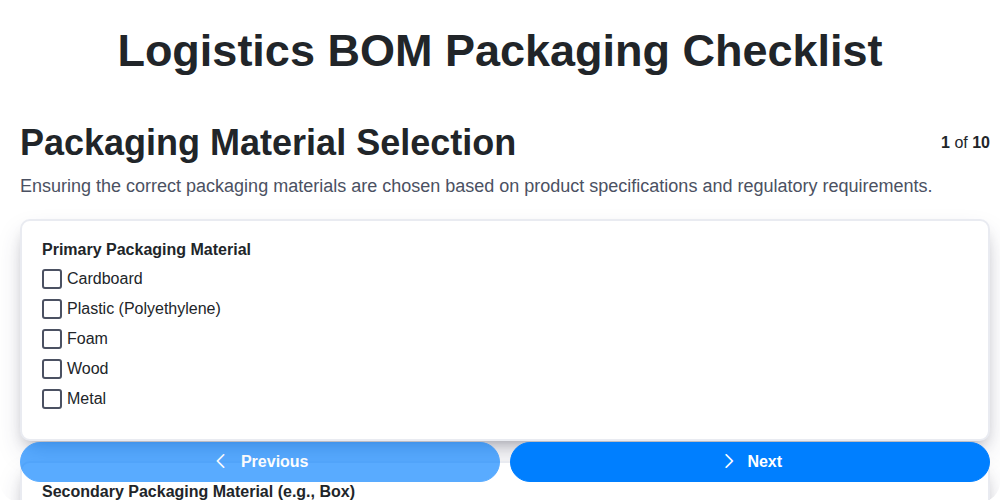
The Ultimate Logistics BOM Packaging Checklist: Ensuring Safe & Efficient Shipments
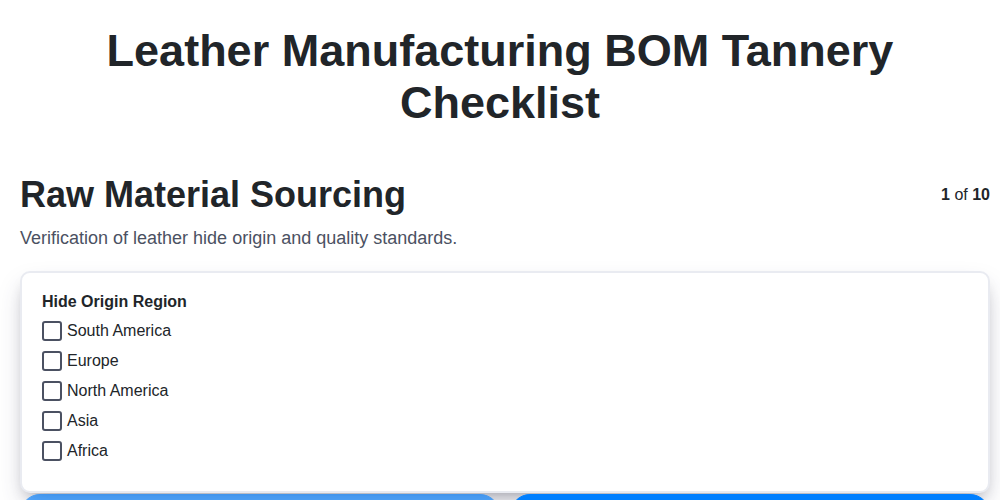
Mastering Leather Manufacturing: Your Tannery BOM & Compliance Checklist
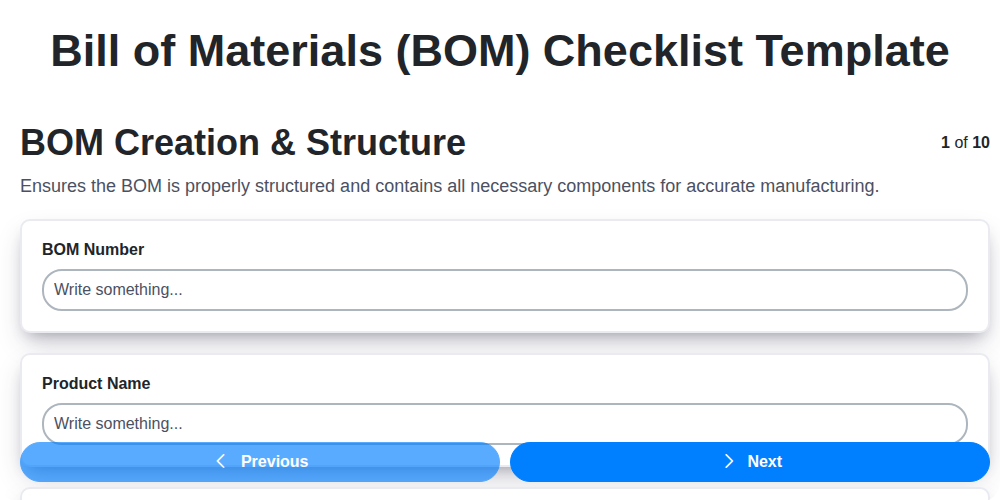
Mastering Your BOM: A Comprehensive Checklist Template for Success
Ensuring Success: Your Oil & Gas BOM Component Approval Checklist Guide
Navigating Medical Device BOM Regulatory Compliance: Your Essential Checklist
The Ultimate Retail BOM Product Definition Checklist: A Step-by-Step Guide
Ensuring Quality: Your Rubber Manufacturing Polymer BOM Checklist Guide
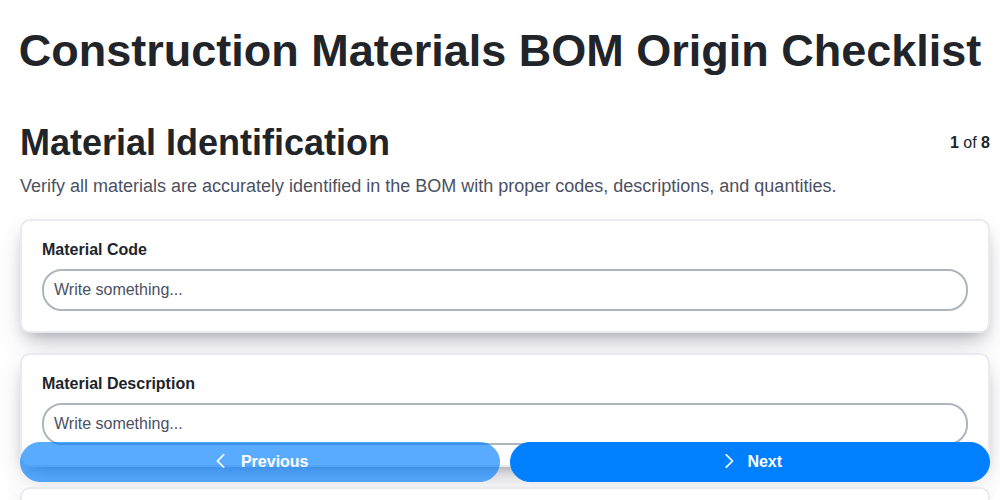
Decoding Origins: Your Construction Materials BOM Origin Checklist Guide
We can do it Together
Need help with
Bill of Materials (BOM) Management?
Have a question? We're here to help. Please submit your inquiry, and we'll respond promptly.