Mastering Accuracy: The Ultimate Journal Entry Verification Checklist Template
Published: 07/12/2026 Updated: 10/05/2026
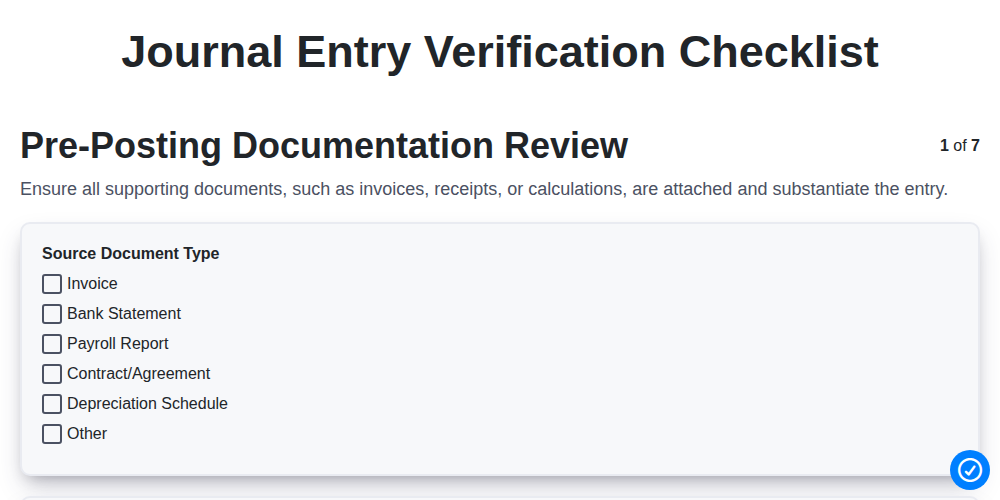
Table of Contents
- Introduction: Why Journal Entry Verification is Critical for Financial Integrity
- Step 1: Pre-Posting Documentation Review - Ensuring the Audit Trail
- Step 2: Data Accuracy & Mathematical Integrity - The Foundation of Precision
- Step 3: GL Account & Coding Validation - Ensuring Correct Classification
- Step 4: Period & Date Verification - Maintaining Temporal Accuracy
- Step 5: Compliance & Policy Adherence - Mitigating Risk and Fraud
- Step 6: Implementing a Robust Review & Approval Workflow
- Step 7: Post-Posting Reconciliation - Closing the Loop
- Conclusion: Building a Culture of Financial Precision
- Resources & Links
TLDR: Ensure financial integrity and eliminate manual errors with our comprehensive Journal Entry Verification Checklist. This guide provides a step-by-step template designed to streamline your month-end close by auditing everything from data accuracy and GL coding to compliance and post-posting reconciliation, helping you maintain a flawless audit trail.
Introduction: Why Journal Entry Verification is Critical for Financial Integrity
In the world of accounting, the general ledger serves as the single source of truth for an organization's financial health. Every transaction, from routine payroll to complex month-end adjustments, relies on the integrity of the journal entries (JEs) recorded within this ledger. However, because journal entries are often manual interventions, they represent one of the highest-risk areas for human error, oversight, and even fraudulent activity.
A single misplaced decimal point, an incorrect account code, or a posting error in the wrong fiscal period can trigger a domino effect, leading to distorted financial statements, failed audits, and flawed management decisions. When errors migrate from the journal to the final financial reports, they compromise the reliability of your entire reporting ecosystem.
Effective journal entry verification is not merely a procedural hurdle; it is a fundamental internal control. By implementing a rigorous verification checklist, organizations can transition from a reactive error-correction mindset to a proactive error-prevention strategy. This process ensures that every entry is substantiated, mathematically sound, and compliant with established accounting standards, ultimately safeguarding the accuracy of your financial narrative and maintaining the trust of stakeholders, auditors, and regulators alike.
Step 1: Pre-Posting Documentation Review - Ensuring the Audit Trail
Before a single number is entered into your general ledger, the foundation of a reliable journal entry lies in the strength of its supporting documentation. The Pre-Posting Documentation Review is your first line of defense against errors, fraud, and audit findings.
This step is about verifying that the transaction is not just a standalone entry, but a documented event with a clear, traceable audit trail. A robust review process involves confirming that every entry is accompanied by verifiable evidence-such as invoices, bank statements, payroll registers, or approved contracts-that justifies the transaction.
During this phase, you should ask:
- Is the source documentation complete? Ensure no pages are missing and all relevant attachments are present.
- Does the documentation support the amount? The value in the journal entry must match the figure stated on the supporting invoice or receipt exactly.
- Is the business purpose clear? There should be enough context within the documentation to explain why this entry is being made, making it easy for an auditor to reconstruct the event months or even years later.
By prioritizing this step, you move beyond simple data entry and toward a culture of verification first, significantly reducing the time spent on retroactive corrections and month-end investigations.
Step 2: Data Accuracy & Mathematical Integrity - The Foundation of Precision
Before a single number is posted to the General Ledger, the integrity of the underlying math must be beyond reproach. Even the most minor calculation error can ripple through your financial statements, leading to significant discrepancies in your balance sheet and income statement. This step is about more than just checking the math; it is about verifying the logical consistency of the entire entry.
To ensure complete precision, your verification process should include the following sub-steps:
- Verify Totals and Subtotals: Ensure that the sum of all debits exactly matches the sum of all credits. A single cent of imbalance can trigger a reconciliation nightmare during month-end closing.
- Check Source Document Alignment: Cross-reference the figures in your journal entry against the original supporting documents (invoices, receipts, or bank statements). The numbers in the system must be an exact mirror of the physical or digital evidence.
- Audit Recalculations: Do not assume that automated spreadsheets or system-generated totals are correct. Manually or independently recalculate complex line items, especially those involving taxes, discounts, or currency conversions.
- Verify Formula Integrity: If the entry was prepared using Excel or a similar tool, audit the formulas used to aggregate data. Ensure there are no broken links, hidden rows, or hard-coded errors that could distort the final output.
By treating mathematical integrity as a non-negotiable gatekeeper, you prevent the garbage in, garbage out phenomenon, ensuring that your financial reporting remains a reliable source of truth for stakeholders.
Step 3: GL Account & Coding Validation - Ensuring Correct Classification
The foundation of an accurate general ledger lies in the precision of your coding. Even if your transaction amounts are mathematically correct, an error in account classification can lead to distorted financial statements, skewed budget-to-actual comparisons, and significant headaches during month-end reconciliations.
During this stage of the checklist, you must verify that every line item in the journal entry is mapped to the correct General Ledger (GL) account. A common pitfall is misclassification creep, where expenses are inadvertently recorded in the wrong department or a capital expenditure is mistakenly coded as an operating expense.
To perform a thorough validation, focus on these three critical areas:
- Account Mapping Accuracy: Confirm that the chosen GL code matches the nature of the transaction. For example, ensure that a payment for a new software subscription is coded to Software Subscriptions rather than General Office Supplies.
- Departmental & Cost Center Alignment: It isn't enough to hit the right account; you must also ensure the transaction is assigned to the correct cost center or department. Incorrect coding here creates ghost expenses in one department and underreported costs in another.
- Sub-ledger Consistency: If the entry impacts specific sub-ledgers (such as Accounts Payable or Accounts Receivable), ensure the coding in the journal entry aligns perfectly with the underlying sub-ledger data.
By rigorously validating your GL coding, you prevent the ripple effect of errors that typically necessitates complex reversing entries and manual adjustments later in the closing cycle.
Step 4: Period & Date Verification - Maintaining Temporal Accuracy
One of the most common sources of financial discrepancies and audit findings is incorrect period attribution. When a journal entry is posted to the wrong fiscal period, it doesn't just create a single-day error; it distorts the entire financial narrative for that month, quarter, or year, making comparative analysis and trend reporting impossible.
To ensure temporal accuracy, your verification process must confirm that the transaction date aligns perfectly with the period in which the economic event actually occurred. It is not enough to simply check that a date is present; you must verify that the entry is being recorded in the correct open accounting period.
When performing this check, focus on these three critical elements:
- Matching the Economic Event: Ensure the transaction date reflects when the obligation was incurred or the revenue was earned, rather than simply when the invoice was processed.
- Period Closing Status: Confirm that the target period is still open for entries. Posting to a closed period can trigger significant downstream issues with finalized financial statements and tax filings.
- Cut-off Integrity: Pay special attention to entries made near the end of a month or fiscal year. Rigorous date verification prevents window dressing and ensures that expenses and revenues are recognized in accordance with the matching principle.
By verifying the period and date, you safeguard the integrity of your month-end close and ensure that your financial statements provide a true and fair view of the company's performance within the appropriate timeframe.
Step 5: Compliance & Policy Adherence - Mitigating Risk and Fraud
The final layer of a robust journal entry verification process involves moving beyond the numbers to examine the why and how behind the entry. Compliance and policy adherence act as the organization's primary defense against financial misstatement, internal fraud, and audit failures.
At this stage, the reviewer must ensure that the journal entry aligns with both internal controls and external regulatory requirements. This involves verifying that the entry follows established Delegation of Authority (DoA) limits-ensuring that no single individual has the power to both initiate and approve high-value transactions-and confirming that all necessary supporting documentation is attached and sufficient to justify the entry.
Failing to enforce these standards doesn't just lead to messy books; it creates significant vulnerabilities. Without rigorous adherence to policy, an organization is exposed to the risk of unauthorized manual overrides, which are common vehicles for fraudulent financial reporting. By treating this step as a mandatory checkpoint, you ensure that every entry is not only mathematically correct but also legally defensible and fully transparent for future internal and external audits.
Step 6: Implementing a Robust Review & Approval Workflow
A checklist is only as effective as the human oversight governing it. Even with perfect data, a lack of structured oversight can allow errors or even fraudulent activities to slip through the cracks. Implementing a robust review and approval workflow ensures that no single individual has total control over the entire lifecycle of a journal entry-a fundamental principle of internal controls known as Segregation of Duties (SoD).
To build a resilient workflow, your process should follow these three core pillars:
1. The Principle of Segregation of Duties
The person responsible for preparing the journal entry should never be the same person responsible for approving it. By separating the Preparer role from the Approver role, you create a natural checkpoint. This layer of defense is critical for mitigating the risk of intentional manipulation or accidental oversight.
2. Standardized Approval Thresholds
Not all journal entries carry the same level of risk. A sophisticated workflow implements tiered approval levels based on materiality. For example:
- Low-value entries: May only require a single supervisor's sign-off.
- High-value or complex entries: May require secondary approval from a Controller or CFO.
- Sensitive accounts: Entries affecting cash, intercompany transfers, or tax accounts should automatically trigger a higher level of scrutiny regardless of the dollar amount.
3. Audit-Ready Documentation
An approval is not truly complete until there is a digital or physical paper trail. Your workflow must capture the Who, When, and Why. Every approved entry should be accompanied by an immutable log that shows:
- The identity of the preparer.
- The timestamp of the submission.
- The identity of the reviewer.
- The date of final authorization.
By integrating these layers into your monthly closing cycle, you transform your review process from a simple rubber stamp exercise into a powerful mechanism for maintaining financial integrity and audit readiness.
Step 7: Post-Posting Reconciliation - Closing the Loop
The final and arguably most critical step in the verification process occurs after the journal entry has been officially posted to the General Ledger. Post-posting reconciliation is where you close the loop to ensure that the digital record accurately reflects the intended transaction and that no systemic errors occurred during the posting process.
It is not enough to simply assume that because a transaction was approved, it was recorded correctly. This stage requires a sanity check of the impact on your financial statements. You should verify that the debit and credit amounts migrated correctly to the trial balance and that the sub-ledger (if applicable) matches the entry made in the General Ledger.
A common pitfall is failing to check for orphaned entries or unintended impacts on related accounts, such as unexpected fluctuations in bank balances or tax liabilities. By performing a quick reconciliation immediately after posting, you can catch and rectify discrepancies before they migrate into month-end reports, saving your team from the high-stress scramble of period-end closing. Successful reconciliation ensures that the audit trail remains unbroken and that your financial data remains a single source of truth.
Conclusion: Building a Culture of Financial Precision
Implementing a Journal Entry Verification Checklist is more than just a way to prevent simple typos or coding errors; it is a strategic investment in your organization's financial integrity. By moving away from a reactive fix-it-later mindset and adopting a proactive, structured approach to validation, you transform the accounting function from a mere recording process into a robust internal control system.
Ultimately, consistency is the cornerstone of audit readiness and reliable reporting. When every team member adheres to a standardized verification workflow, you reduce the burden on your month-end close, minimize the need for painful period-end adjustments, and build an indisputable trail of accuracy. Precision in every entry fosters trust-not only with stakeholders and auditors but within the finance team itself-ensuring that the data driving your business decisions is always beyond reproach.
Resources & Links
- IFAC (International Federation of Accountants): Global standards and resources for professional accountants to ensure compliance and high-quality auditing practices.
- AICPA: Industry-leading resources on internal controls, financial reporting standards, and accounting best practices.
- AccountingTools: An educational resource providing in-depth technical explanations of journal entries, GL coding, and accounting workflows.
- Oracle NetSuite: Insights into automated financial workflows, real-time reconciliation, and modernizing the month-end close process.
- COSO: The gold standard for internal control frameworks, essential for understanding the 'Compliance & Policy Adherence' step.
- AuditBoard: Resources focusing on risk management, review workflows, and automating the journal entry approval process.
Frequently Asked Questions
What is the primary purpose of a journal entry verification checklist?
The primary purpose is to ensure accuracy, completeness, and compliance in the accounting process by providing a standardized set of steps to validate every transaction before it is posted to the general ledger.
Who should use this journal entry verification template?
This template is designed for accountants, bookkeepers, auditors, and finance managers responsible for preparing, reviewing, and approving manual and automated journal entries.
What are the most common errors caught by this checklist?
The checklist helps identify common errors such as incorrect account coding, transposition errors (typos), incorrect dates, missing supporting documentation, and unbalanced debits and credits.
Does this checklist cover both manual and automated entries?
Yes, while the specific steps for validation may vary slightly, the checklist provides a framework applicable to verifying the integrity of both manual adjustments and system-generated entries.
How often should the journal entry verification process be performed?
The verification process should be performed every time a journal entry is created, typically as part of the daily, weekly, or monthly closing procedures to ensure real-time data integrity.
Can this template be customized for specific industry needs?
Absolutely. While the core principles of accuracy and documentation remain the same, the checklist can be adapted to include specific regulatory requirements or industry-specific account codes.
Comments
There are no comments yet. Be the first to add one!
Accounting Management Solution Demo
Move beyond rigid, one-size-fits-all software. Leverage a fully programmable accounting environment designed to adapt to your unique workflows, complex hierarchies, and evolving business logic.
Related Articles
The Ultimate Financial Data Integrity Audit Checklist: A Step-by-Step Template for Precision and Compliance
The Ultimate Financial Statement Review Checklist: A Step-by-Step Guide to Ensuring Accuracy and Compliance
Mastering Financial Control: The Ultimate Departmental Budget Monitoring Checklist
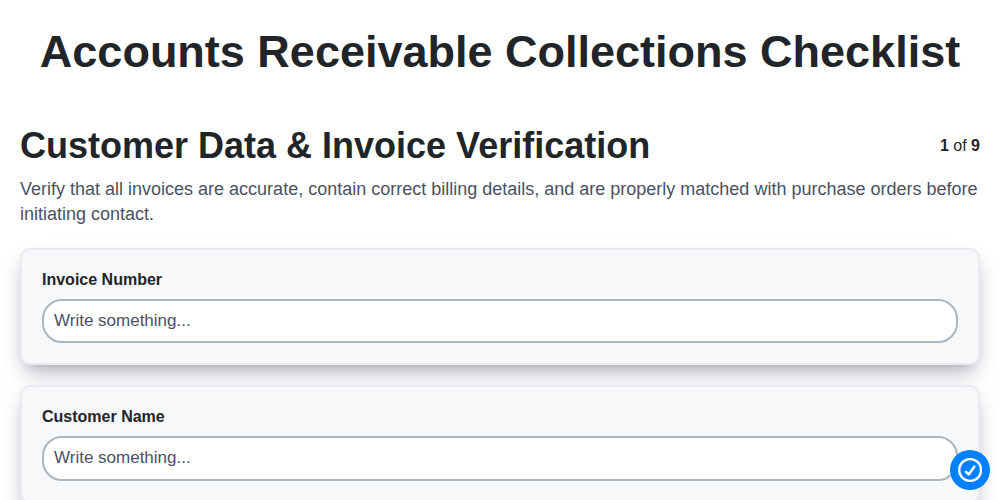
The Ultimate Accounts Receivable Collections Checklist: A Step-by-Step Guide to Streamlining Your Cash Flow
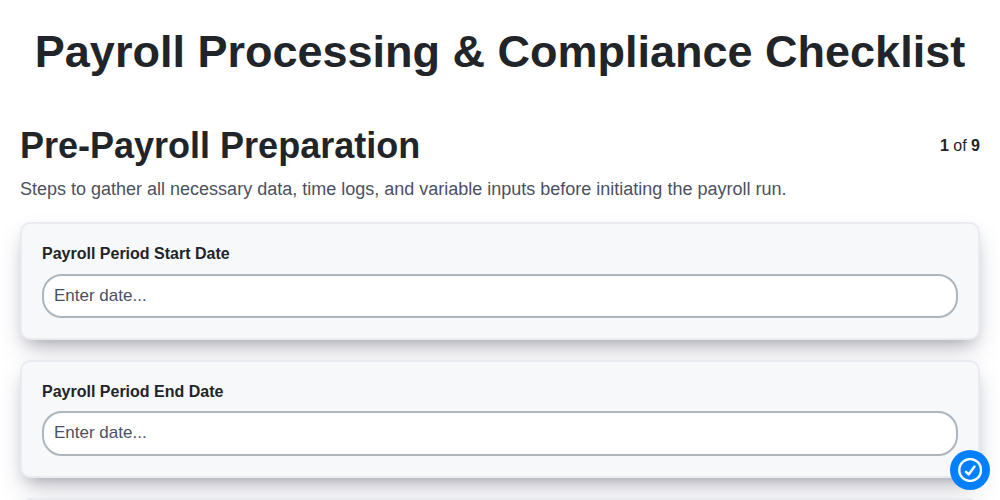
The Ultimate Payroll Processing & Compliance Checklist: A Step-by-Step Guide to Error-Free Payroll
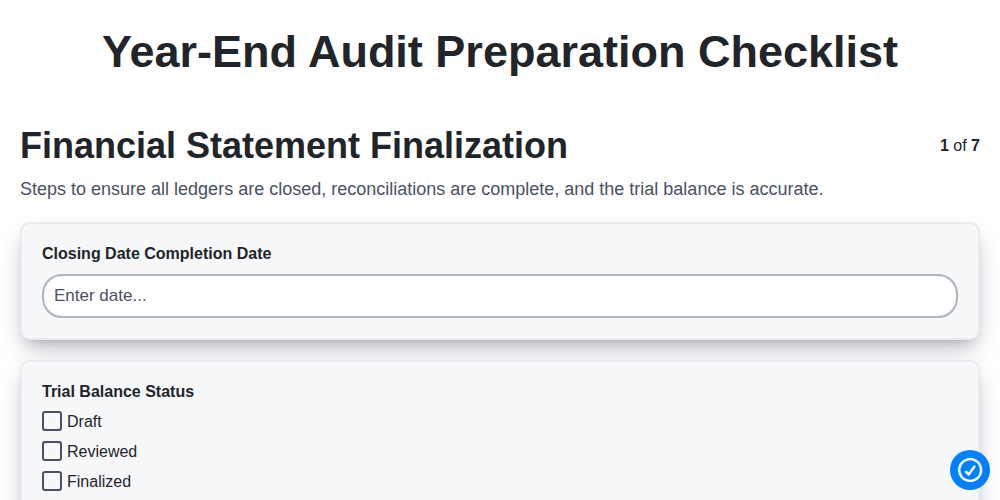
The Ultimate Year-End Audit Preparation Checklist: A Step-by-Step Guide to a Stress-Free Audit
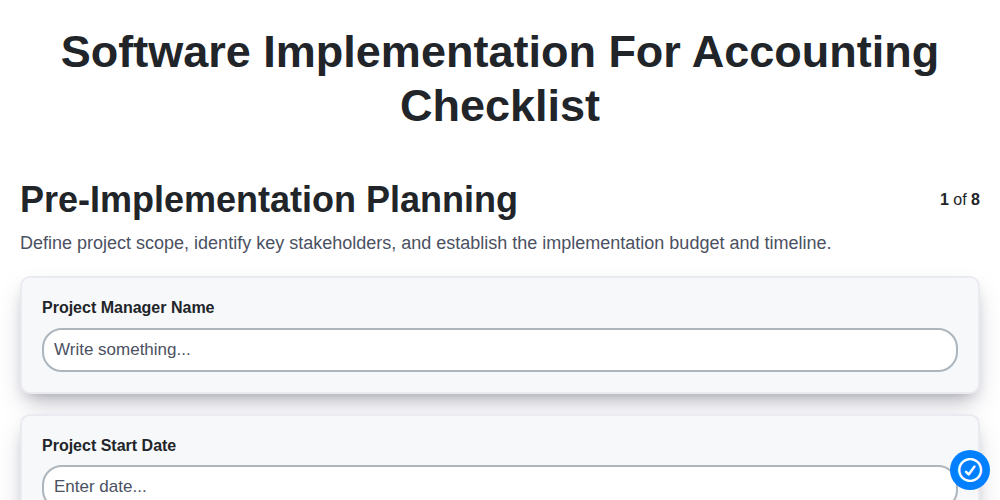
The Ultimate Software Implementation Checklist for Accounting Teams: A Step-by-Step Guide to a Seamless Transition
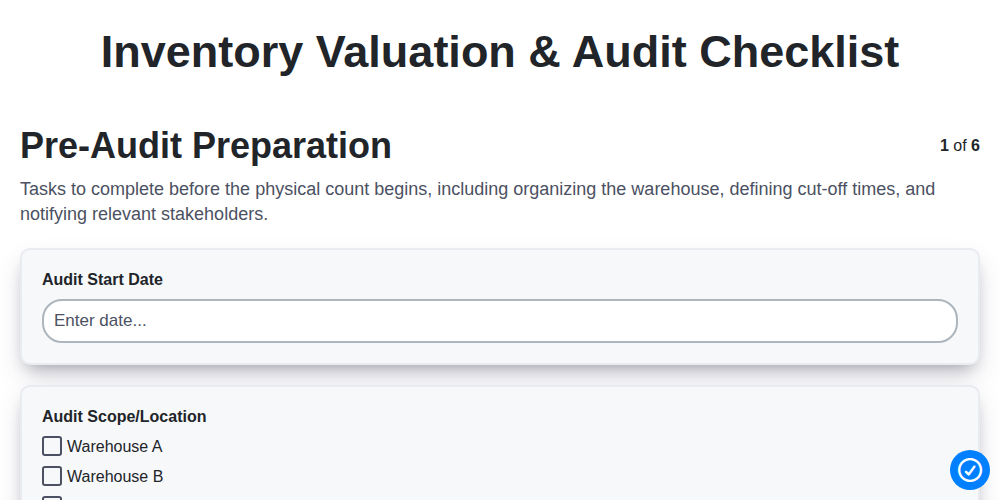
The Ultimate Inventory Valuation & Audit Checklist: A Step-by-Step Guide to Accuracy and Compliance
We can do it Together
Need help with
Accounting Management?
Have a question? We're here to help. Please submit your inquiry, and we'll respond promptly.