The Ultimate Year-End Audit Preparation Checklist: A Step-by-Step Guide to a Stress-Free Audit
Published: 07/12/2026 Updated: 10/05/2026
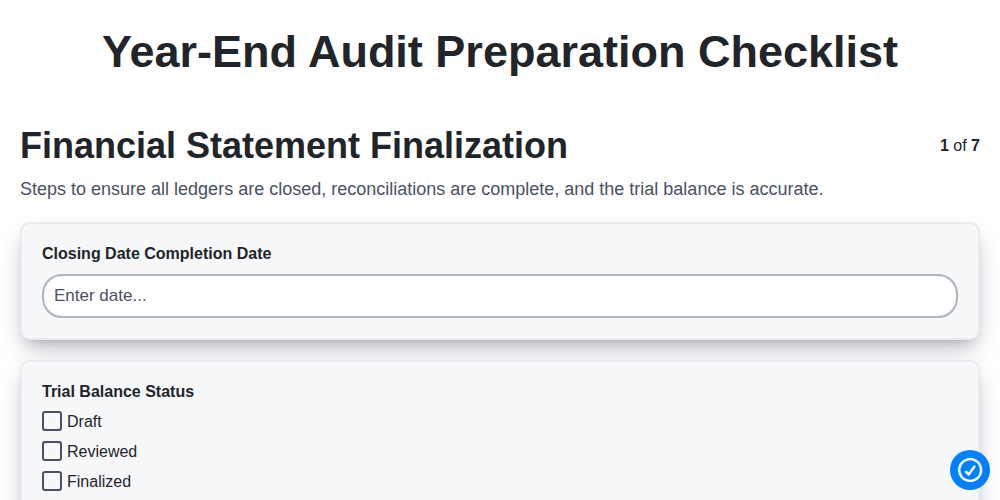
Table of Contents
- Introduction: Why Proactive Audit Preparation Matters
- Phase 1: Financial Statement Finalization
- Phase 2: Thorough Balance Sheet Reconciliations
- Phase 3: Comprehensive Accounts Payable & Receivable Review
- Phase 4: Fixed Asset & Inventory Verification
- Phase 5: Ensuring Tax & Regulatory Compliance
- Phase 6: Strengthening Internal Controls & Documentation
- Phase 7: Audit Readiness & Auditor Coordination
- Common Pitfalls to Avoid During Year-End Preparation
- Conclusion: Achieving a Seamless Audit Cycle
- Resources & Links
TLDR: Avoid the year-end audit crunch with this comprehensive guide and checklist template. Learn how to streamline your preparation process by systematically tackling financial finalization, reconciliations, and compliance reviews to ensure a smooth, error-free, and stress-free audit experience.
Introduction: Why Proactive Audit Preparation Matters
The year-end audit is often viewed by finance teams as a period of high stress, long hours, and unexpected hurdles. However, the difference between an audit that feels like a chaotic scramble and one that is a smooth, routine procedure lies in one single factor: preparation.
An audit is not merely a formal inspection of your books; it is a critical evaluation of your company's financial integrity and the reliability of its internal processes. When a company approaches an audit reactively-scrambling to find missing receipts or reconciling accounts only after the auditors arrive-it risks significant delays, increased audit fees, and the discovery of costly errors that could lead to qualified opinions or even regulatory scrutiny.
By adopting a proactive approach through a structured checklist, you transform the audit from a looming deadline into a manageable process. Proactive preparation allows your team to identify and rectify discrepancies in a controlled environment, ensuring that your financial statements are accurate and your internal controls are robust. Ultimately, a well-prepared audit does more than just ensure compliance; it builds trust with stakeholders, investors, and lenders, providing a clear, undisputed picture of your organization's true financial health.
Phase 1: Financial Statement Finalization
The foundation of a successful audit lies in the accuracy and completeness of your primary financial records. Before auditors arrive, your first priority must be ensuring that all transactions for the fiscal year have been recorded, categorized, and closed. This stage involves reviewing the general ledger to ensure there are no unposted entries, unrecorded accruals, or misclassified expenses that could lead to significant adjustments later.
To execute this phase effectively, focus on reviewing your income statements and cash flow statements for any glaring discrepancies or unusual fluctuations that might trigger auditor inquiries. Finalizing your financial statements isn't just about hitting a deadline; it is about ensuring that the data reflecting your company's performance is a true and fair representation of its economic reality. Properly closing the books during this phase minimizes the risk of audit adjustments that can erode stakeholder confidence.
Phase 2: Thorough Balance Sheet Reconciliations
Once your financial statements have been drafted, the focus must shift to the granular level: verifying the accuracy of every line item on your balance sheet. Reconciliations are the backbone of a successful audit; they serve as the primary evidence that the numbers reported in your ledger actually exist and are accurately valued.
To ensure a smooth audit, your reconciliation process should move beyond simple bank statement matching. You must systematically verify all asset and liability accounts, ensuring that the ending balances in your general ledger align perfectly with supporting third-party documentation. This phase includes:
- Bank & Cash Reconciliations: Confirming that all bank statements, petty cash, and undeposited funds match your internal records, with all outstanding checks and deposits in transit clearly identified.
- Intercompany & Inter-departmental Accounts: Ensuring that balances between subsidiaries or departments net out to zero and that all internal transfers are documented.
- Prepaid Expenses & Accrued Liabilities: Verifying that prepaid amounts are being amortized correctly and that all accrued expenses (such as utilities, wages, or interest) are accurately estimated and recorded.
- Loan & Debt Verification: Matching outstanding loan balances against periodic bank statements and amortization schedules to ensure principal and interest are captured correctly.
The goal of this phase is to identify and resolve discrepancies-such as unrecorded transactions, timing errors, or posting mistakes-well before the auditors arrive. An unreconciled account is a red flag that signals potential systemic errors, so thoroughness here is your best defense against audit findings.
Phase 3: Comprehensive Accounts Payable & Receivable Review
Ensuring that your sub-ledgers are accurate is critical to preventing discrepancies during the audit. A thorough review of Accounts Payable (AP) and Accounts Receivable (AR) helps ensure that the company's obligations and expected inflows are recorded in the correct period.
Accounts Receivable (AR) Review
The goal here is to confirm that the revenue recognized matches the actual amount owed to you. Focus on the following:
- Aging Report Analysis: Review your AR aging report to identify long-overdue accounts. Investigate any significant balances that are significantly past due, as these may require an allowance for doubtful accounts adjustment.
- Revenue Cut-off Testing: Verify that all sales recorded in the final weeks of the fiscal year are supported by valid shipping documents or service completion records. This prevents window dressing or premature revenue recognition.
- Credit Memo Audit: Review all credit memos issued near year-end to ensure they are legitimate and not being used to artificially reduce receivables.
Accounts Payable (AP) Review
The objective for AP is to ensure that all liabilities are fully captured and that no expenses are missing from the current fiscal year.
- Unrecorded Liabilities Search: Scrutinize invoices received in the first month of the new fiscal year. Check if the services or goods were actually delivered prior to year-end; if so, they must be accrued in the current period.
- Vendor Statement Reconciliation: Periodically reconcile your AP aging summary against statements sent by major vendors. Discrepancies here are common red flags for auditors.
- Debit Balance Investigation: Identify any significant debit balances within your AP ledger. These often represent prepayments or overpayments that should be reclassified as assets rather than negative liabilities.
By cleaning up these balances now, you minimize the risk of audit adjustments that can erode trust in your financial reporting and complicate the finalization of your year-end statements.
Phase 4: Fixed Asset & Inventory Verification
Ensuring that your physical assets and inventory counts align perfectly with your digital records is a critical component of the audit process. Discrepancies in these areas are often red flags for auditors, as they can signal potential theft, mismanagement, or inaccurate depreciation calculations.
To prepare for this phase, follow these essential steps:
- Conduct a Physical Inventory Count: Perform a comprehensive wall-to-wall physical count of all stock and raw materials. Ensure that the results are reconciled against your perpetual inventory system to identify and investigate any shrinkage or discrepancies.
- Verify Fixed Asset Existence: Physically inspect significant pieces of equipment, machinery, and vehicles to confirm they are still in use and located where they are recorded.
- Review the Fixed Asset Register (FAR): Audit your FAR for accuracy. Ensure that all new acquisitions during the year have been properly capitalized and that all disposals or retirements have been removed from the books.
- Validate Depreciation Calculations: Re-verify that depreciation methods, useful lives, and residual values are being applied consistently and accurately according to your company policy.
- Check for Impairment Indicators: Assess whether any assets have become obsolete or damaged, which may require an impairment loss to be recognized in your financial statements.
Phase 5: Ensuring Tax & Regulatory Compliance
As the year draws to a close, your audit preparation must extend beyond the numbers on your balance sheet to encompass your legal and tax obligations. This phase is critical because any discrepancy between your financial records and your tax filings can trigger red flags for auditors and lead to costly penalties.
To navigate this phase effectively, focus on the following key areas:
- Tax Provision Review: Reconcile your estimated tax provisions with actual tax payments made throughout the year. Ensure that all deferred tax assets and liabilities are accurately calculated and supported by documentation.
- Regulatory Filing Alignment: Verify that all statutory filings-including sales tax, payroll tax, and industry-specific regulatory reports-match the figures presented in your financial statements.
- Review of Tax Laws & Changes: Ensure your accounting treatments align with any new tax laws or changes in regulations that took effect during the fiscal year.
- Documentation of Tax Positions: If your company has taken aggressive tax positions or utilized specific credits, ensure there is a clear, documented audit trail that justifies these treatments.
- Compliance Calendar Check: Confirm that all deadlines for upcoming tax filings have been accounted for in your cash flow projections and that no significant liabilities are being overlooked.
By proactively aligning your tax obligations with your financial reporting, you minimize the risk of unexpected adjustments and demonstrate a commitment to transparency and regulatory integrity.
Phase 6: Strengthening Internal Controls & Documentation
An audit is more than just a mathematical verification of numbers; it is an evaluation of the integrity of your underlying processes. This phase focuses on ensuring that the how behind your financial data is just as accurate as the what. Robust internal controls act as the organization's first line of defense against errors and fraud, and demonstrating their effectiveness is a primary objective for auditors.
To prepare for this phase, focus on the following key areas:
- Reviewing Segregation of Duties: Ensure that no single individual has control over all aspects of a financial transaction. Verify that the person authorizing a payment is not the same person recording it in the ledger or reconciling the bank statement.
- Audit Trail Integrity: Confirm that every significant transaction is backed by a clear, traceable paper or digital trail. This includes invoices, purchase orders, approval emails, and delivery receipts. If an auditor cannot trace a number back to its source document, the control is considered failed.
- Updating Policy Manuals: Ensure that your Standard Operating Procedures (SOPs) are up to date and reflect your current business practices. If your processes have changed during the year but your documentation hasn't, it creates a red flag for auditors.
- Testing Controls Proactively: Don't wait for the auditor to find a gap. Perform mini-audits on high-risk areas, such as manual journal entries or credit limit overrides, to ensure that established protocols are being strictly followed.
- Organizing Digital and Physical Archives: Centralize all relevant documentation. A well-organized repository of signed contracts, board meeting minutes, and authorization logs significantly reduces the time auditors spend in your office and minimizes the risk of missing information findings.
Phase 7: Audit Readiness & Auditor Coordination
The final stage of your preparation is about more than just gathering data; it is about managing the relationship with your auditors to ensure a smooth, efficient, and stress-free engagement. Once your books are reconciled and your documentation is in order, your focus must shift to logistics and communication.
Effective audit readiness involves establishing a clear line of communication and a structured environment for the audit process. To ensure success, focus on the following key actions:
- Establish a Single Point of Contact: Designate a specific member of your finance team to act as the primary liaison. This prevents conflicting information from being shared and ensures that all auditor requests are funneled through one organized channel.
- Set Up a Digital Data Room: Avoid the chaos of endless email attachments. Create a secure, centralized digital repository (such as a shared drive or a dedicated audit portal) where auditors can access requested files, trial balances, and supporting documentation.
- Finalize the Audit Timeline: Confirm the audit schedule with your external auditors well in advance. Ensure that your internal team is aware of the fieldwork dates and that key personnel are available to answer queries or provide walkthroughs.
- Pre-emptively Address Potential Issues: If you are aware of any significant transactions, complex accounting estimates, or unusual discrepancies that occurred during the year, prepare an explanatory memorandum beforehand. Proactively addressing red flags demonstrates transparency and reduces the time auditors spend investigating them.
- Review the Audit Scope: Ensure your team understands exactly which accounts, processes, and time periods are being scrutinized so that all necessary evidence is prepared and waiting before the auditors arrive.
By treating the audit as a coordinated project rather than a sudden disruption, you can minimize downtime, reduce the risk of audit adjustments, and foster a professional, collaborative relationship with your auditors.
Common Pitfalls to Avoid During Year-End Preparation
Preparing for a year-end audit is a massive undertaking, and even the most diligent finance teams can stumble. Avoiding certain traps can mean the difference between a smooth, efficient audit and a stressful, costly ordeal. Here are the most common pitfalls to watch out for:
- Procrastination and Last-Minute Reconciliations: The most significant risk is waiting until the final week of the year to begin your reviews. Discovering a discrepancy in a bank statement or a mismatch in the general ledger in late January can create a domino effect of delays, forcing you to reopen closed periods and increasing the pressure on your entire team.
- Incomplete or Disorganized Documentation: An auditor's job is to verify your numbers through evidence. If your supporting documents-such as invoices, contracts, or depreciation schedules-are scattered across different folders, email threads, or physical files, the audit will drag on. Lack of a centralized, organized audit trail is a primary cause of increased audit fees and extended timelines.
- Ignoring Unrecorded Liabilities or Accruals: A frequent oversight is failing to account for expenses that have been incurred but not yet invoiced. Neglecting to record necessary accruals or failing to account for cutoff issues (transactions occurring right at the end of the period) can lead to significant audit adjustments and restatements.
- Fragmented Communication with Auditors: Treating the audit as a black box where you only interact with auditors when they ask for files is a recipe for disaster. Failing to establish a clear line of communication, or failing to flag potential issues (like a known error or a change in accounting policy) ahead of time, creates friction and erodes trust.
- Neglecting Internal Control Testing Throughout the Year: Relying solely on a year-end sweep to check your controls is risky. If control breakdowns have occurred months ago and go undocumented, you won't have the chance to remediate them before the auditors arrive, potentially leading to a deficiency finding in your audit report.
Conclusion: Achieving a Seamless Audit Cycle
Navigating the year-end audit process does not have to be a period of high stress and frantic last-minute fixes. While the checklist is comprehensive, the secret to a successful audit lies in the transition from reactive troubleshooting to proactive management. By treating these steps as a continuous practice throughout the year rather than a seasonal chore, you transform the audit from a daunting hurdle into a routine validation of your company's financial integrity.
Ultimately, a well-executed audit preparation serves a much greater purpose than mere compliance; it provides a clear, transparent view of your organization's financial health and strengthens the trust of stakeholders, investors, and regulators. By following this roadmap, you ensure that when the auditors arrive, you aren't just presenting numbers-you are presenting a well-documented, organized, and verifiable story of your company's operational success.
Resources & Links
- AICPA (American Institute of Certified Public Accountants): Official resources and professional standards for auditing, accounting, and financial reporting compliance.
- Accounting Today: Industry news and expert insights regarding tax regulations, audit trends, and accounting best practices.
- IRS Official Website: Essential for ensuring all tax compliance, reporting requirements, and regulatory obligations are met for year-end filings.
- COSO (Committee of Sponsoring Organizations of the Treadway Commission): The gold standard for understanding internal controls and risk management frameworks to strengthen your documentation.
- IFRS Foundation: Global standards for financial statement preparation and international accounting consistency.
- AuditBoard: Tools and methodologies for automating audit workflows, managing reconciliations, and maintaining audit readiness.
Frequently Asked Questions
What is the primary goal of a year-end audit preparation checklist?
The primary goal is to ensure all necessary financial records, documentation, and reconciliations are organized and verified in advance, minimizing errors and reducing stress during the actual audit process.
When should I start preparing for a year-end audit?
Preparation should ideally begin at least 2-3 months before the audit date. Starting early allows you to identify discrepancies, complete reconciliations, and gather missing documentation without the pressure of a looming deadline.
What are the most important documents to have ready for an auditor?
Key documents include bank statements, general ledger details, accounts payable and receivable aging reports, tax returns, inventory counts, payroll records, and any significant contracts or legal agreements.
How can I ensure my bank reconciliations are audit-ready?
Ensure that all bank statements match your internal general ledger, investigate any outstanding checks or deposits, and verify that all adjustments are documented and approved.
What should I do if I find a discrepancy during the preparation phase?
If a discrepancy is found, investigate the root cause immediately, perform the necessary adjusting entries, and document the correction process. It is much better to resolve these issues internally before the auditors arrive.
Who should be involved in the audit preparation process?
Audit preparation is a collaborative effort involving the CFO, accounting manager, bookkeeping staff, and potentially department heads who manage specific expense accounts or inventory.
Comments
There are no comments yet. Be the first to add one!
Accounting Management Solution Demo
Move beyond rigid, one-size-fits-all software. Leverage a fully programmable accounting environment designed to adapt to your unique workflows, complex hierarchies, and evolving business logic.
Related Articles
Mastering Global Consolidation: The Ultimate Intercompany Reconciliation Checklist Template
The Ultimate Payroll Processing & Compliance Checklist: A Step-by-Step Guide to Error-Free Payroll
The Ultimate Software Implementation Checklist for Accounting Teams: A Step-by-Step Guide to a Seamless Transition
The Ultimate Financial Statement Review Checklist: A Step-by-Step Guide to Ensuring Accuracy and Compliance
The Ultimate Inventory Valuation & Audit Checklist: A Step-by-Step Guide to Accuracy and Compliance
Mastering Financial Control: The Ultimate Departmental Budget Monitoring Checklist
The Ultimate Accounts Receivable Collections Checklist: A Step-by-Step Guide to Streamlining Your Cash Flow
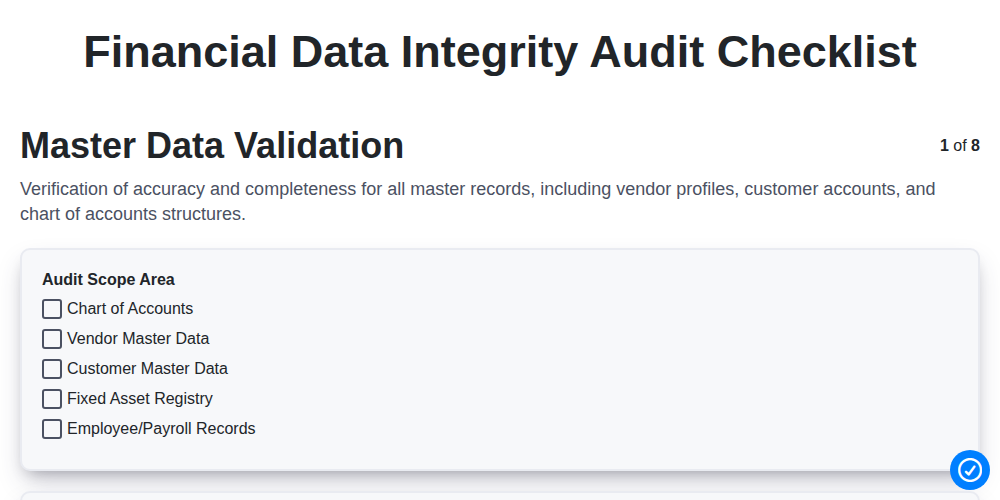
The Ultimate Financial Data Integrity Audit Checklist: A Step-by-Step Template for Precision and Compliance
We can do it Together
Need help with
Accounting Management?
Have a question? We're here to help. Please submit your inquiry, and we'll respond promptly.