Step-by-Step Workflow for Open-Pit Mining Operational Planning
Published: 06/18/2026 9:00 PM Updated: 06/19/2026 12:29 PM
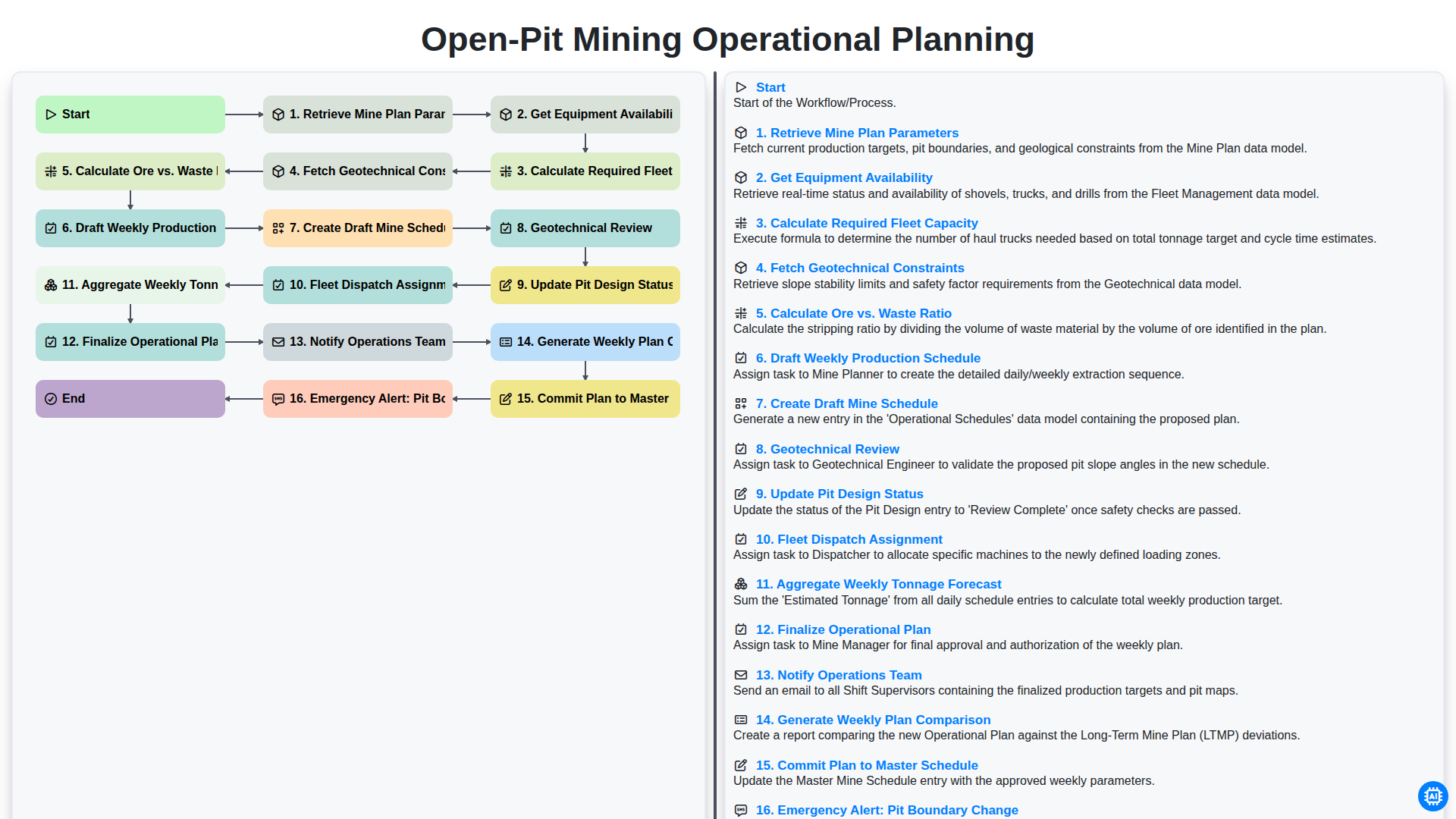
Table of Contents
- Phase 1: Data Collection and Parameter Initialization
- Step 1: Retrieve Mine Plan Parameters
- Step 2: Get Equipment Availability and Fleet Assessment
- Step 3: Fetch Geotechnical Constraints and Safety Parameters
- Phase 2: Capacity and Ratio Calculations
- Step 4: Calculate Required Fleet Capacity
- Step 5: Calculate Ore vs. Waste Stripping Ratio
- Phase 3: Schedule Drafting and Production Modeling
- Step 6: Draft Weekly Production Schedule
- Step 7: Create Comprehensive Draft Mine Schedule
- Phase 4: Validation and Engineering Review
- Step 8: Geotechnical Review and Safety Validation
- Step 9: Update Pit Design Status and Constraints
- Phase 5: Resource Allocation and Finalization
- Step 10: Fleet Dispatch Assignment and Logistics
- Step 11: Aggregate Weekly Tonnage Forecast
- Step 12: Finalize Operational Plan and Official Approval
- Phase 6: Communication and Deployment
- Step 13: Notify Operations Team and Stakeholders
- Step 14: Generate Weekly Plan Comparison and Variance Analysis
- Step 15: Commit Plan to Master Schedule
- Contingency Protocol: Managing Emergency Pit Boundary Changes
- Resources & Links
TLDR: Learn how to streamline your mining operations with our comprehensive workflow template for Open-Pit Mining Operational Planning. This guide explores how to automate the journey from retrieving mine plan parameters and analyzing equipment availability to executing geotechnical reviews and finalizing a master schedule, ensuring precision, safety, and maximized production efficiency.
Phase 1: Data Collection and Parameter Initialization
The foundation of a successful open-pit mining operation lies in the accuracy of the initial data inputs. Before any scheduling can occur, the system must undergo a rigorous process of Retrieving Mine Plan Parameters, which establishes the foundational targets for the upcoming period, including production goals and long-term strategic objectives.
To ensure the plan is executable, the workflow immediately moves into Getting Equipment Availability, integrating real-time data regarding the health and readiness of the haul truck fleet and loading units. Simultaneously, the system must Fetch Geotechnical Constraints, incorporating critical slope stability data and pit wall safety parameters to ensure that the proposed extraction paths do not compromise site integrity. This phase ensures that the operational plan is built upon a single source of truth, where physical constraints and resource limitations are synchronized before any computational modeling begins.
Step 1: Retrieve Mine Plan Parameters
The foundation of any successful operational plan lies in the accuracy of the initial data inputs. The workflow begins with the critical step of retrieving the established Mine Plan Parameters. This phase involves extracting key geological and spatial data from the long-term and medium-term strategic plans, including target ore grades, pit depth targets, and specific extraction sequences. By integrating these predefined parameters into the weekly planning cycle, we ensure that the short-term operational goals remain strictly aligned with the broader strategic objectives of the mine, preventing-drift from the long-term life-of-mine (LOM) targets.
Step 2: Get Equipment Availability and Fleet Assessment
Once the mine plan parameters are established, the next critical phase involves a deep dive into the reality of your available resources. The step Get Equipment Availability serves as the reality check for your operational ambitions. It is not enough to know how much material you need to move; you must determine exactly how much the current fleet is capable of moving.
This stage involves auditing the real-time status of your primary movers-excavators, shovels, and haul trucks-alongside support equipment like dozers and graders. By integrating data from maintenance management systems, planners can identify scheduled downtime, unplanned breakdowns, and the impact of preventative maintenance cycles.
Following this, the workflow moves into Calculating Required Fleet Capacity. This is a mathematical reconciliation where the theoretical targets from the mine plan are compared against the actual mechanical availability and utilization rates of your fleet. This calculation helps identify potential bottlenecks early; for instance, if the mine plan requires a specific production rate that exceeds the capacity of your current active haulage fleet, the plan must be adjusted or additional resources must be mobilized. This step ensures that the subsequent production schedule is built on a foundation of operational truth rather than optimistic projections.
Step 3: Fetch Geotechnical Constraints and Safety Parameters
Once the initial fleet requirements and capacity calculations are established, the planning process must integrate the critical physical boundaries of the mine. During this stage, the workflow moves beyond mere logistics to address the geological reality of the site by fetching geotechnical constraints. This step involves pulling real-time data regarding pit slope stability, factor of safety (FoS) requirements, and any identified structural weaknesses such as fault lines or shear zones.
Integrating these constraints is not just a matter of operational efficiency, but a fundamental safety mandate. By overlaying geotechnical data onto the production plan, engineers can ensure that the proposed extraction sequences do not compromise the integrity of the highwalls or benches. This step acts as a vital reality check, ensuring that the planned mine movement remains within the permitted operational envelopes and that all extraction activities align with the geotechnical models designed to prevent slope failures and ensure long-term pit stability.
Phase 2: Capacity and Ratio Calculations
Once the foundational parameters and equipment availability are established, the workflow shifts from data collection to the critical analytical stage of the planning process. This phase, Capacity and Ratio Calculations, serves as the mathematical engine of the operational plan, ensuring that the proposed schedule is physically and operationally achievable.
The process begins by calculating the required fleet capacity. By cross-referencing the available machinery with the total volume of material to be moved, planners can determine if the current fleet can meet the target throughput or if bottlenecks will occur. This is immediately followed by fetching geotechnical constraints, which integrates vital safety and stability data-such as pit slope angles and berm requirements-into the capacity models to ensure the plan does not compromise mine integrity.
The final, and perhaps most critical, step in this phase is to calculate the ore vs. waste ratio (strip ratio). By analyzing the proportion of ore to overburden, planners can assess the economic viability of the upcoming production period. This calculation dictates the intensity of stripping required and directly influences the ore delivery targets, providing the necessary constraints for the subsequent scheduling and drafting stages.
Step 4: Calculate Required Fleet Capacity
Once the mine plan parameters and equipment availability are established, the next critical step is to Calculate Required Fleet Capacity. This stage acts as the bridge between theoretical production targets and practical execution. It involves a rigorous quantitative analysis to ensure that the available machinery-such as excavators, haul trucks, dozers, and graders-can physically move the volume of material specified in the mine plan.
During this phase, engineers must calculate the cycle times for each equipment type, accounting for haul distances, gradients, and loading times. By applying these variables to the total tonnage requirements, the system determines if the current fleet can meet the target production rate or if a deficit exists. This calculation is vital for identifying potential bottlenecks; if the required capacity exceeds the available fleet capacity, it triggers an immediate need to either adjust the production targets, optimize haul routes, or reallocate equipment from other areas of the pit. Failure to accurately calculate capacity at this stage can lead to missed production targets and inefficient resource idling.
Step 5: Calculate Ore vs. Waste Stripping Ratio
After determining the necessary fleet capacity, the next critical step in the planning workflow is to Calculate the Ore vs. Waste Stripping Ratio. This calculation is the heartbeat of open-pit economics, as it defines the fundamental relationship between the amount of ore extracted and the amount of overburden (waste) that must be removed to access it.
In this stage, planners analyze the geological model and the mine design to quantify the volume of waste material that must be stripped to expose the next layer of ore. A rising stripping ratio can significantly impact the cost per tonne of ore produced, potentially squeezing profit margins if not managed effectively. By precisely calculating this ratio, the planning team can determine whether the current production rate is economically sustainable and ensure that the stripping process is adequately prepared to prevent ore starvation in future periods. This step ensures that the subsequent production schedule remains balanced, maintaining a steady flow of material to the processing plant while managing the operational costs of waste removal.
Phase 3: Schedule Drafting and Production Modeling
Once the fundamental constraints and resource availability are established, the workflow moves into the core analytical stage: Schedule Drafting and Production Modeling. This phase is where the raw data is transformed into a functional roadmap for the upcoming production period.
The process begins by calculating the Ore vs. Waste Ratio (Strip Ratio), a critical metric that determines the economic viability of the extraction sequence. With this ratio defined, the planning team can proceed to Draft the Weekly Production Schedule and Create the Draft Mine Schedule. This involves simulating various extraction sequences to ensure that the mine plan parameters and equipment capacities are being utilized optimally to meet production targets.
During this modeling stage, the plan is not merely a mathematical exercise but a structural blueprint. It integrates the previously retrieved mine plan parameters with the calculated fleet capacity to ensure the proposed schedule is physically achievable. This stage serves as the bridge between high-level strategic goals and the granular, day-to-day operational realities of the pit.
Step 6: Draft Weekly Production Schedule
Once the fundamental constraints-such as equipment availability and geotechnical limits-are established, the process moves into the core execution phase: Drafting the Weekly Production Schedule.
This step is where strategic objectives meet operational reality. During this phase, the planning team translates long-term mining goals into a granular, seven-day tactical roadmap. The primary objective is to allocate specific mine blocks and haulage routes to ensure that the required ore tonnage is delivered to the processing plant while maintaining the necessary waste stripping ratio.
Drafting the schedule involves a delicate balancing act. Planners must synchronize the movement of the hauling fleet with the digging capacity of the loading units, ensuring that no single shovel becomes a bottleneck and that the pit's ramp productivity remains optimized. This is not merely about moving dirt; it is about creating a precise, actionable blueprint that dictates exactly which benches will be active, which dump sites will be utilized, and how the fleet will be distributed across the pit to meet the week's production targets.
Step 7: Create Comprehensive Draft Mine Schedule
Once the core mathematical variables-such as required fleet capacity and ore-to-waste ratios-have been established, the process moves into the critical phase of structuralizing these data points into a cohesive timeline. Creating the draft mine schedule is where raw data is transformed into a logical, chronological sequence of mining activities.
During this stage, the objective is to translate the high-level mine plan parameters into a detailed roadmap that dictates exactly which benches, pushbacks, or ore zones will be targeted during the upcoming period. This draft serves as the blueprint for the mine's short-term operations, outlining the specific extraction sequences required to meet production targets while respecting the physical limitations of the pit. It is a balancing act of optimizing productivity against the logistical constraints of the mine site, providing a preliminary framework that will later be refined through geotechnical validation and fleet assignment.
Phase 4: Validation and Engineering Review
Once the preliminary production schedules are drafted, the process moves into a critical period of rigorous validation. This phase ensures that the theoretical plan is physically and structurally feasible before any machinery moves. The workflow begins with a formal Geotechnical Review, where engineers examine the proposed pit geometry against slope stability models to ensure that the planned extraction rates do not compromise pit wall integrity.
During this stage, the Update Pit Design Status step is executed to reflect any real-time changes in the pit's structural limits. This is a crucial checkpoint: if any instability is detected, the system triggers an Emergency Alert: Pit Boundary Change, forcing an immediate recalculation of the mineable reserves. By integrating geotechnical constraints into the design validation, the planning team can mitigate the risk of unexpected slope failures and ensure that the operational path remains within the safe, engineered boundaries of the mine.
Step 8: Geotechnical Review and Safety Validation
After the initial draft of the mine schedule is prepared, the process moves into a critical validation phase: the Geotechnical Review. No operational plan is viable if it compromises the structural integrity of the pit walls or the safety of the personnel and machinery.
During this stage, geotechnical engineers meticulously examine the proposed production schedule against the established pit slope stability models. They evaluate whether the planned extraction rates and bench configurations align with the Factor of Safety (FoS) requirements. The review focuses on identifying potential risks, such as high-wall instability, crest erosion, or slope failure, which could be triggered by the planned blasting sequences or increased loading patterns.
If the review uncovers any instabilities or suggests that the proposed digging angles are too aggressive for the current ground conditions, the schedule is flagged for immediate revision. This step acts as a rigorous safety gate, ensuring that the pursuit of production targets never overrides the fundamental necessity of pit stability and operational safety.
Step 9: Update Pit Design Status and Constraints
Once the geotechnical review is completed and the structural integrity of the pit walls is verified, the workflow moves into the critical phase of updating the pit design status. This step serves as the bridge between theoretical planning and physical reality. During this stage, any adjustments necessitated by recent geotechnical findings-such as revised bench heights, modified slope angles, or the establishment of new exclusion zones-are formally integrated into the digital mine model.
Updating the pit design status is not merely an administrative task; it is a fundamental realignment of the operational boundaries. By synchronizing the design parameters with the latest geological and geotechnical data, we ensure that the subsequent fleet assignments and production schedules are based on a safe, achievable, and accurate spatial framework. This prevents the discrepancy between the planned excavation path and the actual physical constraints of the pit, mitigating the risk of unexpected operational delays or safety incidents.
Phase 5: Resource Allocation and Finalization
Once the preliminary scheduling is established, the focus shifts from theoretical modeling to the practicalities of the mine site. This phase is where the plan meets reality, ensuring that the proposed production targets are physically achievable with the available assets and safety constraints.
The process begins with the Fleet Dispatch Assignment, where specific machines-from haul trucks to excavators-are assigned to designated areas of the pit to ensure continuous movement. With the fleet deployed, the system performs an Aggregate Weekly Tonnage Forecast, summing up the expected output to verify that the total volume matches the production targets.
The transition from a draft to an actionable directive occurs during the Finalize Operational Plan stage. At this point, all previous inputs-including geotechnical constraints and equipment availability-are reconciled into a single, cohesive instruction. To ensure seamless execution, the system will automatically Notify Operations Team members, providing supervisors and operators with the updated targets and routing instructions.
To maintain continuous improvement, the workflow concludes by performing a Generate Weekly Plan Comparison, which analyzes the new plan against the previous week's performance to identify variances. Once validated, the workflow will Commit Plan to Master Schedule, integrating the weekly targets into the long-term mine strategy. However, the system remains vigilant: if a critical variable changes, such as an Emergency Alert: Pit Boundary Change, the workflow is designed to trigger immediate re-evaluation to safeguard personnel and equipment.
Step 10: Fleet Dispatch Assignment and Logistics
Once the production schedule and ore-to-waste ratios are finalized, the focus shifts from strategic planning to tactical execution through Fleet Dispatch Assignment. This critical stage involves the precise allocation of your mobile assets-including haul trucks, excavators, loaders, and dozers-to specific work areas within the pit.
The goal of this step is to optimize the synchronization between loading units and hauling fleets. By analyzing the planned production targets against real-time equipment locations and cycle times, dispatch engineers can assign specific truck fleets to primary loading faces to ensure that the movement of material aligns perfectly with the weekly production goals. This stage also involves determining the optimal routing to minimize queue times at shovels and reduce idle time at crushers or waste dumps. Effective assignment at this stage ensures that the high-level mine plan is translated into a seamless, continuous flow of material, preventing bottlenecks that could compromise the entire week's tonnage forecast.
Step 11: Aggregate Weekly Tonnage Forecast
Once the draft production schedules and individual pit updates are finalized, the next critical step is to Aggregate Weekly Tonnage Forecast. This phase serves as the consolidation point where granular, pit-specific data is rolled up into a high-level view of the mine's total output.
At this stage, the system or planning team sums the projected tonnage from all active mining faces to determine the total volume of ore and waste movement expected for the upcoming week. This aggregation is not merely a mathematical summation; it is a vital verification step to ensure that the cumulative tonnage aligns with the long-term strategic goals and the mill's processing capacity. By aggregating these figures, planners can identify potential bottlenecks-such as a surplus of waste movement that might overwhelm the haulage fleet or an ore deficit that could lead to mill starvation-allowing for real-time adjustments before the plan is locked in.
Step 12: Finalize Operational Plan and Official Approval
After all the iterative cycles of calculation, geotechnical verification, and resource allocation are complete, the workflow reaches its most critical juncture: Finalizing the Operational Plan. This stage represents the transition from a theoretical model to a binding operational directive.
At this phase, the data-driven insights gathered from previous steps-such as the validated ore vs. waste ratios, the confirmed fleet capacity, and the reviewed geotechnical constraints-are consolidated into a single, cohesive document. Finalization involves a final high-level audit to ensure that the proposed production targets are not only mathematically feasible but also aligned with the broader strategic goals of the mine site and the long-term life-of-mine (LOM) objectives.
Once the plan is vetted for accuracy, it undergoes the formal approval process. This is the point of no return where the plan is officially sanctioned by mine management. This step is vital because it transforms a working draft into a high-stakes commitment of capital, labor, and machinery. Once finalized, the plan serves as the single source of truth for the upcoming production period, providing the operational foundation upon which all downstream activities-from drilling and blasting to hauling and crushing-will rely.
Phase 6: Communication and Deployment
Once the technical calculations and scheduling are complete, the final phase focuses on transforming the strategic plan into actionable intelligence for the field. This stage is critical for ensuring that the transition from planning to execution is seamless, transparent, and synchronized across all departments.
The process begins with the Finalization of the Operational Plan, where all validated data is consolidated into a single source of truth. To ensure total alignment, the Notification of the Operations Team is triggered immediately, providing site managers and supervisors with the necessary visibility to prepare for the upcoming cycle.
To maintain continuous improvement, the system will Generate a Weekly Plan Comparison, analyzing the delta between the current plan and previous performance to identify trends or potential bottlenecks. Once the plan is validated against historical performance, it is officially Committed to the Master Schedule, integrating the short-term goals into the long-term mine life objectives.
However, mining is a dynamic environment. To manage unforeseen geological or operational shifts, the workflow includes a high-priority Emergency Alert: Pit Boundary Change protocol. This ensures that if geotechnical or survey updates necessitate an immediate change to the pit limits, the entire operational chain is notified instantly, preventing equipment from entering unsafe or unauthorized zones and ensuring the integrity of the production cycle.
Step 13: Notify Operations Team and Stakeholders
Once the operational plan has been finalized, the workflow moves into its most critical phase: communication. A perfectly engineered plan is only effective if the people on the ground are aligned with its objectives. At this stage, the system triggers automated notifications to the entire operations hierarchy, including mine managers, pit supervisors, and dispatch controllers.
This step ensures that the transition from planning to execution is seamless. By disseminating the finalized parameters-including specific production targets, haulage routes, and shift priorities-you eliminate the information silos that often lead to operational delays. Real-time notifications ensure that every decision-maker is working from a single source of truth, minimizing the risk of discrepancies between the office and the field.
Step 14: Generate Weekly Plan Comparison and Variance Analysis
Once the operational plan is finalized and committed, the workflow moves into a critical phase of continuous improvement: Generating the Weekly Plan Comparison and Variance Analysis. This step serves as the bridge between strategic intent and operational reality.
By automatically comparing the newly generated weekly plan against the previous week's actual performance and the long-term master schedule, the system identifies critical deviations in production targets, haulage efficiency, and tonnage accuracy. This granular analysis allows mine planners to pinpoint exactly where discrepancies arise-whether it be an unexpected drop in shovel productivity, an increase in cycle times, or a shift in the ore-to-waste ratio.
Rather than simply documenting gaps, this comparison provides the data-driven insights necessary to adjust future planning cycles, ensuring that the mining operation remains resilient, predictable, and aligned with the overall mine life objectives.
Step 15: Commit Plan to Master Schedule
The final and most critical stage of the workflow is the formal integration of the weekly operational plan into the Master Schedule. This is the moment where the tactical, short-term plan transitions from a standalone document into a binding operational directive.
Committing the plan to the Master Schedule ensures-level synchronization across all departments, including mine engineering, logistics, and processing plants. By locking this data into the centralized planning system, you create a single source of truth that eliminates ambiguity and prevents conflicting instructions from circulating within the site. This step also serves as the baseline for all future performance tracking; once the plan is committed, it becomes the benchmark against which actual production, equipment utilization, and tonnage reconciliations are measured throughout the week.
Contingency Protocol: Managing Emergency Pit Boundary Changes
In the unpredictable environment of open-pit mining, even the most meticulously crafted operational plans can be disrupted by sudden geological instabilities or unforeseen geotechnical shifts. The Emergency Alert: Pit Boundary Change protocol is a critical fail-safe within our workflow, designed to trigger immediately when a deviation in the pit wall integrity or a structural instability is detected.
When an emergency alert is activated, the workflow shifts from routine optimization to rapid-response reconfiguration. This process bypasses standard scheduling intervals to prioritize safety and structural containment. The protocol necessitates an immediate halt to production in the affected sector, followed by an urgent re-evaluation of the Geotechnical Constraints. Once the new boundaries are defined, the system triggers a downstream cascade: re-calculating the Ore vs. Waste Ratio, adjusting the Required Fleet Capacity, and re-drafting the Weekly Production Schedule to account for the lost or redirected tonnage.
By integrating this emergency trigger directly into the core operational workflow, we ensure that the transition from crisis to recovery is seamless. This prevents plan drift, where operations continue under outdated parameters, and ensures that the Finalized Operational Plan always reflects the current, safest, and most efficient reality of the mine site.
Resources & Links
- Mining Technology: In-depth industry news, trends, and technical insights regarding open-pit mining operations and digital transformation.
- Australasian Institute of Mining and Metallurgy (AusIMM): Professional resources and technical papers regarding mine planning, geotechnical safety, and operational excellence.
- ScienceDirect - Mining Engineering: Academic research and peer-reviewed studies on pit design optimization, stripping ratio calculations, and fleet management algorithms.
- Geotech Magazine: Essential resources for understanding geotechnical constraints, slope stability, and pit boundary safety protocols.
- Caterpillar - Mining Fleet Solutions: Technical documentation and case studies regarding equipment availability, fleet capacity, and dispatch automation.
- Esri - Mining GIS Solutions: Information on using GIS and spatial data for mine plan parameter retrieval and pit design updates.
- Mine Planning Software Resources: Tools and methodologies for automating weekly production schedules and integrating ore/waste ratio forecasting.
Found this Article helpful?
Comments
There are no comments yet. Be the first to add one!
Mining Management Solution Demo
Maximize efficiency & safety in mining operations! ChecklistGuro streamlines task management, equipment tracking, and compliance reporting. Optimize workflows, reduce risk, & boost productivity. Manage it all with our Work OS.
Related Articles
Ensuring Mine Safety: Your Geotechnical Stability Checklist Guide
Ensuring Safety & Efficiency: Your Mine Haul Road Inspection Checklist Guide
Mastering Mine Safety: Your Guide to the Ground Control Checklist
Mining Security Procedures Checklist: A Comprehensive Template for Safety
Ensuring Safety: Your Mining Incident Reporting Checklist Guide
Ensuring Safety Underground: Your Mine Traffic Management Checklist Guide
Ensuring Safety: Your Mining Explosives Handling Checklist Template
Ensuring Safety & Compliance: Your Mining Noise Monitoring Checklist Guide
We can do it Together
Need help with
Checklists?
Have a question? We're here to help. Please submit your inquiry, and we'll respond promptly.