Ensuring Resin Excellence: Your Plastics Manufacturing BOM Checklist for Quality Control
Published: 10.12.2025 22:00 Updated: 14.12.2025 7:54
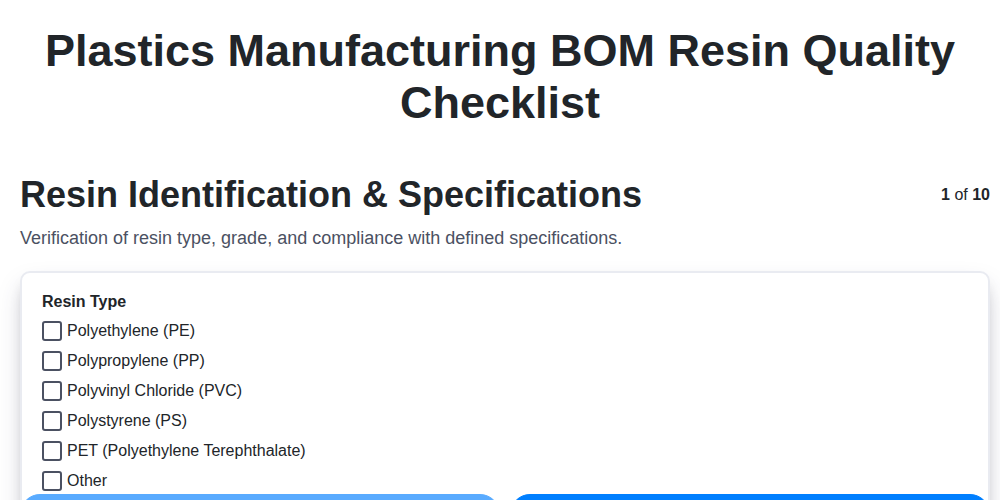
Table of Contents
- Introduction: Why Resin Quality Matters in Plastics Manufacturing
- Understanding the Bill of Materials (BOM) and Resin Specifications
- 1. Resin Identification & Specifications: The Foundation of Quality
- 2. Decoding the Certificate of Analysis (CoA): What to Look For
- 3. Physical Property Testing: Verifying Resin Performance
- 4. Chemical Property Testing: Ensuring Stability and Compatibility
- 5. Color & Clarity Assessment: Meeting Aesthetic Requirements
- 6. Batch Traceability & Documentation: Maintaining a Clear Audit Trail
- 7. Supplier Quality Assurance: Partnering for Consistent Quality
- 8. Maintaining Optimal Storage Conditions: Preserving Resin Integrity
- 9. Non-Conformance Reporting: Identifying and Addressing Issues
- 10. Corrective Action Verification: Validating Solutions
- 11. Continuous Improvement: Beyond the Checklist
- Conclusion: Achieving Resin Excellence for Superior Plastics Products
- Resources & Links
TLDR: This checklist is your go-to guide for consistent, high-quality resin in plastics manufacturing! It covers everything from verifying resin specs and reviewing lab reports (CoA) to testing physical & chemical properties, tracking batches, and ensuring proper storage. Use it to minimize defects, improve efficiency, and safeguard your product's performance.
Introduction: Why Resin Quality Matters in Plastics Manufacturing
The Bill of Materials (BOM) for plastics manufacturing is more than just a list of components; it's a roadmap to consistent, high-quality finished products. And at the heart of that BOM lies the resin - often accounting for the largest cost and directly impacting the final product's performance and aesthetics. Compromising on resin quality can trigger a domino effect, leading to defects, production delays, increased scrap rates, and ultimately, dissatisfied customers.
This isn't just about ensuring the resin is what it's supposed to be; it's about proactively verifying it. That's why a robust resin quality checklist, meticulously integrated into your BOM process, is absolutely essential. This checklist acts as a critical safety net, guaranteeing each batch meets your exact specifications and minimizing the risks associated with inconsistent or substandard materials. Let's dive into the key steps and why they're vital to maintaining top-tier product quality.
Understanding the Bill of Materials (BOM) and Resin Specifications
In plastics manufacturing, the Bill of Materials (BOM) serves as the foundational blueprint for every product. It's a comprehensive list of raw materials, components, and instructions needed to manufacture an end product. For plastics, the resin - the polymer that forms the bulk of the material - is a critical element within that BOM. Ensuring the right resin, in the right quantity, and with the right properties is paramount to product quality and consistency.
The resin specification within the BOM isn't just a name; it's a detailed technical document outlining expected performance characteristics. These specifications act as the agreed-upon standard between the manufacturer and the supplier. They encompass everything from the resin's chemical composition (e.g., Polypropylene, Polyethylene, ABS) to its intended application and required physical and chemical properties. Neglecting to properly define and adhere to these specifications can lead to processing issues, compromised part performance, and ultimately, product failure. A well-defined resin specification, clearly integrated into the BOM, is the first line of defense in maintaining quality control throughout the manufacturing process.
1. Resin Identification & Specifications: The Foundation of Quality
Before a single gram of resin hits the mixing hopper, meticulous identification and verification against specified requirements are absolutely critical. This isn't just about confirming the resin type; it's about ensuring it precisely matches the recipe and intended application for your plastic manufacturing process.
Start with a thorough review of your Bill of Materials (BOM). Clearly define the resin designation (e.g., Polypropylene Homopolymer, Polyethylene Terephthalate), grade, and any specific manufacturer designations. Cross-reference this with the engineering specifications for the final product. Are you using the correct molecular weight? What are the acceptable levels of additives and fillers?
Don't assume a supplier's catalog is always accurate. Verify the resin's intended use aligns with your application. A resin suitable for a low-stress component might be wholly inadequate for a structural part. Misidentification here can lead to catastrophic failures, process instability, and ultimately, product recalls.
Finally, document everything. Maintain records of resin identification, including supplier part numbers, internal codes, and dates of verification. This crucial documentation provides a clear audit trail and facilitates problem-solving down the line.
2. Decoding the Certificate of Analysis (CoA): What to Look For
Understanding the Certificate of Analysis (CoA) is critical to ensuring consistent resin quality in your plastics manufacturing process. It's much more than just a document; it's a snapshot of the resin's characteristics at the time of production. Here's what you need to scrutinize:
1. Resin Identification & Grade: Verify that the CoA clearly identifies the specific resin type (e.g., Polypropylene, Polyethylene, ABS) and the exact grade you ordered. Mismatches here can lead to unpredictable processing and final product performance.
2. Key Property Specifications: The CoA should list key properties and their corresponding results. These will vary based on the resin type and intended application, but generally include:
- Molecular Weight/Viscosity: These properties affect melt flow and processing characteristics. Deviations can impact part strength and surface finish.
- Melting Point/Glass Transition Temperature (Tg): Essential for understanding the resin's behavior during processing and its final application temperature range.
- Density: Impacts weight and dimensional accuracy of finished parts.
- Additives & Modifiers: The CoA should detail the types and amounts of additives used (e.g., antioxidants, UV stabilizers, flame retardants). Confirm these align with your requirements.
3. Acceptance Criteria & Tolerances: Pay close attention to the specified acceptance criteria (e.g., ≥98% purity, within +/- 2%). The CoA results must fall within these acceptable ranges.
4. Testing Methods: Note the testing methods used (e.g., ASTM, ISO). Understanding the method ensures the data is comparable and reliable.
5. Date of Manufacture & Expiration: The CoA should clearly state the date the resin was manufactured. While resins don't typically expire, knowing the age allows you to track potential degradation over time.
6. Signature & Stamp: A properly signed and stamped CoA from an authorized representative of the supplier adds validity and accountability.
Don't hesitate to question any discrepancies or lack of information on the CoA. A proactive approach to CoA review can prevent costly production issues down the line.
3. Physical Property Testing: Verifying Resin Performance
Physical property testing is a critical step in ensuring your plastic manufacturing BOM (Bill of Materials) resin meets performance expectations. These tests move beyond identification and documentation, delving into how the resin behaves under various conditions. Common tests include Melt Flow Index (MFI) - measuring the resin's flow characteristics during processing - and Density, which verifies material consistency. Tensile strength and elongation tests assess the resin's ability to withstand pulling forces and stretching, respectively, crucial for parts subjected to stress. Impact strength testing determines the resin's resistance to sudden impacts, vital for applications like automotive components or protective housings. Heat Deflection Temperature (HDT) reveals the temperature at which the resin begins to deform under load, essential for high-temperature applications. Finally, hardness testing, often using a Shore durometer, provides an indication of the resin's surface resistance to indentation. Each test should be rigorously compared against the resin's specifications outlined in the BOM and CoA. Deviations necessitate further investigation and potential rejection of the batch.
4. Chemical Property Testing: Ensuring Stability and Compatibility
Chemical properties are paramount to the success of plastics manufacturing, directly impacting the final product's performance and lifespan. This testing goes beyond the visual and physical - it delves into how the resin reacts and behaves under various conditions. Key tests include:
- Viscosity Measurement: Determines the resin's flow characteristics, crucial for processing efficiency and part uniformity. Deviations can indicate molecular weight changes or contamination.
- Molecular Weight Determination (Mw, Mn): This provides insight into the polymer chain length, influencing melt strength, impact resistance, and processability. Significant shifts can signify degradation or improper polymerization.
- Acid Value/Hydroxyl Value: Indicates the presence of acidic or alcoholic groups, which can affect compatibility with additives, pigments, and other components in the compound.
- Moisture Content: Excessive moisture can lead to hydrolysis, bubble formation during processing, and compromised part quality. Karl Fischer titration is a common method for precise measurement.
- Gel Time/Flow Time: Essential for thermoset resins, these tests measure the time it takes for the resin to gel or cease flowing, critical for determining pot life and processing parameters.
Understanding and meticulously tracking these chemical properties through rigorous testing helps ensure the resin's suitability for its intended application and guarantees consistent product quality.
5. Color & Clarity Assessment: Meeting Aesthetic Requirements
Color and clarity are critical, especially in plastics manufacturing where the final product's appearance directly impacts marketability and perceived quality. A seemingly minor deviation can render a batch unusable, particularly in applications like packaging, consumer goods, and automotive components. This stage of the resin quality checklist focuses on a meticulous evaluation of these characteristics.
The process begins with visual inspection under controlled lighting conditions. This includes assessing for any discoloration, haze, or foreign particles. Standardized color scales (like Gardner or Munsell) and opacity meters are often employed to provide objective, quantifiable data. Comparing the resin's color and clarity to established specifications - typically defined by the customer or internal standards - is paramount. Deviations could indicate contamination, improper processing during resin production, or degradation. Furthermore, consider the intended application; a translucent resin requires a higher level of clarity than an opaque one. Consistent, rigorous evaluation at this stage prevents costly rejects and ensures the final product delivers the desired aesthetic appeal.
6. Batch Traceability & Documentation: Maintaining a Clear Audit Trail
In plastics manufacturing, a robust batch traceability system isn't just a "nice to have" - it's a critical component of quality control and regulatory compliance. Every batch of resin used directly impacts the finished product's performance and consistency. Without meticulous documentation, troubleshooting issues, identifying root causes of defects, and demonstrating adherence to specifications becomes significantly harder, if not impossible.
Our resin quality checklist emphasizes this by mandating a clear audit trail. This includes, at a minimum:
- Detailed Record Keeping: Documenting the resin lot number, supplier name, date of receipt, and quantity received for each incoming batch.
- Testing Records Linking to Batches: Ensuring all testing results (physical, chemical, color, etc.) are directly linked to the corresponding resin batch number. This allows for rapid identification of potentially problematic lots.
- Process Data Correlation: Connecting resin batch numbers to specific production runs. This allows for tracking how a particular resin lot performed in the manufacturing process and associating any downstream issues.
- Supplier Documentation Archiving: Maintaining copies of supplier-provided documentation, including Certificates of Analysis (CoAs) and material safety data sheets (MSDS), readily accessible and organized.
- Version Control: If specifications or formulations change, rigorous version control of both resin formulations and testing procedures is crucial.
A well-maintained batch traceability system acts as your first line of defense against quality deviations and facilitates efficient investigations when problems arise. It's also essential for demonstrating due diligence during audits and for managing customer complaints effectively.
7. Supplier Quality Assurance: Partnering for Consistent Quality
The quality of your resin is fundamentally linked to the quality of your supplier. Simply put, you can't achieve consistently high-quality plastic parts without a robust supplier quality assurance program. This isn't about simply finding the lowest price; it's about forging a partnership built on transparency, accountability, and shared quality goals.
Our checklist emphasizes more than just receiving compliant material; it demands proactive supplier management. This includes:
- Supplier Audits: Regular audits (announced and unannounced) are vital to verify the supplier's adherence to quality management systems and their stated capabilities.
- Performance Monitoring: Track key performance indicators (KPIs) such as on-time delivery, material defect rates, and responsiveness to non-conformance reports.
- Communication & Collaboration: Maintain open communication channels with the supplier's quality team. Proactively discuss potential issues and collaborate on solutions. This allows for early identification of process improvements and risk mitigation.
- Supplier Development: View your suppliers as partners and actively participate in their development. Offering technical assistance and best practice sharing can elevate the entire supply chain.
- Approved Vendor List (AVL) Maintenance: Regularly review and update your approved vendor list based on performance and quality data.
A strong supplier quality assurance program isn't just about managing risk; it's about leveraging the supplier's expertise and contributing to mutual success.
8. Maintaining Optimal Storage Conditions: Preserving Resin Integrity
Maintaining optimal storage conditions is absolutely critical in plastics manufacturing. Resin isn't inert; it's a complex material susceptible to degradation if exposed to unfavorable environments. Improper storage can lead to issues like moisture absorption, UV degradation, contamination, and even chemical reactions that compromise the resin's intended properties.
Here's a breakdown of essential storage best practices:
- Temperature Control: Most resins benefit from storage in a cool, dry environment. Specific temperature recommendations are typically outlined in the resin's technical data sheet - always refer to this. Excessively high temperatures can accelerate degradation and potentially alter viscosity.
- Humidity Control: Moisture is a major enemy. Hygroscopic resins (those that readily absorb moisture) are particularly vulnerable. Maintaining low humidity levels (often below 50% relative humidity) is crucial. Desiccants or climate-controlled storage rooms might be necessary.
- UV Light Protection: Exposure to ultraviolet (UV) light causes chain scission and discoloration. Store resins in opaque containers or within a dark, shielded area.
- Container Integrity: Ensure containers are tightly sealed to prevent contamination and moisture ingress. Regularly inspect containers for damage (cracks, dents) and replace them as needed.
- Cleanliness: The storage area itself needs to be clean and free from dust, debris, and other contaminants that could negatively affect resin quality.
- First-In, First-Out (FIFO): Implement a FIFO system to ensure older resin is used before newer stock, minimizing the risk of exceeding shelf life.
- Proper Ventilation: Adequate ventilation can help regulate temperature and humidity.
Adhering to these storage guidelines, and the manufacturer's recommendations, will help ensure your resin maintains its quality and performance, contributing to consistent and reliable plastic products.
9. Non-Conformance Reporting: Identifying and Addressing Issues
When resin quality deviates from established specifications, a robust non-conformance reporting process is critical. This isn't about blame; it's about identifying, documenting, and resolving the root cause to prevent recurrence and maintain consistent product quality.
Our checklist mandates a clear and easily accessible non-conformance reporting system. This system should include:
- Detailed Description: A thorough and objective description of the observed deviation. Avoid assumptions - state only what is observed (e.g., Viscosity measured 2 cP lower than specification).
- Identification of Affected Material: Clearly identify the resin batch number, supplier, and any affected products or processes.
- Personnel Involved: Record the individual(s) who identified the non-conformance and those involved in its assessment.
- Severity Assessment: Categorize the non-conformance based on its potential impact (e.g., minor, major, critical). This dictates the urgency and scope of investigation.
- Containment Actions: Immediate steps taken to prevent further use of the non-conforming material (e.g., quarantine, segregation).
- Documentation: Maintain meticulous records of all reported non-conformances, associated documentation, and actions taken.
A centralized system, ideally digital, facilitates tracking and analysis. Regular review of non-conformance reports helps identify trends, systemic issues, and opportunities for process improvement within our resin quality control program. This active monitoring is a key element in proactive quality management.
10. Corrective Action Verification: Validating Solutions
Addressing resin quality issues isn't just about identifying the problem - it's about ensuring the solution stays a solution. Corrective Action Verification (CAV) is the critical final step in the resin quality control process. It's where you confirm that the implemented corrective actions have effectively eliminated the root cause of the non-conformance and prevent its recurrence.
This phase goes beyond simply re-running the affected batch. It involves a documented and systematic approach:
- Define Acceptance Criteria: Clearly outline what constitutes a successful resolution. This should be tied directly back to the original specifications and the identified deviations.
- Re-testing and Monitoring: After corrective actions are implemented (e.g., changes to supplier, process adjustments, new storage protocols), rigorous re-testing of the resin is crucial. This should mirror the original testing regime outlined in your BOM Resin Quality Checklist.
- Statistical Process Control (SPC): Consider using SPC charts to monitor key resin properties over time after the corrective action. This helps identify any subtle shifts or trends that might indicate a lingering issue.
- Documentation is Key: Record all re-testing results, SPC data, and observations. This provides a traceable record of the verification process.
- Process Ownership: Assign responsibility for CAV to a designated individual or team.
- Periodic Review: Schedule periodic reviews (e.g., quarterly, annually) to ensure the corrective action remains effective and the process continues to yield consistent, high-quality resin.
Without thorough CAV, you risk the return of the original problem, leading to wasted resources and potential product failures. It's the assurance that your efforts to improve resin quality are truly sustainable.
11. Continuous Improvement: Beyond the Checklist
While this comprehensive checklist provides a robust framework for ensuring resin quality in plastics manufacturing, it's crucial to recognize that quality isn't a static achievement. It's a journey demanding continuous improvement. Regularly review and update this checklist based on production trends, new resin formulations, changing industry standards, and feedback from operators and quality personnel.
Don't just view the checklist as a compliance tool - use it as a springboard for proactive improvements. Analyze non-conformance data to identify recurring issues and their root causes. Explore opportunities to optimize testing procedures, enhance supplier communication, and implement new technologies for real-time monitoring. Encourage a culture of questioning and innovation, where team members are empowered to suggest and implement changes that elevate resin quality and process efficiency. Consider incorporating statistical process control (SPC) to track key parameters and identify trends before issues arise. Ultimately, ongoing evaluation and adaptation are the keys to maintaining exceptional resin quality and maximizing the value of your plastics manufacturing operation.
Conclusion: Achieving Resin Excellence for Superior Plastics Products
Maintaining consistent resin quality is non-negotiable for plastics manufacturers striving for superior products. This checklist, encompassing resin identification, CoA review, rigorous testing, traceability, and proactive supplier management, provides a robust framework for achieving that excellence. Implementing these steps isn't merely about ticking boxes; it's about cultivating a culture of quality throughout the entire resin lifecycle. By diligently following this checklist and continually seeking improvements, manufacturers can minimize defects, enhance product performance, reduce waste, and ultimately, build a stronger brand reputation built on reliability and quality. Remember, consistently excellent resin quality translates directly into exceptional plastics products.
Resources & Links
- American Plastics Council (APC): Provides industry-wide information, best practices, and resources related to plastics manufacturing, including quality and safety. Useful for general background and industry standards.
- The Plastics Resource: Offers a range of plastics resources, including technical data, process knowledge, and expert advice. Can be a good source for understanding resin properties and potential issues.
- International Organization for Standardization (ISO): Provides international standards (e.g., ISO 9001 for Quality Management) relevant to plastics manufacturing and supplier evaluation. Important for demonstrating commitment to quality.
- ASTM International: Develops and publishes voluntary consensus standards for materials, products, systems, and services, including numerous tests for plastics and resins. Crucial for physical and chemical property testing (as mentioned in section 3 & 4).
- American National Standards Institute (ANSI): ANSI doesn't create standards themselves, but coordinates the development of voluntary consensus standards and helps ensure their quality. Many ASTM standards are also ANSI-approved.
- Sample Results: Provides Certificates of Analysis (CoAs) and other technical documentation for various plastics materials. A good example of what to look for, though not a direct resource for creation.
- LABMAN Software: While a software vendor, their website contains useful articles and guides related to Certificate of Analysis management, traceability, and quality control processes relevant to Section 4 and 6.
- The Society for the Plastics Industry, Composites Division (SPI): Focuses on thermoset resins and composites. Offers resources and information relevant to those specific resin types (If your article covers this). Useful for more specialized testing parameters.
- Quality Assurance World: Provides information and training on quality assurance and quality control, relevant to sections 9, 10 and 11 (non-conformance reporting, corrective action, and continuous improvement).
- Polymer Database: A comprehensive resource for information on polymers and plastics, including chemical structures, properties, and applications. Useful for understanding resin behavior and potential compatibility issues (Section 5 & 4).
- Polymers (MDPI): An open access journal publishing research on polymers and plastics. Can be used to research specific testing methods or material properties. Relevant to physical and chemical property testing.
- Spectroline: Specializes in UV and visual inspection equipment. Relevant for color and clarity assessment (Section 5).
Frequently Asked Questions
What does BOM stand for in the context of plastics manufacturing?
BOM stands for Bill of Materials. It's a comprehensive list of all the raw materials, components, and instructions needed to manufacture a plastic part, essentially acting as a blueprint for production.
Why is a BOM checklist crucial for quality control in plastics manufacturing?
A well-maintained BOM checklist ensures consistency and traceability throughout the production process. It minimizes errors, reduces scrap, prevents defects, and ultimately guarantees the desired quality of the finished plastic parts.
What are the key elements I should include in my plastics manufacturing BOM checklist?
Your checklist should include: Resin type and grade, Additives (colorants, fillers, stabilizers), Batch numbers, Supplier details, Quantities needed, Processing parameters (temperature, pressure, time), Mold details, and Quality control specifications.
What's the difference between resin type and resin grade, and why does it matter?
Resin type (e.g., polypropylene, polyethylene) defines the polymer itself. Resin grade refers to a specific formulation of that resin with particular characteristics (e.g., melt flow index, impact strength). Using the correct grade is critical for achieving the desired part properties.
How does traceability play a role in a resin BOM checklist?
Tracking batch numbers and supplier details allows you to trace back any quality issues to a specific raw material lot, enabling swift corrective action and preventing future occurrences. This is essential for regulatory compliance too.
Beyond raw materials, why should processing parameters be included in the BOM checklist?
Processing parameters (temperature, pressure, cycle time) directly influence the final part's properties. Documenting them ensures that each batch is processed identically, reducing variability and maintaining quality.
What role do additives play in plastics manufacturing, and should they be included in the BOM?
Additives like colorants, fillers, and stabilizers are added to resins to modify their properties. They *absolutely* should be included in the BOM with precise formulations and specifications to ensure consistent coloring and performance.
How often should my plastics manufacturing BOM be reviewed and updated?
The BOM should be reviewed and updated regularly, ideally at least annually, or whenever there's a change in raw materials, processing techniques, supplier, or design. Even minor adjustments can impact quality.
What are some potential consequences of neglecting or improperly maintaining a plastics manufacturing BOM checklist?
Neglecting the BOM can lead to inconsistent product quality, increased scrap rates, production delays, customer complaints, potential recalls, and damage to your brand's reputation.
How can digital BOM management systems improve my quality control process?
Digital BOM systems centralize data, automate workflows, provide real-time visibility, improve traceability, and facilitate collaboration, ultimately leading to better quality control and greater efficiency.
Found this Article helpful?
Comments
There are no comments yet. Be the first to add one!
BOM - Bill of Materials Management Solution Demo
Struggling with inaccurate BOMs & costly errors? ChecklistGuro provides a centralized BOM Management solution, connecting your design, engineering, & manufacturing teams for improved collaboration and control. Simplify operations & boost efficiency.
Related Articles
The Ultimate Logistics BOM Packaging Checklist: Ensuring Safe & Efficient Shipments
Mastering Leather Manufacturing: Your Tannery BOM & Compliance Checklist
Mastering Your BOM: A Comprehensive Checklist Template for Success
Ensuring Success: Your Oil & Gas BOM Component Approval Checklist Guide
Navigating Medical Device BOM Regulatory Compliance: Your Essential Checklist
The Ultimate Retail BOM Product Definition Checklist: A Step-by-Step Guide
Ensuring Quality: Your Rubber Manufacturing Polymer BOM Checklist Guide
Decoding Origins: Your Construction Materials BOM Origin Checklist Guide
We can do it Together
Need help with
Bill of Materials (BOM) Management?
Have a question? We're here to help. Please submit your inquiry, and we'll respond promptly.