Master Your Quarterly Taxes: The Ultimate Quarterly Tax Estimate Checklist Template
Published: 07/12/2026 Updated: 10/05/2026
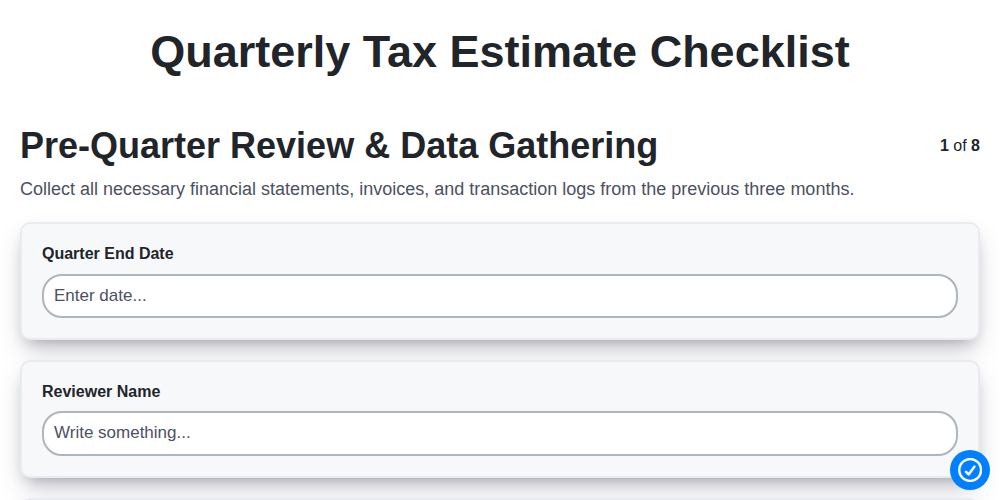
Table of Contents
- Introduction: Why Staying Ahead of Quarterly Tax Estimates is Crucial
- Phase 1: Pre-Quarter Review & Data Gathering
- Phase 2: Income and Revenue Verification
- Phase 3: Comprehensive Expense & Deductible Analysis
- Phase 4: Payroll & Withholding Reconciliation
- Phase 5: Accurate Tax Liability Calculation
- Phase 6: Estimated Tax Payment Preparation
- Phase 7: Payment Execution & Essential Documentation
- Phase 8: Final Quarterly Tax Filing Completion
- Pro-Tips for Avoiding Underpayment Penalties
- Conclusion: Building a Sustainable Tax Workflow
- Resources & Links
TLDR: Avoid the stress of tax season with this comprehensive Quarterly Tax Estimate Checklist. This guide provides a step-by-step template-covering everything from data gathering and expense analysis to final payment execution-to help business owners accurately calculate liabilities, ensure timely filings, and maintain seamless financial compliance every quarter.
Introduction: Why Staying Ahead of Quarterly Tax Estimates is Crucial
For many business owners and freelancers, the arrival of a new tax quarter feels less like a routine administrative task and more like an approaching deadline of uncertainty. When you are self-employed or running a small business, the tax burden doesn't just vanish at the end of the year; it is distributed across four critical milestones throughout the year.
Failing to manage these quarterly estimates effectively can lead to much more than just a disorganized filing cabinet. The stakes include unexpected cash flow shortages, the dreaded tax season surprise where you realize you owe a massive lump sum, and, most importantly, costly underpayment penalties from the IRS.
Staying ahead of your quarterly estimates is about more than just compliance; it is about financial clarity. By implementing a structured approach to tracking your income and expenses every three months, you transform tax season from a chaotic period of frantic math into a predictable, manageable part of your business operations. Using a systematic checklist ensures that you aren't just guessing at your liability, but instead making informed decisions that protect your bottom line and keep your business's financial health on track.
Phase 1: Pre-Quarter Review & Data Gathering
Before diving into the complex numbers, the foundation of a successful tax season lies in the preparation phase. The Pre-Quarter Review & Data Gathering stage is all about organization and consolidation. The goal here isn't to calculate your final liability, but to ensure that every relevant financial snapshot is accessible and ready for scrutiny.
To make this phase efficient, start by centralizing your financial documents. This includes gathering bank statements, credit card statements, and all digital receipts from the preceding three months. You should also ensure that your accounting software is fully reconciled and that all transactions have been categorized correctly. By taking the time to gather your data upfront, you prevent the common pitfall of missing information anxiety later in the process, allowing for a much smoother transition into the analytical stages of your tax preparation.
Phase 2: Income and Revenue Verification
The foundation of an accurate quarterly tax estimate lies in the precision of your top-line numbers. In this phase, the goal is to move beyond a simple glance at your bank balance and perform a deep dive into every dollar that entered your business during the previous three months.
To ensure you aren't underestimating your liability, follow these critical verification steps:
- Reconcile Gross Receipts: Match your total sales recorded in your accounting software against your bank deposits. Discrepancies here are often the primary cause of inaccurate tax filings.
- Review All Income Streams: Don't forget to account for non-service revenue, such as interest earned on business savings accounts, rental income, or the sale of business assets.
- Verify 1099 and Contract Income: If you act as a subcontractor or receive payments via third-party platforms, ensure all incoming payments have been documented and categorized correctly.
- Account for Refunds and Returns: If your business involves physical goods, ensure that any processed refunds or credits are deducted from your gross revenue to avoid overpaying on taxes for money you didn't actually retain.
- Check for Accrual vs. Cash Basis Consistency: Ensure you are reporting income based on the same accounting method you use for your annual tax return. If you use the accrual method, ensure you are accounting for earned revenue, even if the cash hasn't hit your account yet.
By verifying your revenue with this level of granularity, you prevent the tax surprise that occurs when a small oversight leads to a massive underpayment penalty at the end of the year.
Phase 3: Comprehensive Expense & Deductible Analysis
Once you have verified your revenue, the next critical step is to dive deep into your outflows. The goal of this phase is to ensure you are not overpaying your estimated taxes by failing to account for every possible business deduction. A thorough analysis of your expenses directly reduces your taxable income, which in turn lowers your quarterly payment obligation.
To perform a comprehensive analysis, follow these sub-steps:
- Audit Categorized Expenses: Review your bookkeeping software or bank statements to ensure all business-related costs-such as rent, utilities, software subscriptions, and professional services-have been correctly categorized.
- Identify New Deductible Items: Look for seasonal or one-off expenses that occurred during the quarter, such as new equipment purchases, repairs, or marketing campaigns, which may qualify for immediate deduction or depreciation.
- Review Home Office & Remote Costs: If you operate a home office, calculate the proportional costs of utilities, internet, and insurance that are applicable to your business use.
- Analyze Contractor & Travel Costs: Scrutinize payments made to 1099 contractors and ensure all business-related travel, including meals and lodging, are documented according to IRS guidelines.
- Check for Tax Credits: Beyond simple deductions, determine if any recent business activities qualify you for specific tax credits, which can provide a dollar-for-dollar reduction in your tax liability.
By meticulously scrutinizing these figures, you transform your tax preparation from a guessing game into a strategic financial maneuver, ensuring you retain as much much-needed cash flow as possible.
Phase 4: Payroll & Withholding Reconciliation
One of the most critical steps in ensuring your tax estimates are accurate is reconciling your payroll and withholdings. If you have employees, your quarterly tax liability isn't just about your business income; it's also about the taxes already withheld from your team's paychecks.
During this phase, you should perform a detailed audit to ensure that the federal and state income taxes, Social Security, and Medicare taxes withheld during the quarter align perfectly with your payroll reports. Discrepancies here can lead to significant errors in your final calculation. Additionally, if you are a sole proprietor or partner, review your own owner draws or distributions to ensure any applicable self-employment taxes are accounted for. The goal is to confirm that every cent withheld is documented and ready to be credited against your total quarterly obligation, preventing both overpayment and unexpected tax shortfalls.
Phase 5: Accurate Tax Liability Calculation
Once you have gathered all your income and expense data, the next critical step is calculating your actual tax liability for the quarter. This is the moment where raw data transforms into a concrete financial obligation.
To perform this calculation accurately, you must apply your current effective tax rate to your net profit (total income minus total allowable deductions). It is vital to not only look at your federal obligations but also to account for state and local taxes, as these can significantly impact your final amount due.
If you are a freelancer or small business owner, remember to factor in both the employer and employee portions of self-employment tax. To avoid the common pitfall of underpayment penalties, use this phase to compare your calculated liability against your year-to-date payments. This ensures that your quarterly estimate is sufficient to cover your projected annual tax burden, preventing a massive, unexpected bill come April.
Phase 6: Estimated Tax Payment Preparation
Once you have calculated your total tax liability, the next critical step is preparing the actual payments. This phase is about more than just deciding on a number; it involves determining the logistics of how and where the funds will be distributed.
To ensure a smooth process, begin by verifying the specific payment methods accepted by your tax authority (such as the IRS or your state's Department of Revenue). Whether you plan to use the Electronic Federal Tax Payment System (EFTPS), a direct debit from your business bank account, or a physical check, you should prepare your payment details well in advance to avoid last-minute technical hurdles.
During this stage, you should also decide on your payment strategy: will you pay the full calculated amount upfront, or will you distribute the funds across multiple smaller payments throughout the quarter? Carefully double-check that the payment amount matches your calculation exactly to prevent underpayment penalties or the unnecessary overpayment of funds that could otherwise remain in your business's cash flow.
Phase 7: Payment Execution & Essential Documentation
Once your tax liability has been calculated and your payment method is selected, the final stretch of the process begins. This stage is where you move from calculation to action. It is not enough to simply know what you owe; you must ensure the funds are transferred accurately and that a clear paper trail is established for future audits.
Executing the Payment
Timing is the most critical factor in this phase. To avoid late payment penalties and interest charges from the IRS (or your local tax authority), ensure that your payment is initiated well before the quarterly deadline. Whether you are using the IRS Direct Pay system, making a credit card payment, or scheduling an EFTPS (Electronic Federal Tax Payment System) transfer, confirm that the transaction is processed in time to be credited to the correct period.
The Golden Rule: Maintain a Paper Trail
Never assume a payment has been successfully processed just because you clicked submit. To protect your business in the event of an audit, you must maintain rigorous documentation. For every quarterly payment, archive the following:
- Confirmation Numbers: The unique digital receipt generated by the payment portal.
- Transaction Receipts: Digital or printed copies of the payment confirmation showing the date, amount, and tax period.
- Bank/Credit Card Statements: A secondary layer of proof showing the actual withdrawal of funds.
- Payment Instructions: A log of which account (checking, savings, etc.) the funds were drawn from.
By treating payment execution and documentation as a single, unified step, you eliminate the stress of missing payments and ensure your financial records remain bulletproof.
Phase 8: Final Quarterly Tax Filing Completion
The final step in your quarterly tax journey is the formal completion of your filing. Once the payment has been executed, the process isn't truly over until you have properly documented the filing with the appropriate tax authorities.
To ensure you are fully prepared for year-end audits or potential IRS inquiries, you should archive a digital and physical tax trail. This includes saving copies of your completed Form 1040-ES (or relevant state forms), the confirmation receipt of your payment, and a summary of the data used for the calculation. Completing this phase provides the peace of mind that your records are consistent, your liabilities are satisfied, and you are officially in the clear for the quarter.
Pro-Tips for Avoiding Underpayment Penalties
Staying ahead of the IRS is about more than just meeting deadlines; it is about precision and foresight. To avoid the dreaded underpayment penalties, consider implementing these strategic practices:
- Aim for the Safe Harbor Rule: One of the most effective ways to avoid penalties is to ensure your quarterly payments equal at least 100% of your tax liability from the previous year (or 110% if your adjusted gross income is high). Even if you expect a significant jump in income this year, hitting this threshold provides a legal safety net against penalties.
- Build a Tax Buffer: Never calculate your payments based on net profit alone. Always set aside a percentage of every incoming payment into a dedicated tax savings account. Treating tax obligations as a separate entity from your operating capital prevents the common mistake of overestimating your available cash flow.
- Use Real-Time Tracking: Don't wait until the end of the quarter to start your review. Use accounting software to categorize expenses and track income weekly. The more frequent your micro-reconciliations, the less likely you are to encounter sticker shock when it comes time to write the check.
- Monitor Significant Income Spikes: If you land a major contract or experience an unexpected surge in seasonal revenue, don't wait for the next scheduled deadline to adjust your estimates. Recalculate your quarterly obligation immediately to ensure you aren't carrying an undue tax debt into the next period.
- Double-Check Withholdings: If you have employees or operate as a contractor with specific withholding arrangements, ensure that your math accounts for the tax already being intercepted. Overpaying is better than underpaying, but overpaying significantly can lead to unnecessary cash flow strain.
Conclusion: Building a Sustainable Tax Workflow
Managing your quarterly tax estimates doesn't have to be a source of seasonal stress. By implementing this checklist, you are moving away from reactive, last-minute scrambling and moving toward a proactive, organized financial strategy. The key to long-term success lies in consistency; treating these steps as a recurring ritual rather than a one-time chore ensures that your business remains compliant and your cash flow remains predictable.
Remember, the goal of a structured tax workflow is not just to satisfy the IRS, but to gain clarity over your business's profitability. As you refine this process, you will reduce the risk of costly penalties, avoid unexpected year-end surprises, and ultimately gain the peace of mind necessary to focus on what truly matters: growing your business. Start small, stay disciplined, and let this checklist serve as the foundation for your financial stability.
Resources & Links
- IRS - Estimated Taxes: The official Internal Revenue Service resource for calculating estimated tax payments and understanding federal tax deadlines.
- QuickBooks Tax Tools: Comprehensive small business accounting software to automate expense tracking and income verification for tax preparation.
- FreshBooks Invoicing & Expense Tracking: Tools designed to help freelancers and small business owners manage revenue and organize deductible business expenses.
- TurboTax Self-Employed: Automated tax preparation software specifically designed to help users calculate quarterly estimated tax liabilities.
- Gusto Payroll Services: A platform for managing payroll, tracking employee withholdings, and reconciling payroll taxes for small businesses.
- SCORE Small Business Resources: Free mentorship and educational resources for entrepreneurs to learn about financial management and tax compliance.
- Accounting Today: Industry news and expert insights regarding changes in tax laws, regulations, and professional accounting workflows.
Frequently Asked Questions
What are quarterly estimated taxes?
Quarterly estimated taxes are prepayments of your tax liability made throughout the year to the IRS and state authorities, preventing a large, single bill and potential underpayment penalties at the end of the year.
Who is required to pay quarterly estimated taxes?
Generally, anyone who expects to owe $1,000 or more in taxes from sources other than wages (such as self-employment income, interest, dividends, or rental income) is required to make quarterly payments.
How does the checklist template help me master my taxes?
The checklist provides a structured, step-by-step workflow to ensure you track all income streams, calculate net profit accurately, account for deductible expenses, and meet all federal and state deadlines without missing critical information.
When are the quarterly tax deadlines?
The typical deadlines for estimated tax payments are April 15, June 15, September 15, and January 15 of the following year, though dates may vary slightly depending on weekends and holidays.
What documents should I gather before using the checklist?
You should gather all records of gross income (invoices, 1099s), a complete list of business expenses (receipts, utility bills, supplies), and any records of previous quarterly payments made during the current year.
Can I use this checklist for both federal and state taxes?
Yes, while the calculation methods may differ, the checklist is designed to help you organize the necessary data required to compute estimated payments for both the IRS and your specific state tax agency.
Comments
There are no comments yet. Be the first to add one!
Accounting Management Solution Demo
Move beyond rigid, one-size-fits-all software. Leverage a fully programmable accounting environment designed to adapt to your unique workflows, complex hierarchies, and evolving business logic.
Related Articles
The Ultimate Financial Data Integrity Audit Checklist: A Step-by-Step Template for Precision and Compliance
The Ultimate Financial Statement Review Checklist: A Step-by-Step Guide to Ensuring Accuracy and Compliance
Mastering Financial Control: The Ultimate Departmental Budget Monitoring Checklist
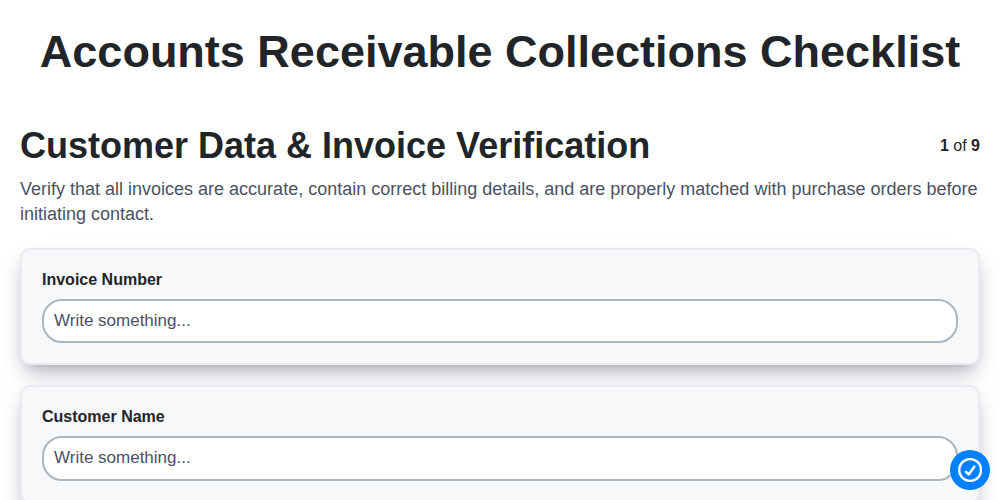
The Ultimate Accounts Receivable Collections Checklist: A Step-by-Step Guide to Streamlining Your Cash Flow
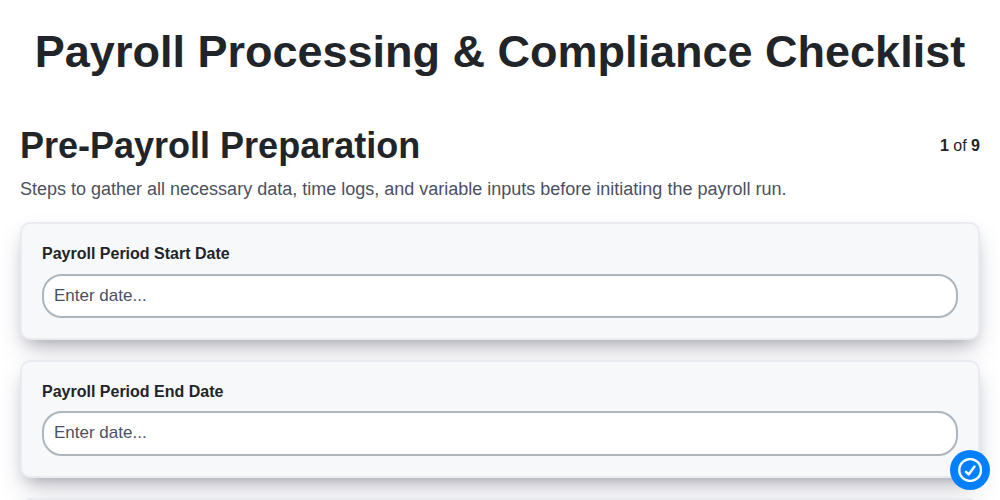
The Ultimate Payroll Processing & Compliance Checklist: A Step-by-Step Guide to Error-Free Payroll
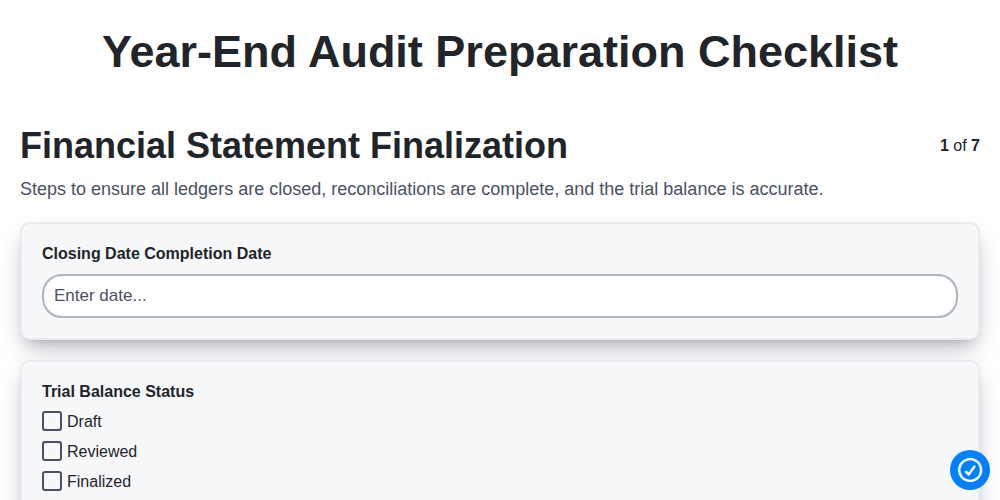
The Ultimate Year-End Audit Preparation Checklist: A Step-by-Step Guide to a Stress-Free Audit
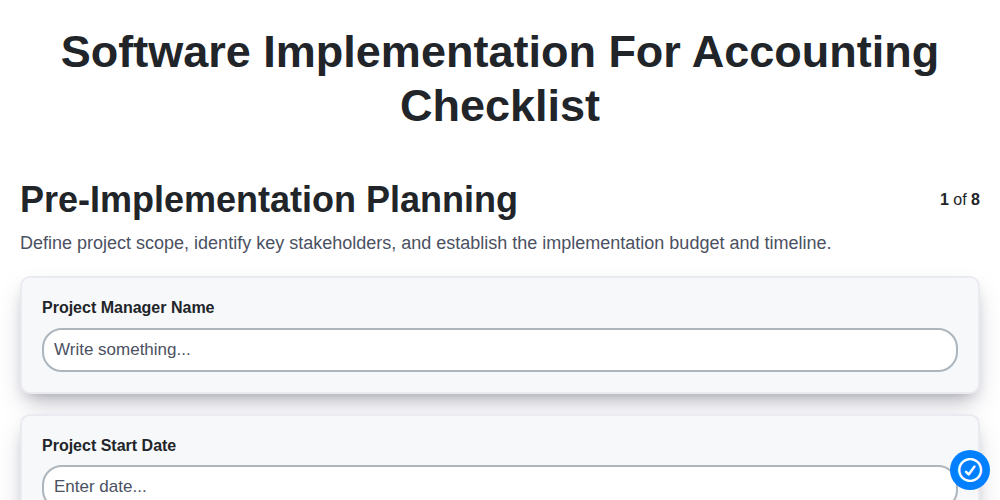
The Ultimate Software Implementation Checklist for Accounting Teams: A Step-by-Step Guide to a Seamless Transition
The Ultimate Inventory Valuation & Audit Checklist: A Step-by-Step Guide to Accuracy and Compliance
We can do it Together
Need help with
Accounting Management?
Have a question? We're here to help. Please submit your inquiry, and we'll respond promptly.