The Ultimate Revenue Recognition Compliance Checklist: A Step-by-Step Guide to Ensuring Audit-Ready Financials
Published: 12.07.2026 Updated: 05.10.2026
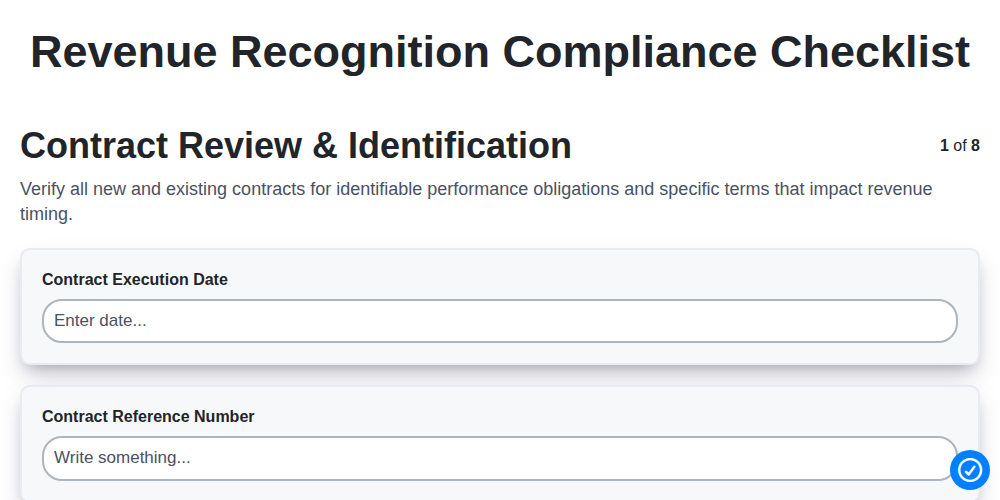
Table of Contents
- Introduction: Why Revenue Recognition Compliance Matters
- Step 1: Contract Review & Identification
- Step 2: Performance Obligation Assessment
- Step 3: Transaction Price Determination
- Step 4: Allocation of Transaction Price
- Step 5: Revenue Recognition Timing
- Step 6: Documentation & Evidence Collection
- Step 7: Data Integrity & System Reconciliation
- Step 8: Disclosures & Reporting Compliance
- Conclusion: Maintaining Continuous Compliance
- Resources & Links
TLDR: Ensure your revenue accounting is audit-ready and compliant with ASC 606/IFRS 15 standards using our comprehensive Revenue Recognition Compliance Checklist. This guide provides a systematic, step-by-step framework-from contract review to final disclosure-to help finance professionals mitigate risk, prevent revenue leakage, and streamline the financial reporting process.
Introduction: Why Revenue Recognition Compliance Matters
For any growing business, revenue is the ultimate lifeblood. However, the way that revenue is recorded on your financial statements is governed by strict accounting standards, such as ASC 606 and IFRS 15. Revenue recognition is no longer just about when the cash hits your bank account; it is a complex process of matching income to the specific moment a service is rendered or a product is delivered.
Failure to adhere to these rigorous compliance standards can lead to much more than just messy spreadsheets. Inaccurate reporting can trigger significant financial penalties, lead to failed audits, distort your company's valuation, and even result in legal repercussions. In an era of heightened regulatory scrutiny, getting it wrong can erode investor confidence and damage your brand's credibility overnight.
Maintaining a robust compliance framework ensures that your financial statements reflect the true economic reality of your operations. By implementing a structured checklist, you transition from a reactive approach-scrambling during audit season-to a proactive stance of precision, transparency, and financial integrity.
Step 1: Contract Review & Identification
The foundation of accurate revenue recognition lies in the initial identification of a contract. Before any numbers can be recorded, you must ensure that a valid, legally binding agreement exists between the entity and the customer. This step is not merely about signing a piece of paper; it requires a rigorous evaluation to ensure the contract meets specific criteria under accounting standards (such as ASC 606 or IFRS 15).
To successfully complete this step, your team should verify the following:
- Approval and Commitment: Confirm that all parties have approved the contract and are committed to performing their respective obligations.
- Identification of Rights: Clearly define the specific rights each party has regarding the goods or services to be transferred.
- Payment Terms: Ensure the payment terms are clearly outlined, including when payments are due and any potential penalties.
- Commercial Substance: Verify that the contract has commercial substance-meaning the risk, timing, or amount of the entity's future cash flows is expected to change as a result of the contract.
- Collectability Assessment: Evaluate whether it is probable that you will collect the consideration to which you are entitled. If collectability is not probable at the outset, revenue recognition cannot proceed.
Failure to properly identify and review contracts can lead to top-line errors, where revenue is recognized for agreements that are not legally enforceable or where the terms are too ambiguous to support accounting entries.
Step 2: Performance Obligation Assessment
Once you have identified your contracts, the next critical step is to break them down into their individual components. Under the core principles of revenue recognition standards (such as ASC 606 or IFRS 15), you must identify each distinct performance obligation within a contract.
A performance obligation is a promise to transfer a good or service to a customer. To perform an accurate assessment, you must determine if a promised good or service is distinct. A good or service is considered distinct if the customer can benefit from it on its own and if it is separable from other promises in the contract.
During this stage, your team should focus on the following:
- Identifying Unbundled Items: Determine if the contract includes multiple deliverables, such as software licenses, implementation services, and ongoing maintenance.
- Evaluating Integration Services: Assess whether certain goods or services are highly interdependent. If you are providing a customized service that requires integrating multiple inputs to create a single combined output, those individual components may not be separate performance obligations.
- Distinguishing Between Goods and Services: Carefully analyze whether the customer is purchasing a finished product or a service that is performed over time.
Failure to correctly identify performance obligations can lead to significant errors in revenue timing, potentially resulting in non-compliance and the need for costly restatements. Accuracy here is the foundation upon which the rest of the revenue recognition process is built.
Step 3: Transaction Price Determination
Once you have identified your performance obligations, the next critical step is determining the exact amount of consideration you expect to be entitled to in exchange for transferring those goods or services. Under accounting standards like ASC 606 and IFRS 15, this is not always as simple as looking at the face value of an invoice.
To ensure compliance, your transaction price determination must account for all variable elements within a contract. You must carefully evaluate and estimate the following components:
- Variable Consideration: This includes discounts, rebates, refunds, credits, incentives, or performance bonuses. You must use either the expected value method (sum of probability-weighted amounts) or the most likely amount method to estimate these values.
- Constraints on Estimates: A key compliance requirement is the constraint rule. You should only include variable consideration in the transaction price to the extent that it is highly probable that a significant reversal in the amount of cumulative revenue recognized will not occur.
- Significant Financing Components: If the timing of payments provides the customer (or the entity) with a significant benefit of financing (i.e., a large gap between performance and payment), you must adjust the transaction price to reflect the time value of money.
- Non-Cash Consideration: If a customer pays in goods or services instead of cash, you must measure that consideration at fair value.
- Consideration Payable to a Customer: Any payments made to a customer, such as vendor rebates or slotting fees, must be assessed to determine if they should be treated as a reduction of the transaction price or as a separate expense.
Failure to accurately calculate the transaction price is one of the most common drivers of revenue restatements. Precision at this stage is vital, as any error here will flow downstream into your allocation and timing processes.
Step 4: Allocation of Transaction Price
Once you have determined the total transaction price, the next critical step is determining how much of that total amount should be assigned to each individual performance obligation identified in Step 2. Under standard accounting frameworks like ASC 606 or IFRS 15, you cannot simply split the price equally; you must allocate the transaction price based on the relative stand-alone selling price (SSP) of each promise in the contract.
To execute this step accurately, follow these essential sub-steps:
- Determine Stand-Alone Selling Prices (SSP): For every distinct good or service in the contract, you must identify the price at which you would sell that item separately to a customer.
- Use Observable Data: Whenever possible, use observable prices from recent, arm's-length transactions. This is the gold standard for audit compliance.
- Apply Estimation Methods: If a stand-alone price is not directly observable, you must use reliable estimation techniques, such as:
- Adjusted Market Assessment Approach: Evaluating the cost of fulfilling the promise plus a reasonable margin.
- Expected Cost Plus Margin Approach: Calculating the internal cost of production and adding an appropriate profit markup.
- Residual Approach: Using the remaining amount after deducting known prices (use this sparingly, as auditors will scrutinize its application).
- Calculate the Pro-Rata Allocation: Once all SSPs are established, allocate the total contract price proportionally based on the ratio of each item's SSP to the sum of all SSPs in the contract.
Why this matters for compliance: Improper allocation is a frequent trigger for audit findings. If you over-allocate value to a performance obligation that is satisfied upfront, you risk prematurely recognizing revenue, which leads to overstated earnings and potential regulatory non-compliance.
Step 5: Revenue Recognition Timing
Determining exactly when revenue can be recognized is the most critical-and often the most scrutinized-aspect of compliance. Under accounting standards like ASC 606 and IFRS 15, revenue cannot be recorded simply because an invoice has been sent; it can only be recognized when (or as) the entity satisfies a performance obligation by transferring control of a promised good or service to a customer.
To ensure compliance, your checklist must differentiate between two distinct methods:
- Point in Time: This applies to goods or services where control transfers at a specific moment (e.g., a retail sale at a cash register). You must verify that all criteria for transfer of control-such as physical possession, legal title, and the customer's ability to direct the use of the asset-have been met.
- Over Time: This applies to services or long-term contracts where the customer simultaneously receives and consumes the benefits (e.g., subscription services or maintenance contracts). In these cases, you must determine whether to use an input method (e.g., costs incurred) or an output method (e.g., milestones reached) to measure progress accurately.
A common pitfall in this step is recognizing revenue prematurely before the transfer of control is legally and operationally complete. Regularly auditing your milestones and delivery proofs is essential to prevent the inflation of current period earnings and subsequent audit adjustments.
Step 6: Documentation & Evidence Collection
In the world of revenue recognition, if it isn't documented, it didn't happen. Documentation and evidence collection serve as the audit trail that proves your revenue figures are accurate and that you have adhered to the prescribed accounting standards (such as ASC 606 or IFRS 15).
During this stage, you must move beyond simply performing the calculations and focus on gathering the objective evidence required to support every decision made in the previous steps. This includes maintaining organized records of signed contracts, amendments, and side letters that could impact the terms of a deal. You must also preserve proof of the satisfaction of performance obligations, such as delivery receipts, service acceptance forms, or milestone completion certificates.
A robust documentation process should also include a clear record of the professional judgments made-specifically regarding how you determined the transaction price and how you allocated it across multiple obligations. When auditors or internal stakeholders review your revenue figures, they aren't just looking at the final number; they are looking for the why and how behind it. Establishing a centralized, easily accessible repository for all contract-related evidence is essential for minimizing audit friction and ensuring long-term regulatory compliance.
Step 7: Data Integrity & System Reconciliation
Even the most accurate revenue recognition policy is rendered useless if the underlying data is flawed. Data integrity and system reconciliation serve as the audit trail that proves your reported revenue matches the actual economic activity captured in your sub-ledgers. To ensure compliance, you must verify that the data flowing from your CRM (like Salesforce) to your billing systems and finally to your ERP (like NetSuite or SAP) remains consistent and untampered with.
This step requires a rigorous approach to two critical areas:
- Automated Data Flow Validation: Ensure that contract terms entered during the initial review phase are mapped correctly to billing triggers. Any manual intervention or workarounds in the data pipeline are high-risk areas for errors that can lead to significant restatements.
- Reconciliation of Sub-ledgers to the General Ledger: Perform regular, periodic reconciliations to ensure that the revenue recognized in your revenue module aligns perfectly with your GL. Discrepancies often hide in unapplied credits, duplicate invoices, or timing differences in automated revenue recognition engines.
The goal is to move away from manual spreadsheets and toward a single source of truth. By implementing automated reconciliations and regular integrity checks, you reduce the risk of human error and ensure that when auditors arrive, your numbers are backed by a seamless, verifiable digital thread.
Step 8: Disclosures & Reporting Compliance
The final and most critical stage of the compliance process is ensuring that everything you have calculated and documented is accurately communicated to stakeholders. Under frameworks like ASC 606 and IFRS 15, transparency is just as important as the numbers themselves. Disclosure compliance is not merely about reporting a final revenue figure; it is about providing a clear roadmap of how that revenue was derived.
To ensure full compliance in this step, your checklist should focus on the following key areas:
- Disaggregation of Revenue: You must provide detailed breakdowns of revenue to help users understand the nature, amount, timing, and uncertainty of income. This includes presenting revenue by categories such as product lines, geographic regions, contract duration, or timing of transfer (point in time vs. over time).
- Contract Balances: Ensure your reports clearly state the opening and closing balances of contract assets and contract liabilities. Any significant changes in these balances during the reporting period must be explained.
- Significant Judgments: This is where most audit findings occur. You must explicitly disclose the methods, assumptions, and judgments used in determining the transaction price, assessing performance obligations, and allocating the transaction price. If you used complex estimation models for variable consideration, the logic behind those estimates must be transparent.
- Remaining Performance Obligations (Backlog): For many industries, disclosing the amount of revenue recognized in the current period that is included in the transaction price of remaining performance obligations is vital for predicting future cash flows.
By treating disclosure as a structured part of your revenue recognition workflow rather than an afterthought, you protect your organization from audit adjustments and build long-term credibility with investors and regulators.
Conclusion: Maintaining Continuous Compliance
Achieving revenue recognition compliance is not a one-time event, but an ongoing commitment to financial integrity. As business models evolve, new contracts are signed, and regulatory standards shift, your compliance framework must remain dynamic. Relying on a static approach leaves your organization vulnerable to audit findings, financial restatements, and loss of stakeholder trust.
By treating this checklist as a living document-integrating these steps into your monthly or quarterly closing cycles-you move beyond mere reactive troubleshooting and toward proactive financial leadership. Implementing rigorous controls around contract review, obligation assessment, and data reconciliation ensures that your revenue reporting is not only accurate but also transparent and audit-ready at any moment. Ultimately, consistent application of these principles protects your bottom line and provides the stable financial foundation necessary for long-term scalable growth.
Resources & Links
- FASB (Financial Accounting Standards Board): The official source for ASC 606 standards and updates regarding revenue recognition frameworks.
- IFRS Foundation: Essential resources for understanding IFRS 15 standards for international revenue recognition compliance.
- PwC Accounting Guides: In-depth technical guides and practical interpretations of revenue recognition principles for complex contracts.
- EY Financial Reporting Insights: Expert analysis on navigating the complexities of transaction price allocation and performance obligations.
- Deloitte IAS Plus: Comprehensive summaries of revenue recognition developments and regulatory reporting requirements.
- KPMG Audit & Assurance Resources: Insights into maintaining data integrity, documentation, and audit-ready financial controls.
Frequently Asked Questions
What is revenue recognition compliance?
Revenue recognition compliance is the process of ensuring that a company records its income in accordance with established accounting standards, such as ASC 606 or IFRS 15, to ensure financial statements accurately reflect the timing and amount of earned revenue.
Why is it important to be 'audit-ready' for revenue recognition?
Being audit-ready minimizes the risk of financial restatements, prevents penalties from regulatory bodies, and builds trust with investors, lenders, and stakeholders by demonstrating transparent and accurate financial reporting.
What are the five core steps of the ASC 606 revenue recognition model?
The five steps are: 1) Identify the contract with a customer, 2) Identify the performance obligations in the contract, 3) Determine the transaction price, 4) Allocate the transaction price to the performance obligations, and 5) Recognize revenue when (or as) the entity satisfies a performance obligation.
What common pitfalls should companies avoid during revenue recognition?
Common pitfalls include failing to properly identify separate performance obligations, incorrectly estimating variable consideration (like discounts or rebates), and neglecting to document significant changes in contract terms.
How often should a company review its revenue recognition processes?
Companies should review their processes continuously, but formal audits and reconciliations should occur at least quarterly and annually to ensure ongoing compliance with evolving accounting standards.
What documentation is essential for a revenue recognition audit?
Essential documentation includes signed customer contracts, evidence of service delivery or product shipment, invoices, proof of payment, and internal memos explaining the application of accounting standards to complex transactions.
Comments
There are no comments yet. Be the first to add one!
Accounting Management Solution Demo
Move beyond rigid, one-size-fits-all software. Leverage a fully programmable accounting environment designed to adapt to your unique workflows, complex hierarchies, and evolving business logic.
Related Articles
The Ultimate Financial Data Integrity Audit Checklist: A Step-by-Step Template for Precision and Compliance
The Ultimate Financial Statement Review Checklist: A Step-by-Step Guide to Ensuring Accuracy and Compliance
Mastering Financial Control: The Ultimate Departmental Budget Monitoring Checklist
The Ultimate Accounts Receivable Collections Checklist: A Step-by-Step Guide to Streamlining Your Cash Flow
The Ultimate Payroll Processing & Compliance Checklist: A Step-by-Step Guide to Error-Free Payroll
The Ultimate Year-End Audit Preparation Checklist: A Step-by-Step Guide to a Stress-Free Audit
The Ultimate Software Implementation Checklist for Accounting Teams: A Step-by-Step Guide to a Seamless Transition
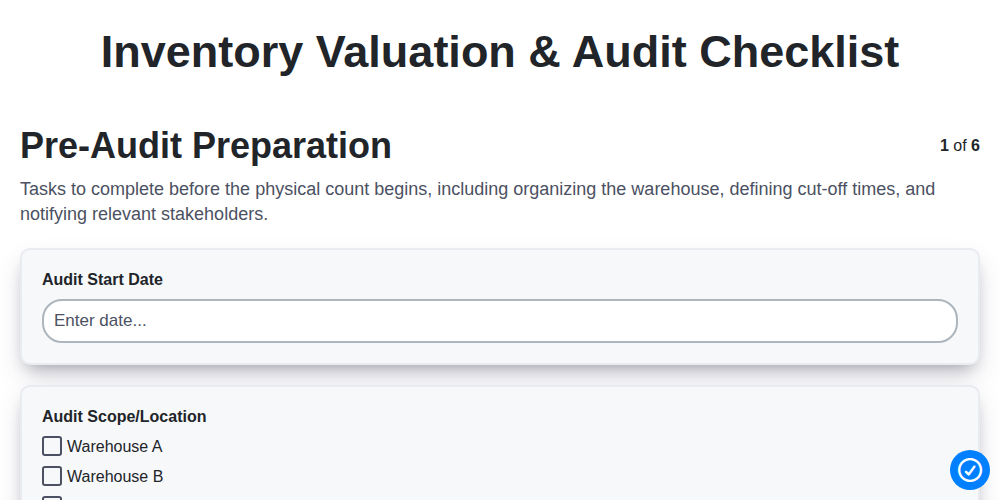
The Ultimate Inventory Valuation & Audit Checklist: A Step-by-Step Guide to Accuracy and Compliance
Need help with
Accounting Management?
Have a question? We're here to help. Please submit your inquiry, and we'll respond promptly.