The Ultimate Sales Tax Filing & Reporting Checklist: A Step-by-Step Guide to Compliance Accuracy
Published: 07/12/2026 Updated: 10/05/2026
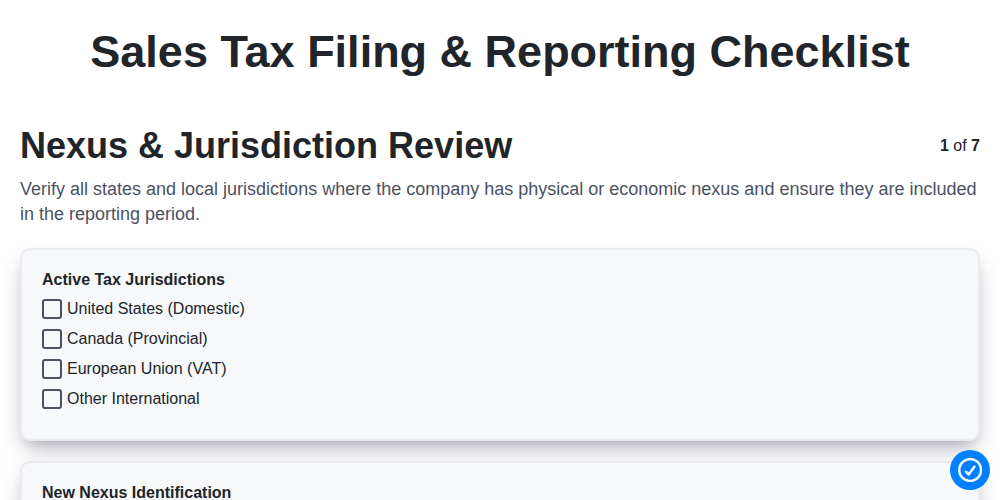
Table of Contents
- Introduction: Why a Systematic Sales Tax Checklist is Essential
- Step 1: Nexus & Jurisdiction Review: Determining Where You Owe
- Step 2: Transaction Data Validation: Ensuring Data Integrity
- Step 3: Exemption Certificate Audit: Verifying Tax-Exempt Sales
- Step 4: Gross Sales Reconciliation: Aligning Revenue Records
- Step 5: Tax Collected vs. Tax Payable Verification: Spotting Discrepancies
- Step 6: Filing & Remittance Execution: Completing the Payment Process
- Step 7: Post-Filing Documentation & Archive: Building an Audit Trail
- Conclusion: Maintaining Continuous Compliance
- Resources & Links
TLDR: Avoid costly penalties and-audit risks with our comprehensive Sales Tax Filing & Reporting Checklist. This guide provides a streamlined, step-by-step framework-from Nexus Review to Post-Filing Documentation-designed to help businesses validate transaction data, audit exemptions, and ensure 100% accuracy in tax remittance and compliance reporting.
Introduction: Why a Systematic Sales Tax Checklist is Essential
Managing sales tax is one of the most high-stakes responsibilities in any-tax-collecting business. Unlike many other financial tasks, sales tax errors are rarely fixable with a simple correction; they often trigger aggressive audits, significant penalties, and interest charges from state and local authorities. As businesses expand across state lines, the complexity of tax obligations grows exponentially, turning a simple periodic task into a logistical minefield.
A systematic sales tax filing and reporting checklist serves as more than just a productivity tool-it acts as your business's primary defense mechanism. By implementing a standardized, step-by-step process, you move away from a reactive panic-driven filing approach and toward a proactive culture of compliance. A rigorous checklist ensures that no jurisdiction is overlooked, every exemption is properly documented, and the numbers reported to the government align perfectly with your internal ledgers. Ultimately, a well-structured checklist minimizes the risk of human error, reduces the time spent on manual reconciliations, and provides a clear audit trail that can save your company from costly-compliance nightmares.
Step 1: Nexus & Jurisdiction Review: Determining Where You Owe
Before you can accurately report your sales tax, you must first determine exactly where you have a legal obligation to collect and remit it. This process, known as establishing nexus, is the foundation of your entire tax strategy.
A nexus review involves identifying the physical and economic triggers that link your business to a specific state or jurisdiction. Traditionally, this was based on a physical nexus-having an office, warehouse, or even a single employee in a state. However, in the modern e-commerce era, most states now enforce economic nexus laws. These laws trigger tax obligations based on a specific threshold of sales volume or the number of transactions occurring within that state's borders.
To complete this step effectively, you should:
- Audit your physical footprint: List all locations, inventory centers, and remote employees across all states.
- Evaluate economic thresholds: Monitor your sales totals per state to see if you have crossed the bright-line thresholds (e.g., $100,000 in sales or 200 transactions) that trigger a filing requirement.
- Identify specific jurisdictions: Remember that your obligation isn't just to the state, but potentially to local municipalities, counties, or special taxing districts that may impose their own additional rates.
Failing to perform a thorough nexus review can lead to significant liabilities, including back taxes, interest, and hefty penalties for uncollected tax. Mapping out your jurisdictions early ensures you aren't overpaying in states where you have no obligation, while ensuring you aren't missing much more critical liabilities elsewhere.
Step 2: Transaction Data Validation: Ensuring Data Integrity
The foundation of an accurate tax filing lies in the quality of your underlying data. Before you even begin calculating tax liabilities, you must perform a rigorous validation of your transaction data to ensure that every taxable event is accounted for and every error is caught early.
Data discrepancies-often caused by manual entry errors, system glitches, or incorrect product mapping-are the primary drivers of audit red flags. To maintain data integrity, focus on the following key validation checks:
- Verify Transaction Completeness: Cross-reference your total number of orders in your sales platform against your accounting software and tax engine. Ensure no transactions were dropped during the data sync process.
- Audit Product Taxability Mapping: Confirm that each SKU or product category is assigned the correct tax code. A single misclassified item (e.g., treating a taxable service as a non-taxable good) can lead to significant under- or over-reporting.
- Review Shipping and Surcharge Accuracy: Ensure that shipping fees, handling charges, and other surcharges are being taxed according to the specific rules of each jurisdiction. In many states, shipping is taxable, and overlooking this can lead to unexpected liabilities.
- Detect Duplicate Entries: Scan for duplicate transaction IDs or overlapping entries that may have occurred during period closes or data imports.
By proactively scrubbing your data for inaccuracies, you mitigate the risk of silent errors that are difficult and expensive to correct once the filing has been submitted to the state.
Step 3: Exemption Certificate Audit: Verifying Tax-Exempt Sales
One of the most common-yet-overlooked pitfalls in sales tax compliance is failing to properly document tax-exempt transactions. When you do not charge sales tax to a customer, the burden of proof lies entirely on your business to demonstrate why that tax was not collected. During an audit, tax authorities will scrutinize every exempt sale to ensure they are legitimate.
An effective Exemption Certificate Audit involves more than just checking a box; it requires a systematic review of your documentation to ensure compliance. Follow these essential steps:
- Validate Certificate Completeness: Ensure every exempt transaction is supported by a valid, completed certificate from the buyer. A certificate is considered invalid if it is missing key information such as the buyer's legal name, tax ID number, or the specific jurisdiction's required fields.
- Verify Expiration Dates: Exemption certificates are not permanent. Many jurisdictions require periodic renewals, and some certificates have expiration dates tied to the buyer's business license. Periodically review your database to identify and request updated certificates for expired accounts.
- Confirm Proper Classification: Not all tax-free sales are the same. Ensure that the exemption type applied (e.g., resale, manufacturing, non-profit, or governmental) matches the actual nature of the transaction. Applying a resale exemption to a non-profit sale is a major red flag for auditors.
- Match Certificates to Transactions: Conduct periodic spot checks to ensure that the exempt orders listed in your sales ledger correspond directly to a valid certificate on file.
By maintaining a rigorous audit process, you mitigate the risk of hidden tax liabilities, where an auditor reclassifies exempt sales as taxable, leading to significant back taxes, interest, and penalties.
Step 4: Gross Sales Reconciliation: Aligning Revenue Records
The core of any successful sales tax filing lies in the accuracy of your top-line numbers. Gross sales reconciliation is the critical process of ensuring that the total revenue reported on your income statements, P&L, or general ledger matches the total taxable and non-taxable sales reported in your sales tax return.
Discrepancies between your accounting software and your tax filings are a major red flag for auditors. To perform an effective reconciliation, you must systematically compare your gross sales figures across all platforms-including e-commerce stores, point-of-sale (POS) systems, and third-party marketplaces-against your internal financial records.
When performing this step, focus on identifying and accounting for:
- Timing Differences: Revenue recognized in one period but settled in another.
- Returns and Allowances: Ensuring that refunds and credits are properly deducted from your gross sales to avoid overpaying tax.
- Discounts and Promotions: Verifying that promotional reductions were applied to the taxable base correctly.
- Shipping and Handling: Confirming whether these line items are taxable in your specific jurisdictions.
By reconciling these figures before you hit submit, you mitigate the risk of under-reporting (which leads to penalties) and over-reporting (which results in lost margin and unnecessary overpayments). A clean reconciliation ensures that your tax liability is based on a single, verifiable source of truth.
Step 5: Tax Collected vs. Tax Payable Verification: Spotting Discrepancies
After you have reconciled your gross sales, the next critical step is to perform a direct comparison between the actual amount of tax you collected from customers and the amount you are preparing to remit to the tax authorities. This is the moment of truth in the filing process.
The goal here is to ensure that your Tax Collected (the liability recorded in your books) matches your Tax Payable (the calculated amount based on your nexus-specific tax rates). Even a minor discrepancy can trigger an automated red flag in state tax agency auditing software.
When performing this verification, look for these common culprits:
- Rounding Errors: Small differences often arise when your-point-of-sale (POS) system rounds fractions of a cent differently than your accounting software.
- Incorrect Tax Rates: Ensure that recent changes in local or district tax rates have been applied correctly to your sales data.
- Misapplied Credits/Discounts: Verify that discounts were applied to the taxable base before tax was calculated, rather than after.
- Unaccounted-for Returns: Ensure that sales tax refunds/credits for returned goods have been properly subtracted from the total tax collected.
If you find a discrepancy, do not proceed with the filing until you have identified the source. If the error is significant, you may need to go back to Step 2 (Transaction Data Validation) to correct the underlying data. A clean reconciliation at this stage is your best defense against future audits and costly penalties.
Step 6: Filing & Remittance Execution: Completing the Payment Process
Once you have verified that your tax liability is accurate, it is time to move into the final, most critical phase: the actual submission of your returns and the transfer of funds. This step is the point of no return, where the accuracy of your previous audits is put to the test.
To ensure a smooth execution, follow these essential sub-steps:
- Timely Submission: Always cross-reference your filing deadline with the specific requirements of each jurisdiction. Missing a deadline-even by a single day-can trigger automatic penalties and interest charges that are difficult to dispute.
- Follow Jurisdiction-Specific Rules: Remember that filing looks different depending on the authority. Some states require electronic filing through their own portals, while others may require third-party integration. Ensure you are using the correct format and specific forms required by each specific tax agency.
- The Payment Transfer: Ensure the funds are available in the appropriate account and that the payment method (ACH, wire, or credit card) is authorized for the amount. If you are using a third-party tax automation tool, double-check that the payment trigger has been successfully confirmed.
- Confirmation of Receipt: Never assume a submit click means the job is done. Always download the electronic confirmation or receipt provided by the tax authority. This serves as your primary defense in the event of a technical glitch or a disputed unpaid status.
Completing this step successfully moves your liability from accrued to settled, officially closing the loop on your reporting period.
Step 7: Post-Filing Documentation & Archive: Building an Audit Trail
The final, and perhaps most underrated, step in the sales tax cycle is the creation of a robust audit trail. Filing your returns and remitting payment only completes the immediate obligation; true compliance requires preserving the evidence behind every number reported.
Post-filing documentation is your primary defense in the event of a state or local tax audit. If a revenue agent arrives months or even years later to challenge your filings, you must be able to reconstruct your logic and verify your data instantly. A set it and forget it mentality is a significant liability.
To build a professional-grade archive, ensure you securely store the following for each filing period:
- Filed Returns & Confirmation Receipts: Keep the final copies of all submitted returns along with the electronic confirmation or timestamped receipt from the state's tax portal.
- Detailed Workpapers: Store the spreadsheets or reports used to calculate your totals. This includes the reconciliation between your gross sales and your taxable sales.
- Proof of Payment: Retain bank statements, ACH confirmations, or canceled checks that prove the exact amount remitted matches the amount reported.
- Exemption Documentation: Maintain an organized digital folder of all valid exemption certificates used to justify non-taxable transactions during that period.
Pro-Tip: Aim for a centralized, cloud-based document management system rather than scattered email attachments. Organize folders by Year > Jurisdiction > Tax Period (e.g., 2023 > California > Q3). This structured approach transforms a potential audit nightmare into a streamlined,-stress-free verification process.
Conclusion: Maintaining Continuous Compliance
Achieving sales tax compliance is not a one-time event, but an ongoing commitment to accuracy and diligence. While following a structured checklist provides a powerful roadmap for managing complex tax obligations, the landscape of nexus laws and jurisdictional regulations is constantly shifting. Relying on a set it and forget it mentality can leave your business vulnerable to costly audits, penalties, and interest.
To truly protect your bottom line, view this checklist as a foundational framework for building a repeatable, scalable process. By integrating these verification steps into your regular monthly or quarterly workflows, you move beyond mere reactive troubleshooting and toward a proactive state of audit-ready readiness. Ultimately, consistent adherence to these practices ensures that your business remains focused on growth, rather than being sidelined by preventable compliance errors.
Resources & Links
- Internal Revenue Service (IRS): The primary resource for understanding federal tax obligations that often intersect with state-level sales tax reporting requirements.
- Tax Foundation: Provides in-depth analysis and research on state and local tax policies, helpful for understanding complex nexus and jurisdiction changes.
- Accounting Today: A leading source for accounting professionals to stay updated on regulatory changes and best practices for tax compliance and audits.
- Avalara: A resource for automated sales tax solutions and insights into managing multi-jurisdictional tax complexities and economic nexus.
- American Institute of Certified Public Accountants (AICPA): Provides professional standards and resources for maintaining rigorous financial documentation and audit-ready reporting processes.
Frequently Asked Questions
What is the main purpose of a sales tax filing and reporting checklist?
The primary purpose is to ensure accuracy and compliance by providing a structured, step-by-step workflow that prevents missed deadlines, calculation errors, and potential audits from tax authorities.
How often do I need to file sales tax returns?
Filing frequency varies significantly depending on your state's regulations and your total sales volume. Common periods include monthly, quarterly, or annually.
What information is required to prepare a sales tax report?
You will typically need your total gross sales, a breakdown of taxable vs. non-taxable sales, the total amount of sales tax collected, and documentation for any exemptions or credits applied.
What are the consequences of failing to file sales tax accurately or on time?
Failure to comply can lead to heavy penalties, interest charges, audits, and in severe cases, the loss of your business license or legal action from state authorities.
How can I manage nexus and multiple state tax obligations?
You should regularly monitor your 'nexus'-the connection to a state that triggers tax obligations-by tracking your sales volume and physical presence (like inventory or employees) in different jurisdictions.
What is the difference between sales tax and use tax?
Sales tax is collected from customers at the point of sale on taxable goods, while use tax is self-assessed and paid by a business on items purchased from out-of-state vendors where no sales tax was collected.
Comments
There are no comments yet. Be the first to add one!
Accounting Management Solution Demo
Move beyond rigid, one-size-fits-all software. Leverage a fully programmable accounting environment designed to adapt to your unique workflows, complex hierarchies, and evolving business logic.
Related Articles
The Ultimate Financial Data Integrity Audit Checklist: A Step-by-Step Template for Precision and Compliance
The Ultimate Financial Statement Review Checklist: A Step-by-Step Guide to Ensuring Accuracy and Compliance
Mastering Financial Control: The Ultimate Departmental Budget Monitoring Checklist
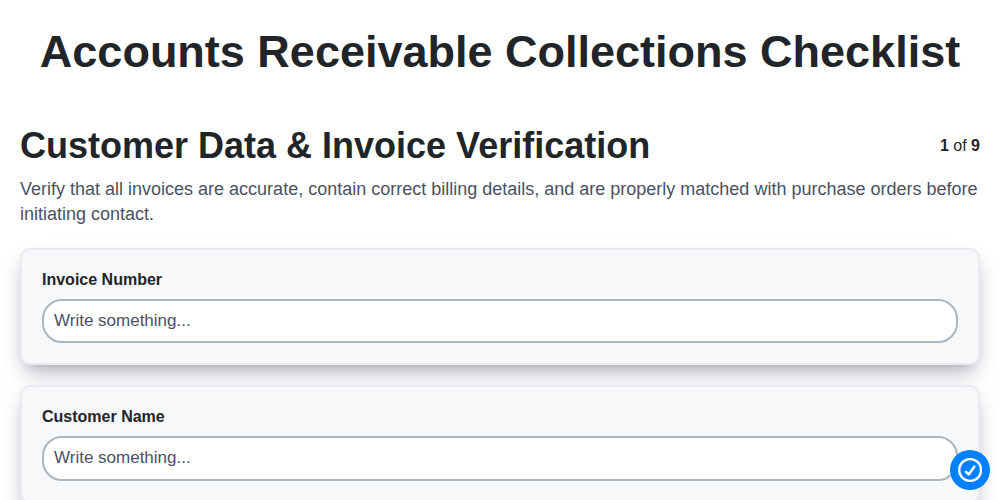
The Ultimate Accounts Receivable Collections Checklist: A Step-by-Step Guide to Streamlining Your Cash Flow
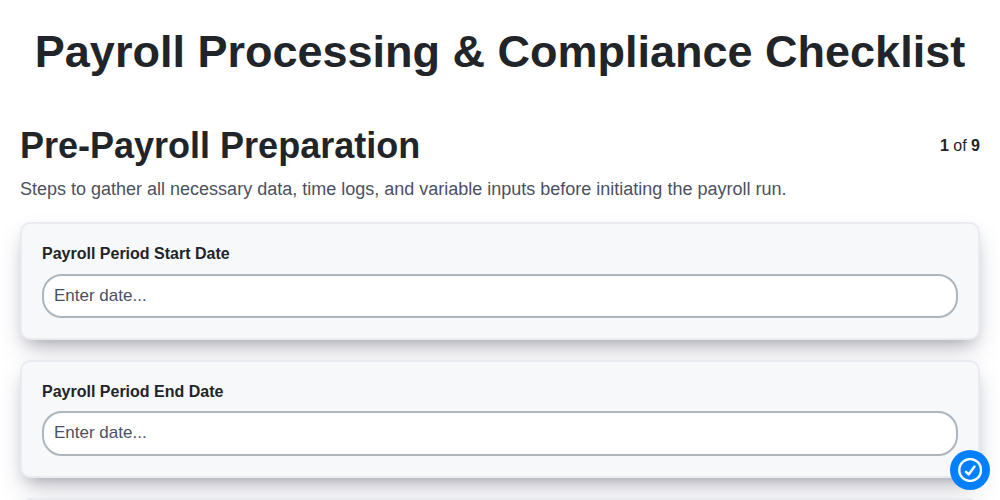
The Ultimate Payroll Processing & Compliance Checklist: A Step-by-Step Guide to Error-Free Payroll
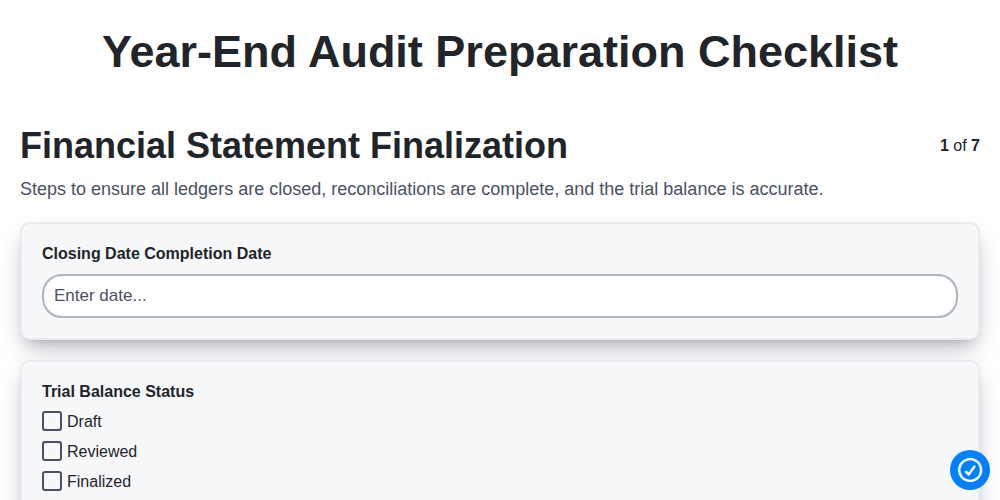
The Ultimate Year-End Audit Preparation Checklist: A Step-by-Step Guide to a Stress-Free Audit
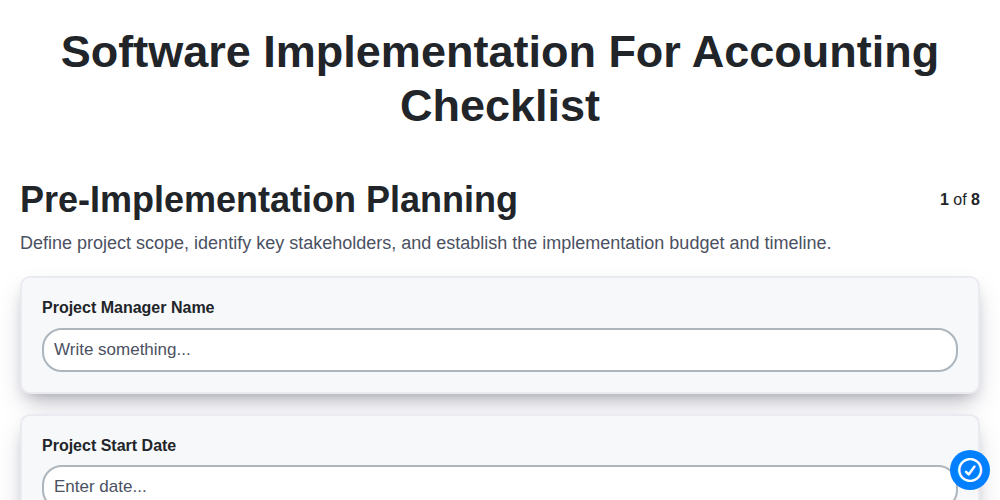
The Ultimate Software Implementation Checklist for Accounting Teams: A Step-by-Step Guide to a Seamless Transition
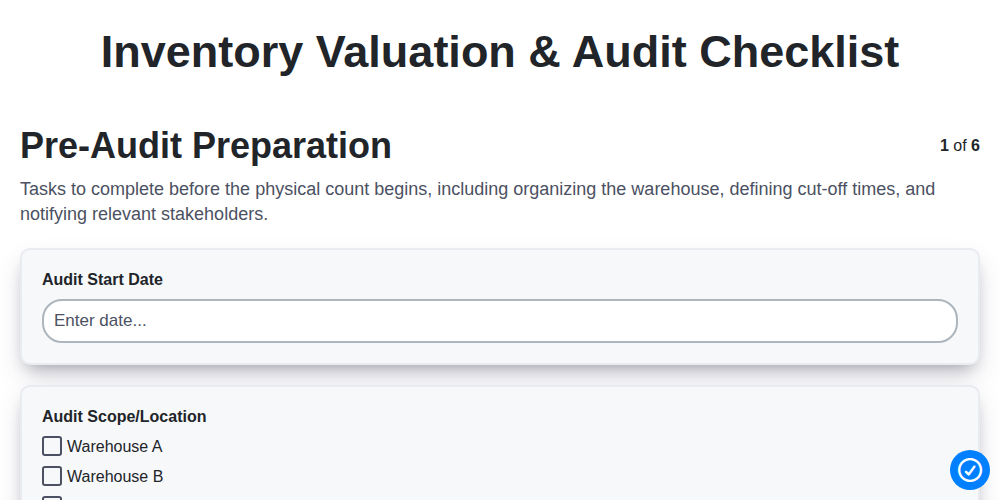
The Ultimate Inventory Valuation & Audit Checklist: A Step-by-Step Guide to Accuracy and Compliance
We can do it Together
Need help with
Accounting Management?
Have a question? We're here to help. Please submit your inquiry, and we'll respond promptly.