Mastering Your Agriculture BOM: A Seed & Fertilizer Checklist for Success
Published: 12/10/2025 10:00 PM Updated: 12/14/2025 7:57 AM
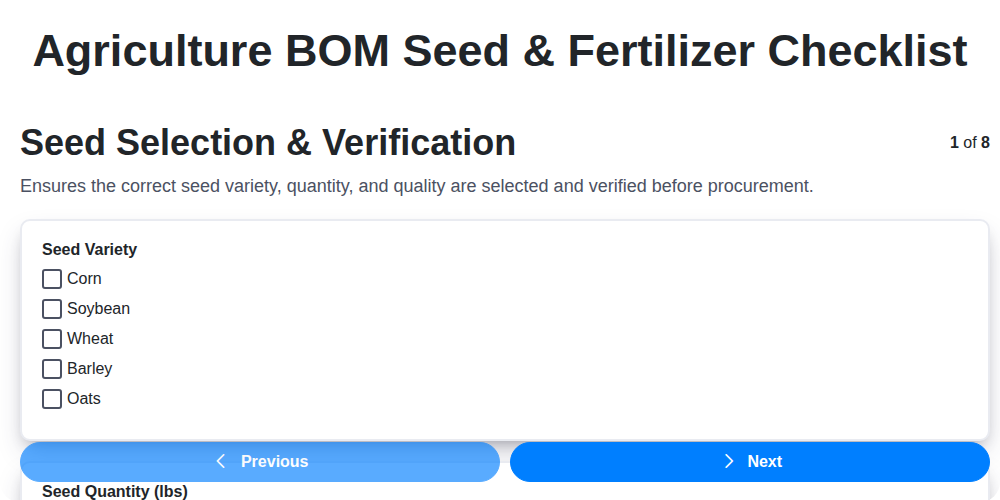
Table of Contents
- Introduction: Why a Seed & Fertilizer BOM is Crucial
- Understanding the Agriculture BOM
- Seed Selection & Verification: Laying the Foundation
- Fertilizer Analysis & Composition: Knowing What You're Using
- Supplier Certification & Traceability: Ensuring Quality & Accountability
- Storage Conditions & Shelf Life: Maintaining Viability
- Regulatory Compliance & Labeling: Staying on the Right Side of the Law
- Application Rates & Records: Precision and Documentation
- Soil Testing & Nutrient Needs: The Groundwork for Success
- Environmental Impact Assessment: Sustainable Practices
- Record Keeping: Your BOM's Living Document
- Technology Integration: Streamlining Your Checklist
- Training & Team Responsibility
- Continuous Improvement: Refining Your BOM
- Resources & Links
TLDR: Ensure optimal yields & avoid costly mistakes! This checklist guides you through seed & fertilizer selection - from verifying quality & compliance to tracking application rates & minimizing environmental impact. It's your one-stop resource for a successful Agriculture Bill of Materials (BOM) and healthy crops.
Introduction: Why a Seed & Fertilizer BOM is Crucial
In modern agriculture, maximizing yield and ensuring crop health isn't just about luck - it's about precision and planning. A Bill of Materials (BOM) for your seeds and fertilizers isn't just a nice-to-have; it's becoming an essential tool for successful and sustainable farming. Think of it as a comprehensive recipe for your crop's nutritional needs, meticulously outlining every component from seed variety to fertilizer composition.
Without a robust BOM, you risk inconsistencies in your inputs, leading to unpredictable results. Variations in seed genetics, fertilizer quality, and application methods can significantly impact yield, crop quality, and overall farm profitability. Furthermore, increasingly strict regulations and a growing emphasis on traceability demand meticulous documentation of all inputs. A well-defined seed & fertilizer BOM provides this documentation, empowering you to manage risk, optimize resources, and demonstrate responsible farming practices. This article will walk you through the key elements of this crucial document, helping you ensure your crops thrive.
Understanding the Agriculture BOM
In agriculture, a Bill of Materials (BOM) isn't just a list; it's a meticulously crafted document that outlines everything needed for a successful and sustainable harvest. Think of it as the blueprint for your planting cycle, ensuring you have the right seeds, fertilizers, and supporting information at your fingertips. For many modern farms, especially those striving for efficiency, traceability, and regulatory compliance, a robust Agriculture BOM is no longer optional - it's essential.
Traditionally, farmers might have kept these details scattered across notebooks, spreadsheets, or even relying on memory. However, a structured BOM consolidates this critical data, promoting consistency and reducing the potential for costly errors. It's a living document, updated and refined based on changing conditions, regulations, and best practices. It facilitates better planning, procurement, and ultimately, helps optimize yields while minimizing environmental impact. This post will explore the key elements of an Agriculture BOM, specifically focusing on seeds and fertilizers.
Seed Selection & Verification: Laying the Foundation
The quality of your harvest begins long before planting. Seed selection isn't just about choosing a variety; it's a critical process demanding meticulous attention to detail. Begin by defining your objectives: what traits are you prioritizing - yield, disease resistance, drought tolerance, or market demand?
Once you've identified potential varieties, thorough verification is paramount. This includes:
- Variety Purity: Ensure the seed is what the supplier claims it is. Request seed analysis certificates verifying genetic purity and absence of unwanted contaminants.
- Germination Rate: A high germination rate translates to fewer replants and higher initial stand density. Demand germination test results, and understand the testing methodology. Consider conducting your own germination tests as a secondary check.
- Seed Health: Inspect seeds for signs of disease, insect damage, or physical defects. A visual inspection can reveal a lot, but consider sending samples for laboratory testing to confirm freedom from seed-borne diseases.
- Seed Size and Uniformity: Uniformity aids in even emergence and simplifies planting.
- Source Reputation: Choose reputable seed suppliers with a proven track record of delivering quality seed.
Prioritize seed with robust documentation and traceability to ensure a strong foundation for your agricultural operation.
Fertilizer Analysis & Composition: Knowing What You're Using
Understanding the precise composition of your fertilizer is absolutely critical for maximizing crop yields and minimizing environmental impact. It's more than just looking at the NPK ratio (Nitrogen, Phosphorus, Potassium); it's about knowing exactly what's contributing to that ratio and what other elements are present.
Decoding the Numbers: The familiar NPK numbers on a fertilizer bag represent the percentage by weight of total nitrogen (N), available phosphorus (P₂O₅), and soluble potash (K₂O). While these are important, they don't tell the whole story. For instance, a fertilizer might claim to be high in nitrogen, but is that nitrogen derived from slow-release urea, ammonium nitrate, or another source? Each has different effects on plant uptake and potential for leaching.
Beyond NPK: The Micronutrient Picture: Healthy plant growth relies on a range of micronutrients, including zinc, iron, manganese, copper, boron, and molybdenum. A complete fertilizer analysis will detail the presence and concentration of these vital elements. Deficiencies in micronutrients can manifest as stunted growth, discoloration, and reduced yields, even if macronutrient levels appear adequate.
Understanding Fertilizer Forms: Fertilizers come in various forms - granular, liquid, soluble powders, and organic. Each form impacts nutrient availability. Soluble fertilizers provide nutrients rapidly, while slow-release options provide a more sustained release, reducing the risk of burn and optimizing nutrient uptake over time. The analysis should also consider the form and its implications for application.
Reviewing the Certificate of Analysis (COA): Reputable fertilizer suppliers will provide a Certificate of Analysis. This document outlines the exact composition of a specific batch, confirming that it meets the advertised specifications. Always review the COA to ensure you're getting what you're paying for. Discrepancies can impact your planting strategy and potentially harm your crops.
Supplier Certification & Traceability: Ensuring Quality & Accountability
The origin and journey of your seeds and fertilizers are critical to their performance and your farm's success. Simply put, knowing who supplied your inputs and where they came from isn't just a nice-to-have; it's a vital component of a robust agricultural BOM (Bill of Materials) checklist.
Why Traceability Matters:
- Authenticity Verification: Certification verifies that your suppliers adhere to recognized quality standards and best practices. This dramatically reduces the risk of counterfeit or substandard products entering your farm.
- Problem Resolution: If issues arise - unexpected crop failure, nutrient deficiencies - robust traceability allows you to quickly identify the source and address the problem efficiently. This could involve recalling a problematic batch or working with the supplier to adjust formulations.
- Accountability: Holding suppliers accountable for the quality and performance of their products fosters a partnership built on trust and mutual benefit.
- Market Access: Increasingly, consumers and retailers demand transparency regarding the origin of agricultural products. Demonstrating supplier certification can enhance your market access and brand reputation.
What to Look For in Supplier Documentation:
- Certifications: Request copies of certifications such as ISO 9001 (Quality Management), Organic certifications (if applicable), or other industry-specific quality control accreditations.
- Batch Records: Suppliers should maintain detailed records for each batch of seed or fertilizer produced, including raw material sources, processing steps, and quality control results.
- Chain of Custody Documentation: Traceability extends beyond the supplier. Understand the origin of their raw materials and verify their chain of custody.
- Regular Audits: Confirm that suppliers are subject to regular, independent audits to ensure ongoing compliance with quality standards.
Prioritizing supplier certification and traceability is an investment in the long-term health and productivity of your farm.
Storage Conditions & Shelf Life: Maintaining Viability
Proper seed and fertilizer storage is critical for ensuring optimal performance in the field. Degradation due to improper conditions can significantly reduce germination rates for seeds and diminish nutrient availability in fertilizers, leading to yield losses and increased input costs.
Seed Storage: Seeds are essentially dormant life - incredibly sensitive to environmental factors. High temperatures and humidity are the primary enemies.
- Temperature: Cool, consistent temperatures (ideally below 50°F or 10°C) are essential for extending seed longevity. Fluctuations are even more damaging than slightly warmer consistent temperatures.
- Humidity: Relative humidity should be kept low, ideally between 8-12%. Moisture encourages mold and fungal growth, which can decimate a seed lot.
- Pest Control: Protect seeds from insects and rodents through sealed containers and regular inspections.
- Packaging: Store seeds in airtight, moisture-proof containers. Original packaging is often designed for optimal storage and should be maintained if possible.
- Shelf Life: While some seeds remain viable for several years under ideal conditions, others degrade much faster. Refer to seed packaging for specific storage recommendations and viability guarantees.
Fertilizer Storage: While fertilizers are generally more robust than seeds, they aren't immune to degradation.
- Moisture Protection: Moisture can cause fertilizers to cake, clump, and even lead to chemical changes, reducing their effectiveness. Store in a dry, covered area.
- Temperature: Excessive heat can lead to nutrient loss and changes in physical properties. Avoid direct sunlight and extreme temperatures.
- Segregation: Store fertilizers separately from seeds and other agricultural chemicals to prevent cross-contamination.
- Shelf Life: Most granular fertilizers have a long shelf life (several years) if stored correctly. However, liquid fertilizers are more susceptible to degradation and should be used within the recommended timeframe specified by the manufacturer.
Regular inspections of storage areas and adherence to manufacturer's instructions are key to preserving the quality and viability of both seeds and fertilizers.
Regulatory Compliance & Labeling: Staying on the Right Side of the Law
Navigating the agricultural landscape means understanding and adhering to a complex web of regulations. Seed and fertilizer labeling, in particular, is heavily scrutinized to protect farmers, consumers, and the environment. Failure to comply can result in hefty fines, product recalls, and damage to your reputation.
Seed Regulations: Most jurisdictions have strict requirements regarding seed labeling, including:
- Variety Designation: Clearly identifying the seed variety, often with specific designations or registration numbers.
- Purity & Germination Rates: Accurate labeling of germination rates and purity percentages is paramount. Independent testing and certification are often required to validate these claims.
- Treated Seeds: If seeds have been treated with pesticides or other substances, this must be clearly indicated on the label with appropriate warnings and handling instructions.
- Genetic Modification (GMOs): Transparency regarding genetically modified organisms (GMOs) is increasingly important and often legally mandated. Proper labeling ensures informed consumer choice.
Fertilizer Regulations: Similarly, fertilizer regulations focus on accurate composition and potential environmental impact:
- Guaranteed Analysis: The label must display a guaranteed analysis, detailing the percentages of key nutrients (Nitrogen, Phosphorus, Potassium - NPK) and other essential elements.
- Ingredient Disclosure: A comprehensive list of ingredients, including inert materials, is typically required.
- Warnings & Safety Precautions: Labels must include warnings about potential hazards, such as toxicity to aquatic life or risks associated with improper handling.
- Registration & Permits: Fertilizer products often require registration with regulatory agencies, and distributors may need specific permits to handle and sell them.
Staying Compliant:
- Know Your Local Laws: Regulations vary significantly by region. It's crucial to research and understand the specific requirements in your area.
- Maintain Records: Keep meticulous records of supplier certifications, testing results, and product labeling information.
- Stay Updated: Regulations evolve. Regularly check with your local agricultural agencies for updates and changes.
- Consult Experts: Consider engaging with agricultural consultants or legal professionals specializing in regulatory compliance to ensure ongoing adherence.
Application Rates & Records: Precision and Documentation
Getting the seed and fertilizer application right is critical for maximizing yields and minimizing waste. It's not just about spreading product; it's about applying the right amount in the right place at the right time. This necessitates a robust system for defining application rates and meticulously maintaining records.
Defining Application Rates: Rates shouldn't be arbitrary. They should be data-driven, informed by factors like soil testing results (discussed earlier!), crop needs at specific growth stages, weather patterns, and the seed and fertilizer's individual specifications. Consult with agronomists and utilize crop modeling tools to determine optimal rates. Keep detailed documentation of the rationale behind each rate; explain why a particular rate was chosen, referencing soil test results, variety recommendations, and anticipated environmental conditions.
Record Keeping: Your Foundation for Improvement: Comprehensive records are the backbone of a successful and sustainable agriculture program. These records should include:
- Date of Application: Crucial for tracking patterns and identifying potential issues.
- Product Applied: Specific type and grade of seed and fertilizer.
- Application Rate: Clearly documented amount per acre/hectare.
- Method of Application: Broadcast, banded, side-dressed, etc.
- Equipment Used: Type of applicator and calibration data.
- Operator: Identifies who performed the application.
- Area Treated: GPS coordinates or field maps to confirm boundaries.
- Weather Conditions: Precipitation, temperature, and wind speed during and after application.
- Observations: Any unusual conditions noted during application (e.g., clogs, uneven spread).
Why are Records So Important?
- Optimization: Analyzing past records allows you to fine-tune application rates for future seasons, improving efficiency and potentially reducing input costs.
- Compliance: Detailed records are often required for regulatory reporting and environmental audits.
- Problem Solving: If crop performance is subpar, records help pinpoint potential issues related to fertilizer or seed application.
- Sustainability: Minimize waste, reduce environmental impact, and promote responsible resource management.
Embrace digital tools - GPS-guided applicators, farm management software, and mobile apps - to streamline data collection and enhance record accuracy. Your future success depends on precision and documentation today.
Soil Testing & Nutrient Needs: The Groundwork for Success
Before a single seed is sown or a pound of fertilizer applied, understanding your soil is paramount. Soil testing isn't just a good practice; it's the bedrock upon which a successful harvest is built. Neglecting this crucial step can lead to wasted resources, stunted growth, and ultimately, a disappointing yield.
Why Soil Testing Matters:
Soil isn't just dirt; it's a complex ecosystem teeming with life and containing essential nutrients. Soil tests provide a snapshot of its current status, revealing:
- pH Levels: Acidity or alkalinity affects nutrient availability. Optimal pH allows plants to absorb nutrients efficiently.
- Macronutrient Levels: Measures the presence of major nutrients like Nitrogen (N), Phosphorus (P), and Potassium (K) - essential for plant growth and development.
- Micronutrient Levels: Checks for the availability of crucial micronutrients like Iron (Fe), Zinc (Zn), and Manganese (Mn), which are needed in smaller quantities but are vital for various physiological processes.
- Organic Matter Content: Influences soil structure, water retention, and nutrient cycling.
- Salinity Levels: High salt concentrations can inhibit plant growth.
Nutrient Needs and Interpretation:
Once you have the soil test results, it's time to interpret them. The lab report will typically include recommendations for fertilizer application based on the crops you intend to grow. These recommendations will consider:
- Crop-Specific Needs: Different crops have varying nutrient requirements. A corn crop will need different amounts of NPK compared to a soybean crop.
- Yield Goals: Higher yield goals often require higher nutrient inputs.
- Soil Type: Sandy soils tend to lose nutrients more quickly than clay soils, requiring more frequent applications.
Beyond the Test:
Soil testing isn't a one-time event. Regular testing (every 1-3 years, or more frequently for intensive cropping systems) helps monitor nutrient levels, identify deficiencies, and adjust fertilization strategies accordingly. Combine soil test results with observations of plant health and growth to fine-tune your approach and ensure optimal plant nutrition.
Environmental Impact Assessment: Sustainable Practices
Agriculture's footprint on the environment is undeniable, but proactive steps can significantly mitigate negative impacts. A robust Environmental Impact Assessment (EIA) is a critical component of any modern seed and fertilizer BOM checklist. This isn't just about ticking a box; it's about fundamentally rethinking how we approach crop production.
The EIA should go beyond simple compliance and consider the wider ecological consequences of your inputs. This includes evaluating the potential for seed and fertilizer runoff to pollute waterways, impacting aquatic life and potentially contaminating drinking water sources. Consider the impact of fertilizer production itself - the energy consumed and greenhouse gas emissions generated.
Specifically, your assessment should address:
- Nutrient Leaching Potential: Evaluate soil types and topography to understand the risk of nitrogen and phosphorus leaching. Consider using slow-release fertilizers or precision application techniques to minimize this.
- Impact on Biodiversity: Assess the potential effects on beneficial insects, pollinators, and soil microorganisms. Promote practices that support a healthy ecosystem.
- Greenhouse Gas Emissions: Calculate the carbon footprint associated with fertilizer production, transportation, and application. Explore options for reducing emissions, like using organic fertilizers or improving nitrogen use efficiency.
- Soil Health Degradation: Assess how seed and fertilizer choices affect soil organic matter, structure, and microbial activity. Prioritize inputs that enhance soil health and fertility long-term.
- Water Usage: Consider the water requirements for seed germination and fertilizer uptake, and implement strategies for efficient irrigation.
By integrating a thorough EIA into your BOM checklist and actively seeking sustainable alternatives, you can contribute to more environmentally responsible agricultural practices. This is not only ethically sound but also increasingly vital for long-term agricultural viability and consumer demand.
Record Keeping: Your BOM's Living Document
Your Bill of Materials (BOM) isn't a static document; it's a living record of your agricultural inputs - seeds and fertilizers - and maintaining accurate records is absolutely crucial for success and compliance. Think of it as the backbone of your farming operation's traceability and performance.
Beyond just listing items, meticulous record-keeping allows you to analyze trends, identify inefficiencies, and proactively address potential issues. This includes documenting the entire process outlined in your seed and fertilizer checklist.
What should you be logging? Think beyond just purchase dates and quantities. Capture details like:
- Seed Lot Numbers & Origin: Link each seed lot back to its source and supplier documentation.
- Fertilizer Analysis Reports: Keep copies of lab reports detailing the nutrient composition.
- Application Dates & Rates: Precisely record when and how much of each fertilizer was applied to specific fields.
- Environmental Assessment Findings: Document the results of any environmental impact assessments conducted.
- Soil Test Results & Recommendations: Maintain a history of soil tests and the corresponding nutrient recommendations.
- Supplier Certificates & Traceability Documents: Store these securely and readily accessible.
- Observed Plant Performance: Note any unusual growth patterns or deficiencies, linking them back to specific seed/fertilizer lots.
Utilize digital tools where possible. Spreadsheet software, farm management apps, or specialized BOM software can significantly streamline record-keeping, making analysis and reporting much easier. Consistent, detailed records aren't just good practice; they're essential for sustainable and profitable agriculture.
Technology Integration: Streamlining Your Checklist
Managing a comprehensive Agriculture BOM (Bill of Materials) checklist for seeds and fertilizers can quickly become overwhelming with manual processes. Thankfully, technology offers powerful solutions to streamline the entire process, improve accuracy, and enhance traceability.
Consider moving beyond paper-based checklists and spreadsheets. Digital platforms, specifically designed for agriculture, offer features like:
- Mobile Accessibility: Allows field staff to record data in real-time, eliminating delays and reducing errors. Imagine instantly documenting seed lot numbers upon delivery or fertilizer application details directly from the field.
- Automated Reminders: Set alerts for approaching expiration dates, regulatory compliance deadlines, or scheduled soil testing, preventing costly oversight.
- Data Centralization: Consolidate all BOM information - seed specifications, fertilizer analysis, supplier certifications, application records - in a single, accessible database. This fosters better collaboration and simplifies reporting.
- Integration with IoT Devices: Connect your BOM checklist with sensor data from soil monitors, weather stations, or fertilizer spreaders for even more informed decision-making.
- Blockchain for Traceability: Enhance transparency and build trust within your supply chain by leveraging blockchain technology to track seeds and fertilizers from origin to application.
By embracing these technologies, you can transform your Agriculture BOM checklist from a cumbersome task into a proactive tool for optimizing yields, minimizing waste, and ensuring sustainable farming practices.
Training & Team Responsibility
Successful implementation of this Seed & Fertilizer BOM checklist hinges on a well-trained and accountable team. Simply having the checklist isn't enough; understanding why each step is crucial and knowing how to execute it correctly is paramount.
We recommend a tiered training program. Initial onboarding should cover the overall purpose of the checklist and the importance of adhering to it for yield optimization, regulatory compliance, and environmental sustainability. Refresher courses, particularly focusing on specific sections like Fertilizer Analysis & Composition or Regulatory Compliance & Labeling, should be conducted regularly (at least annually).
Specific team members should be assigned ownership of key areas. For example, the Agronomist takes responsibility for Soil Testing & Nutrient Needs and Application Rates & Records. The Procurement Manager oversees Supplier Certification & Traceability and Storage Conditions & Shelf Life. Quality Control personnel are vital for Seed Selection & Verification and Fertilizer Analysis & Composition.
Clear lines of communication and reporting are essential. A designated point person should be identified to coordinate checklist activities and address any questions or concerns. Regularly scheduled team meetings to review completed checklists and discuss any challenges encountered will foster accountability and continuous improvement. Ultimately, a shared understanding and commitment from every team member is the cornerstone of a robust and reliable Seed & Fertilizer BOM process.
Continuous Improvement: Refining Your BOM
Your Agriculture Bill of Materials (BOM) isn't a static document; it's a living, breathing guide that should evolve alongside your farming practices and the ever-changing agricultural landscape. Regularly revisiting and refining your BOM is crucial for maximizing efficiency, minimizing waste, and ensuring sustainable farming.
Here's how you can proactively improve your seed and fertilizer BOM:
- Data-Driven Adjustments: Track actual usage against planned amounts. Are you consistently over or under-applying fertilizer? This data can inform adjustments to application rates and fertilizer choices.
- Technology Integration: As precision agriculture technologies like drones, variable rate applicators, and soil sensors become more prevalent, integrate their data directly into your BOM. This allows for highly targeted and efficient resource allocation.
- Supplier Feedback Loop: Establish a communication channel with your seed and fertilizer suppliers. Their expertise and insights into new products, changing regulations, and market trends can be invaluable.
- Performance Metrics: Define key performance indicators (KPIs) related to seed germination rates, fertilizer uptake, and yield. Regularly assess your BOM's effectiveness against these metrics.
- Record Keeping Audits: Periodically review your application records to identify potential errors or inefficiencies. This helps ensure data accuracy and allows for corrective actions.
- Sustainability Focus: Continuously evaluate the environmental impact of your seed and fertilizer choices. Explore alternatives like organic fertilizers or cover crops to improve sustainability and reduce your environmental footprint. Update the BOM to reflect these changes.
- Regular Reviews: Schedule annual or bi-annual reviews of your BOM involving key stakeholders - agronomists, farmers, and even financial managers - to ensure it remains relevant and effective.
Resources & Links
- European and Mediterranean Plant Protection Organization (EPPO): Provides standards and guidelines for pest risk analysis, diagnostics, and plant protection, relevant for seed health and regulatory compliance. Offers valuable information on seed certification schemes and quarantine regulations globally. Useful for understanding international standards mentioned in 'Regulatory Compliance & Labeling'.
- Seed Savers Exchange: An organization dedicated to preserving heirloom seeds and promoting seed saving. Offers insights into seed varieties, genetics, and best practices for seed selection and verification - supporting the 'Seed Selection & Verification' section. Can also inspire discussions about seed diversity.
- International Plant Nutrition Institute (IPNI): A non-profit organization focused on advancing sustainable plant nutrition. Provides extensive data and resources on fertilizer composition, nutrient management, and soil testing - invaluable for 'Fertilizer Analysis & Composition' and 'Soil Testing & Nutrient Needs'.
- The Fertilizer Institute (TFI): Offers information and resources on fertilizer best management practices, responsible fertilizer use, and environmental impact assessment. Supports sections on 'Application Rates & Records' and 'Environmental Impact Assessment'.
- International Organization for Standardization (ISO): Provides standards for quality management, environmental management, and other relevant aspects. Useful for discussing supplier certification and traceability ('Supplier Certification & Traceability').
- Food and Agriculture Organization of the United Nations (FAO): A global leader in providing information and resources on agriculture, food security, and sustainable development. Can inform discussions on best practices, regulatory compliance, and global food systems - particularly helpful for 'Regulatory Compliance & Labeling' and 'Environmental Impact Assessment'.
- Agricultural Marketing Resource Center (AgMRC): Provides practical information and resources for agricultural producers and marketers. Offers insights into supply chain management, risk mitigation, and record-keeping, helpful for 'Record Keeping' and 'Supplier Certification & Traceability'.
- New South Wales Department of Primary Industries (NSW DPI): A government agency providing agricultural advice, research, and support. While specific to NSW, their soil testing guides and best practice resources are often applicable globally and are referenced for 'Soil Testing & Nutrient Needs'.
- Esri: A leading provider of Geographic Information System (GIS) technology. Supports the 'Technology Integration' section, demonstrating how mapping and spatial analysis can enhance BOM management and application rate precision.
- Global Harvest Initiative: Focuses on improving global food security through sustainable agriculture. Provides information on nutrient management, precision agriculture, and the role of technology - supporting the 'Technology Integration' and 'Continuous Improvement' sections.
- Plant Management Network: A collaborative effort to provide plant science information to professionals. Good for information on plant diseases and seed health relating to 'Seed Selection & Verification'.
- Agri-Guidance: Provides resources and information for agricultural professionals. Contains information relating to sustainable agricultural practices, compliance, and record keeping.
Frequently Asked Questions
What does BOM stand for in the context of agriculture?
BOM stands for Bill of Materials. In agriculture, it's a comprehensive list of all the inputs - seeds, fertilizers, pesticides, and other supplies - required for a specific crop and area of land. Think of it as your shopping list for planting and nurturing your crops.
Why is having a well-defined agriculture BOM important?
A BOM ensures you have everything you need, when you need it, preventing delays and potential losses. It helps with budgeting, ordering in bulk for discounts, optimizing resource utilization, and tracking costs throughout the growing season.
What are the key components of a seed checklist within an agriculture BOM?
Your seed checklist should include: seed variety (specific cultivar), quantity needed (based on planting density and acreage), germination rate requirements, source of seeds (supplier), and any specific storage instructions.
What information should be included in the fertilizer checklist within my agriculture BOM?
Your fertilizer checklist should detail: fertilizer type (e.g., NPK ratio, organic vs. synthetic), application rate (kg/ha or lbs/acre), application timing (pre-plant, top dressing), source of fertilizer (supplier), and any special handling requirements.
How do I calculate the correct quantity of seeds and fertilizer needed?
Seed quantity depends on planting density, seed germination rate, and desired plant population. Fertilizer requirements depend on soil test results, crop nutrient needs, and desired yield. Consult with your local agricultural extension office or a certified agronomist for accurate calculations.
What should I do if I realize I'm short on a critical input (e.g., fertilizer) during planting?
Immediately contact your suppliers to see if they can expedite delivery. Explore alternative sources if available. Adjust planting plans to prioritize areas where you have sufficient inputs. Document the situation and the adjustments made for future planning.
Can I use a spreadsheet or other software to manage my agriculture BOM?
Absolutely! Spreadsheets (like Excel or Google Sheets) are a great starting point. There are also specialized farm management software packages that can handle BOM creation, tracking, and reporting. Choose the method that best suits your farm's size and complexity.
How often should I review and update my agriculture BOM?
Review your BOM before each planting season to account for changing market conditions, seed availability, and soil test results. Update it as needed based on actual usage and experience during the growing season. Regularly checking prices and supplier availability is also recommended.
How does soil testing relate to my fertilizer BOM?
Soil tests provide essential information about your soil's nutrient levels. This data allows you to tailor your fertilizer application rates to meet your crop's specific needs, preventing over- or under-fertilization. Use the soil test report as the foundation for your fertilizer checklist.
Are there any environmental considerations I should keep in mind when managing my agriculture BOM?
Yes! Prioritize using fertilizers efficiently to minimize nutrient runoff and water pollution. Consider organic alternatives where possible. Source seeds from reputable suppliers that prioritize sustainable practices.
Found this Article helpful?
Comments
There are no comments yet. Be the first to add one!
BOM - Bill of Materials Management Solution Demo
Struggling with inaccurate BOMs & costly errors? ChecklistGuro provides a centralized BOM Management solution, connecting your design, engineering, & manufacturing teams for improved collaboration and control. Simplify operations & boost efficiency.
Related Articles
The Ultimate Logistics BOM Packaging Checklist: Ensuring Safe & Efficient Shipments
Mastering Leather Manufacturing: Your Tannery BOM & Compliance Checklist
Mastering Your BOM: A Comprehensive Checklist Template for Success
Ensuring Success: Your Oil & Gas BOM Component Approval Checklist Guide
Navigating Medical Device BOM Regulatory Compliance: Your Essential Checklist
The Ultimate Retail BOM Product Definition Checklist: A Step-by-Step Guide
Ensuring Quality: Your Rubber Manufacturing Polymer BOM Checklist Guide
Decoding Origins: Your Construction Materials BOM Origin Checklist Guide
We can do it Together
Need help with
Bill of Materials (BOM) Management?
Have a question? We're here to help. Please submit your inquiry, and we'll respond promptly.