Streamlining Operations: A Comprehensive Workflow for Mine Site Logistics & Supply Chain Management
Published: 06/04/2026 Updated: 10/05/2026
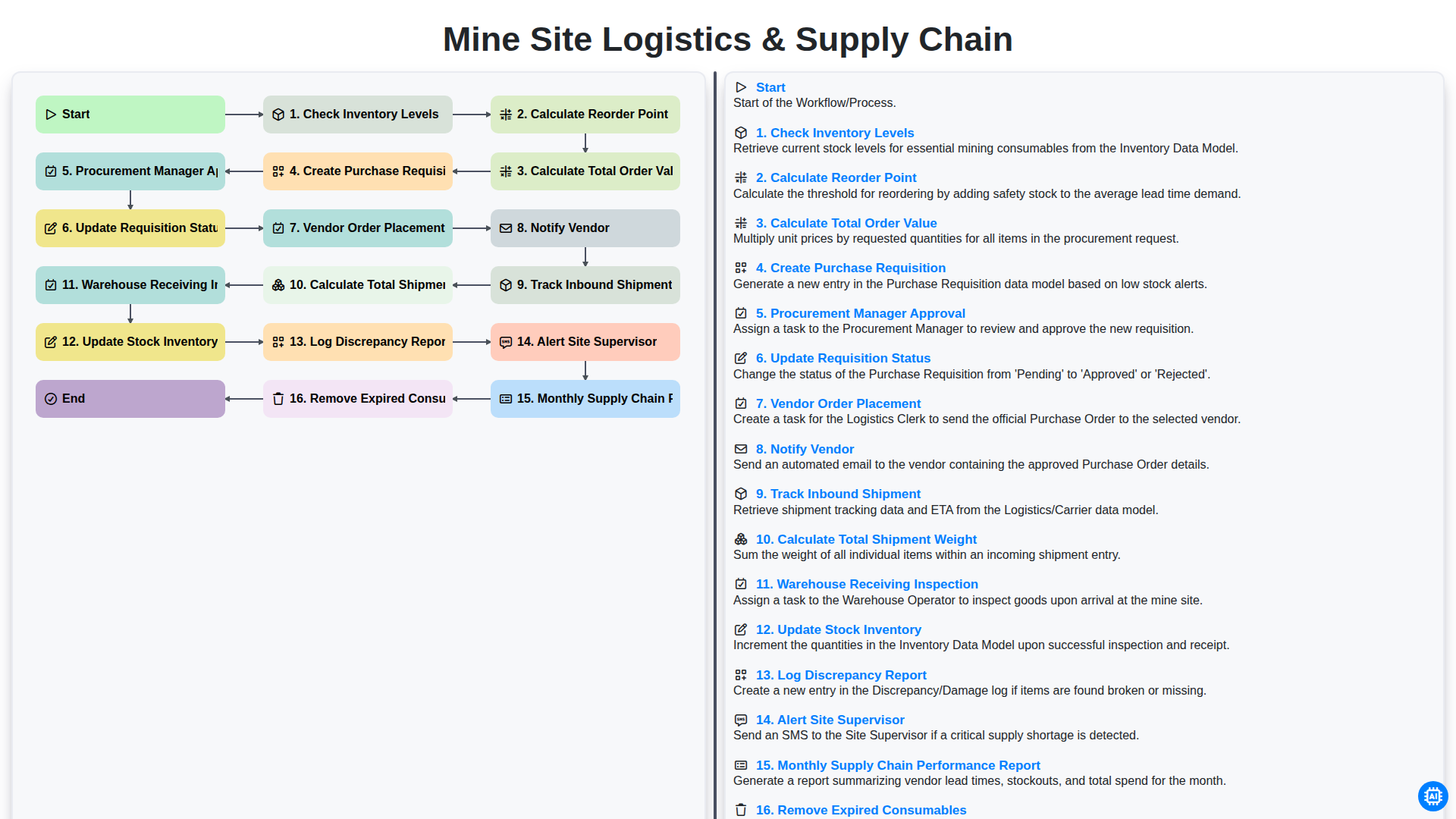
Table of Contents
- Introduction: The Vital Role of Logistics in Mining Operations
- Phase 1: Inventory Assessment and Demand Forecasting
- Determining Reorder Points and Order Valuation
- Phase 2: The Procurement and Approval Process
- From Requisition to Vendor Engagement
- Phase 3: Logistics Oversight and Inbound Transit
- Managing Shipment Logistics and Weight Verification
- Phase 4: Warehouse Receiving and Quality Control
- Inventory Integration and Discrepancy Management
- Escalation Protocols: Handling Supply Chain Anomalies
- Phase 5: Continuous Improvement and Inventory Maintenance
- Performance Analytics and Waste Reduction
- Conclusion: Building a Resilient Supply Chain Ecosystem
- Resources & Links
TLDR: This guide explores an end-to-end automated workflow designed to optimize mine site logistics by managing everything from inventory monitoring and automated reordering to procurement approvals and warehouse receiving. Learn how implementing this structured process reduces manual errors, prevents stockouts, and ensures seamless supply chain visibility from vendor placement to final inspection.
Introduction: The Vital Role of Logistics in Mining Operations
In the high-stakes environment of mining operations, efficiency is not just a goal-it is a necessity for survival. A mine site is a complex ecosystem where the continuity of production depends entirely on the seamless flow of materials, machinery, and consumables. When a critical spare part is missing or a vital chemical reagent fails to arrive on time, the cost is measured in thousands of dollars per hour in lost productivity and operational downtime.
Effective mine site logistics and supply chain management serve as the lifeblood of the operation. It is a sophisticated balancing act that requires managing vast quantities of inventory across remote, often geographically challenging locations. Beyond simple transportation, a robust supply chain integrates precision forecasting, rigorous procurement protocols, and real-time tracking to ensure that the right resources are at the right place at the right time. In this article, we will explore the intricate, step-by-step workflow required to maintain an optimized, resilient, and cost-effective supply chain in the mining industry.
Phase 1: Inventory Assessment and Demand Forecasting
The foundation of an efficient mining operation lies in the ability to predict needs before they become emergencies. The first phase of our integrated workflow focuses on precision and foresight through two critical steps: Checking Inventory Levels and Calculating the Reorder Point.
To prevent costly downtime caused by stockouts, we begin with a comprehensive audit of current on-hand supplies. By maintaining real-time visibility of all consumables, heavy equipment parts, and essential tools, we can move away from reactive ordering. Once current levels are verified, we apply data-driven formulas to determine the exact Reorder Point (ROP). This calculation accounts for lead times, safety stock requirements, and average daily consumption rates. By establishing these mathematical triggers, we ensure that replenishment processes are initiated precisely when necessary, maintaining the delicate balance between overstocking-which ties up precious capital-and understocking, which threatens operational continuity.
Determining Reorder Points and Order Valuation
Efficient inventory management in a mining environment begins with moving from reactive purchasing to a proactive, data-driven strategy. To prevent costly operational downtime caused by stockouts, the process must start by regularly checking inventory levels against established safety stocks. Once current levels are verified, the next critical step is to calculate the reorder point. This calculation must account for lead times, consumption rates, and potential supply chain volatility to ensure that new stock arrives exactly when needed.
Once the reorder point is triggered, the system must then calculate the total order value. This involves quantifying the volume of materials required and applying current market pricing to ensure the procurement budget remains aligned with the mine site's operational goals. By automating these calculations, site managers can avoid the human error associated with manual tracking, ensuring that every replenishment order is both timely and fiscally accurate.
Phase 2: The Procurement and Approval Process
Once inventory levels have been assessed and the reorder points determined, the focus shifts from monitoring to active procurement. This phase is critical to ensuring that the site never faces operational downtime due to stockouts while simultaneously preventing the capital inefficiency of overstocking.
The process begins by calculating the Total Order Value to ensure the procurement request aligns with the site's budgetary constraints. Once the scope of the order is defined, a Purchase Requisition is formally generated within the system. This document serves as the official internal request for much-needed supplies.
To maintain strict financial oversight, the requisition is routed to the Procurement Manager for Approval. This layer of governance ensures that every expenditure is vetted for necessity and accuracy. Once the manager provides the green light, the system automatically Updates the Requisition Status, transitioning it from a pending state to an active state.
With approval secured, the workflow moves into external execution: Vendor Order Placement occurs, followed immediately by a formal notification to the supplier. This automated Notify Vendor step ensures that the supplier receives real-time requirements, reducing the lead time between the request and the actual dispatch of goods. By digitizing this transition from internal request to external order, the mine site minimizes human error and accelerates the entire supply chain cycle.
From Requisition to Vendor Engagement
The journey from identifying a need to securing a commitment from a supplier is a critical phase in mine site logistics. This process begins with the meticulous calculation of the reorder point, a step that ensures replenishment is triggered precisely when stock levels hit their safety threshold. Once the threshold is reached, the total order value is calculated to provide a clear financial picture of the upcoming expenditure.
With these figures finalized, the workflow moves into the formal creation of a purchase requisition. This document serves as the internal trigger for procurement, which then moves into the Procurement Manager Approval stage. This layer of oversight is vital in mining operations to prevent budget overruns and ensure all requests align with the site's operational priorities.
Once approval is granted, the requisition status is updated to reflect its transition from a request to an active order. The process then shifts focus to external engagement: the vendor order placement is executed, followed immediately by a formal notification to the supplier. This seamless transition from internal validation to vendor notification ensures that the supply chain remains fluid, reducing lead times and preventing the critical stockouts that can halt site productivity.
Phase 3: Logistics Oversight and Inbound Transit
Once the vendor order has been officially placed and the vendor is notified, the focus shifts from procurement to active logistics oversight. This critical stage of the workflow is defined by proactive monitoring and data-driven tracking. The primary objective is to track inbound shipments in real-time to mitigate the risks of delays that could lead to costly mine site downtime.
During this phase, logistics coordinators must continuously monitor transit progress to ensure that delivery windows align with site requirements. A key technical step in this stage involves the ability to calculate total shipment weight and dimensions before the vehicle arrives at the gate. This allows the warehouse team to prepare the necessary heavy lifting equipment, such as forklifts or cranes, and allocate sufficient floor space for unloading. By managing these logistics metrics accurately, the site ensures that the transition from transit to warehouse is seamless, preventing bottlenecks at the receiving bay.
Managing Shipment Logistics and Weight Verification
Once the vendor order has been placed and the vendor is notified, the focus shifts to the critical phase of transit monitoring. Effective mine site logistics depend heavily on the ability to Track Inbound Shipment in real-time. Given the remote nature of most mining operations, knowing exactly when essential supplies will arrive is vital to preventing operational downtime.
A crucial step in this stage of the workflow is to Calculate Total Shipment Weight before the transport arrives at the site. This step is not merely a formality; it is a vital safety and operational requirement. Accurately verifying the weight of incoming goods ensures that transport vehicles are within safe load limits and that the site's receiving infrastructure, such as cranes or offloading bays, is prepared for the specific load. This proactive verification prevents logistical bottlenecks and ensures that the transition from transit to the warehouse is seamless and safe.
Phase 4: Warehouse Receiving and Quality Control
Once the inbound shipment has been tracked and the total shipment weight verified, the workflow moves into the critical stage of physical arrival and verification. This phase begins with a rigorous Warehouse Receiving Inspection, where every item is cross-referenced against the original purchase order and packing slip to ensure accuracy.
During this inspection, the team must meticulously Update Stock Inventory to reflect the new arrivals, ensuring real-time data accuracy for the site's operations. However, if any damages or shortages are identified, the process immediately triggers a Log Discrepancy Report. In the event of significant issues, the system will automatically Alert the Site Supervisor to initiate dispute resolution with the vendor. By maintaining strict oversight during this stage, the site prevents stockouts and ensures that only high-quality, verified materials are integrated into the mine's operational supply chain.
Inventory Integration and Discrepancy Management
Effective mine site operations depend on the seamless transition from receiving goods to real-time inventory accuracy. The workflow begins immediately upon the arrival of goods through the Warehouse Receiving Inspection process, where every delivery is scrutinized for quality and quantity against the original purchase order. Once the inspection is complete, the system must Update Stock Inventory to ensure that the digital records reflect the physical reality on the ground.
However, discrepancies are an inevitable challenge in remote logistics. If a shortage or damage is detected during inspection, the system must automatically Log Discrepancy Report to document the gap between ordered and received items. This triggers an immediate critical action: Alert Site Supervisor. By ensuring supervisors are notified of mismatches in real-time, the site can mitigate operational delays and initiate claims or urgent reorders without manual oversight.
Furthermore, maintaining a clean warehouse is essential for safety and cost-control. To prevent the use of degraded materials, the workflow includes a periodic cycle to Remove Expired Consumables, ensuring that only compliant, high-quality supplies are available for use in production. This integrated approach-combating discrepancies and managing expiration-ensures that the supply chain remains reliable, safe, and audit-ready.
Escalation Protocols: Handling Supply Chain Anomalies
In the high-stakes environment of mine site operations, even the most streamlined supply chain is susceptible to unforeseen disruptions. When anomalies occur-such as significant discrepancies found during the Warehouse Receiving Inspection or critical shortages detected during an Inventory Level Check-the ability to transition from routine processing to an active escalation protocol is vital for maintaining operational continuity.
The workflow is designed with built-in fail-safes to ensure that errors do not remain buried in the system. If the inspection process reveals a mismatch between the physical goods received and the original Vendor Order Placement, the immediate priority is to Log a Discrepancy Report. This isn't merely an administrative task; it serves as the trigger for a formal notification chain. Once a discrepancy is logged, the system is programmed to automatically Alert the Site Supervisor, ensuring that leadership is immediately aware of potential impacts on downstream production.
Effective escalation ensures that a simple shipping error doesn't evolve into a site-wide shutdown. By integrating real-time alerts with rigorous reporting, the workflow ensures that every anomaly is met with a structured response, allowing for rapid corrective actions-such as expedited reordering or vendor disputes-before the supply gap can compromise the mine's operational integrity.
Phase 5: Continuous Improvement and Inventory Maintenance
To ensure long-term operational efficiency, the logistics cycle does not end once a shipment is logged into the system. True supply chain excellence requires a commitment to ongoing oversight and proactive maintenance. This phase focuses on two critical pillars: data-driven performance evaluation and rigorous stock integrity.
The first step in this phase involves the generation of a Monthly Supply Chain Performance Report. By analyzing key metrics-such as order lead times, vendor accuracy, and procurement costs-management can identify bottlenecks in the workflow and implement corrective actions to prevent future delays. This high-level visibility ensures that the supply chain remains agile and cost-effective.
Simultaneously, on the warehouse floor, strict inventory hygiene must be maintained. A vital part of this process is the systematic instruction to Remove Expired Consumables. In a mine site environment, using degraded or expired chemicals, lubricants, or safety components can lead to catastrophic equipment failure or safety violations. By integrating regular audits and expiry tracking into the workflow, the site minimizes waste, ensures regulatory compliance, and maintains the highest standards of operational safety.
Performance Analytics and Waste Reduction
To maintain long-term operational efficiency, the workflow extends beyond simple procurement into the critical realms of continuous improvement and waste mitigation. At the end of each operational cycle, the system generates a Monthly Supply Chain Performance Report, providing stakeholders with deep visibility into lead times, vendor reliability, and cost variances. This data-driven approach allows management to identify bottlenecks in the procurement cycle and optimize the reordering process.
Furthermore, proactive inventory management is essential for preventing capital loss and ensuring site safety. A key component of our maintenance protocol involves the systematic process to Remove Expired Consumables, ensuring that all chemical agents, lubricants, and critical-use supplies are within their usable lifespan. By integrating real-time performance tracking with rigorous expiration audits, the workflow minimizes waste, reduces environmental impact, and ensures that site resources are always mission-ready.
Conclusion: Building a Resilient Supply Chain Ecosystem
Optimizing mine site logistics and supply chain management is not a one-time task, but a continuous cycle of precision and vigilance. By integrating a structured workflow-ranging from proactive inventory checks and automated reorder calculations to rigorous receiving inspections and discrepancy logging-mining operations can transition from reactive firefighting to proactive management.
Implementing this end-to-end visibility ensures that critical consumables are always available, waste from expired stock is minimized, and procurement decisions are backed by data-driven performance reports. Ultimately, mastering this workflow does more than just prevent downtime; it builds a resilient, transparent, and cost-effective ecosystem capable of supporting the rigorous demands of modern mining operations.
Resources & Links
- Mining.com: Global source for mining news and industry updates to stay informed on logistical trends and mining technology.
- Supply Chain Management Review: In-depth analysis and professional insights into supply chain best practices, procurement strategies, and logistics management.
- Gartner: Expert research and strategic insights on supply chain technology, inventory management, and procurement optimization.
- ASCM (Association for Supply Chain Management): The leading professional organization for supply chain excellence, providing frameworks for inventory control and warehouse management.
- IBM Supply Chain: Resources on leveraging digital transformation, real-time tracking, and predictive analytics for inbound shipment monitoring.
- SAP Digital Supply Chain: Information on integrated enterprise resource planning (ERP) solutions for managing purchase requisitions and inventory updates.
- MHL News (Material Handling & Logistics): Specialized news regarding warehouse receiving, inspection protocols, and automated inventory tracking technologies.
Frequently Asked Questions
What is the primary goal of implementing a streamlined workflow in mine site logistics?
The primary goal is to optimize the movement of materials, equipment, and personnel, thereby reducing operational downtime, minimizing costs, and enhancing overall supply chain visibility and reliability.
How does effective supply chain management impact mine site safety?
Effective management ensures that essential safety equipment, parts for critical machinery, and hazardous materials are tracked and delivered on time, reducing the risks associated with improvised solutions or equipment failure.
What are the key components of a comprehensive mine site logistics workflow?
Key components include procurement planning, inventory management, inbound/outbound transportation scheduling, warehouse operations, and real-time tracking of site deliveries.
What role does technology play in streamlining mine site operations?
Technology, such as IoT sensors, GPS tracking, and integrated ERP systems, provides real-time data visibility, allowing for predictive maintenance, automated inventory replenishment, and more accurate logistics forecasting.
How can mines mitigate the risks of supply chain disruptions?
Risks can be mitigated through strategic vendor management, maintaining safety stock for critical components, diversifying supplier bases, and implementing robust contingency logistics plans.
What are the main challenges in managing logistics for remote mine sites?
Common challenges include long lead times, difficult terrain, unpredictable weather conditions, limited communication infrastructure, and the high cost of transporting heavy or oversized equipment to isolated locations.
Comments
There are no comments yet. Be the first to add one!
Mining Management Solution Demo
Maximize efficiency & safety in mining operations! ChecklistGuro streamlines task management, equipment tracking, and compliance reporting. Optimize workflows, reduce risk, & boost productivity. Manage it all with our Work OS.
Related Articles
Ensuring Mine Safety: Your Geotechnical Stability Checklist Guide
Ensuring Safety & Efficiency: Your Mine Haul Road Inspection Checklist Guide
Mastering Mine Safety: Your Guide to the Ground Control Checklist
Mining Security Procedures Checklist: A Comprehensive Template for Safety
Ensuring Safety: Your Mining Incident Reporting Checklist Guide
Ensuring Safety Underground: Your Mine Traffic Management Checklist Guide
Ensuring Safety: Your Mining Explosives Handling Checklist Template
Ensuring Safety & Compliance: Your Mining Noise Monitoring Checklist Guide
Need help with
Checklists?
Have a question? We're here to help. Please submit your inquiry, and we'll respond promptly.